You may notice the change in an ordinary week. The person you met for coffee has moved. A health problem makes the drive harder. Caregiving leaves little unscheduled time. Retirement removes the conversations that once gave the day a shape. The routes into other people’s lives have become narrower.
It is tempting to answer that change with a generic instruction to “be more social.” That advice is too vague to be useful, and it can feel like a judgment when mobility, grief, money, hearing, fatigue, culture, or temperament affects what is possible.
Connection and purpose belong in a Healthspan plan because health and function are easier to use when people, roles, places, or practices give you a reason to participate. They do not replace medical care or guarantee a longer life. They help define what you are trying to preserve.
Connection, loneliness, isolation, and purpose are different
The World Health Organization describes social connection through three dimensions: the structure of your relationships and roles, the support exchanged through them, and the quality of the interactions. A large network can still feel strained or unreliable. One or two dependable relationships may fit another person well.
Social isolation is more objective. It means having few relationships, roles, or interactions. Loneliness is the distressing feeling that the connection you have does not match the connection you want or need. You can live alone without feeling lonely, and you can feel lonely in a busy household.
Purpose is a sense that your life has direction, meaning, or worthwhile aims. It does not require paid work, public recognition, or conventional volunteering. It may live in caring for a person, practicing a faith, making music, tending a garden, learning, contributing to a small group, or being present in a relationship. The form depends on the person, culture, life stage, and capacity.
These distinctions change the response. More contact may help someone who has too few opportunities to interact. It may not resolve loneliness rooted in conflict, grief, feeling misunderstood, or depression. A full calendar may create activity without meaning. A quiet life may contain deep connection and clear purpose.
The evidence supports attention, not a promise
The most consistent research finding is an association. In 2023, Wang and colleagues pooled 90 prospective cohort studies with more than 2.2 million adults. Social isolation and loneliness were each associated with higher all-cause mortality, with a larger pooled association for isolation than loneliness. These were observational cohorts. They could adjust for measured differences, but they could not prove that disconnection caused the deaths or rule out health, income, disability, depression, or other unmeasured explanations.
Purpose shows a similar pattern. A Psychological Medicine meta-analysis published July 8, 2026 combined 25 longitudinal samples from the United States, Europe, and Asia, including 488,765 people and 48,928 deaths over as long as 32 years. Higher purpose was associated with lower mortality after several adjustments. The estimates varied greatly, publication bias was possible, and the participants came from high-income countries. Excluding first-year deaths reduced one reverse-causation concern, but it did not prove that increasing purpose extends life.
Relationships may provide practical help, encouragement, and a person who notices change. Participation may support movement, routines, cognition, and care follow-through. Supportive contact may affect stress responses, and researchers have proposed immune, inflammatory, cardiovascular, and neuroendocrine pathways. These mechanisms are plausible, not proof.
A 2022 systematic review of 70 randomized trials involving 8,259 older adults examined exercise, psychotherapy, group, technology, music, and animal-assisted approaches. Most effects on loneliness were small, results varied substantially, and overall certainty was very low. Some programs help some people. The research does not support one universal prescription or show that reducing a loneliness score prevents disease or extends life.
Health can change connection in both directions
Poor health can reduce connection before disconnection has any opportunity to affect health. Pain can make an outing costly. Hearing loss can turn a group conversation into work. Fatigue, vision changes, cognitive problems, anxiety, or fear of falling can shrink a person’s range. Hospitalization may interrupt routines; caregiving may crowd out friendships; bereavement may remove both a person and the structure around that relationship.
Longitudinal studies find evidence of this two-way movement. In a 2020 English cohort of 5,694 adults, health, disability, activity, participation, and financial resources predicted later changes in feeling that life was worthwhile; changes in that feeling also predicted several later outcomes. This is more informative than a one-time survey, but it remains observational.
The practical response is not to blame a person for being disconnected. It is to look for the barrier. Does conversation need a hearing evaluation or a quieter room? Does participation need transportation, seating, an accessible entrance, or a shorter duration? Does caregiving require respite? Does grief need time, a trusted person, or professional support? Does a fixed income make a free library group, faith community, telephone program, or neighborly exchange more realistic than a paid class?
Adaptation, the fifth rung of the Longevity Ladder, is useful here. When health changes, the route may change while the value remains. Someone who can no longer lead in person might make calls, welcome members online, help from home, or mentor one person. The aim is a workable path into meaning and participation, not an exact recreation of an old life.
Start with fit, then choose one small step
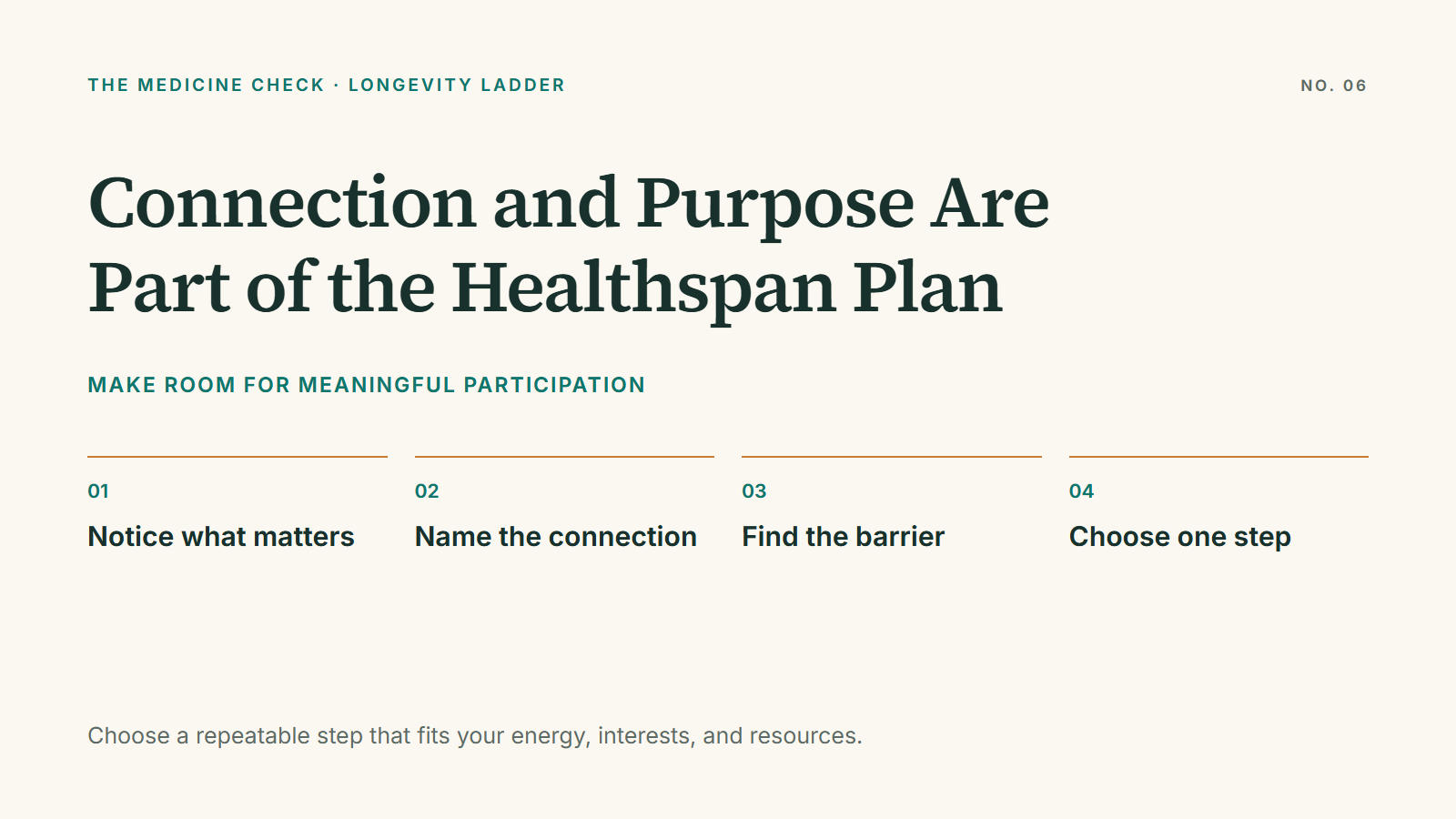
You do not need to diagnose yourself with loneliness or manufacture a grand purpose. A low-pressure review can begin with four prompts:
- Notice what feels missing or sustaining. Which contact leaves you feeling understood or useful? Which role, place, or practice gives the week shape? What has become harder to reach?
- Name the kind of connection you want. Is the need companionship, practical help, belonging, contribution, learning, spiritual life, play, or simply being known by one person? More people are not automatically the answer.
- Find the smallest barrier you can change. Consider timing, fatigue, cost, transportation, hearing, technology, accessibility, caregiving coverage, or the pressure of a long commitment. One adjustment may make participation possible.
- Choose a repeatable next step. Send one message, schedule a ten-minute call, ask about an accessible option, attend once without committing, join a small online or telephone group, resume a shared practice at home, or offer one bounded task.
The test is not whether the step looks impressive. Ask: Does it fit my energy and resources? Does it connect me with someone or something I value? Could I repeat it without borrowing too much from the rest of my week?
Bring specific questions to the right person
A clinician, counselor, community organization, or trusted person can be more helpful when the question is concrete:
- Could pain, fatigue, hearing, vision, sleep, mood, cognition, continence, or a medication effect be making participation harder?
- Is there a rehabilitation, hearing, vision, transportation, caregiver-support, or accessibility resource that could remove a practical barrier?
- Are there local options that match my interests, language, culture, mobility, schedule, and budget, including home-based or telephone options?
- Can you help me think about a role that preserves contribution without exceeding my current capacity?
- Would grief counseling, a support group, or individual therapy fit what I am experiencing?
Persistent distress, loss of interest, hopelessness, changes in sleep or appetite, increasing withdrawal, or difficulty managing usual responsibilities can deserve professional attention. Medical conditions or medication effects can contribute, and this article cannot diagnose the cause. A clinician or mental-health professional can help. In the United States, anyone in emotional crisis or having thoughts of suicide can call 988 or text 988; a life-threatening emergency requires 911.
Evidence verdict
Moderate for association; limited for intervention and causality. Large, prospective studies consistently associate stronger social connection and purpose with better health and mortality outcomes across many populations. Confidence is lower about cause and effect because poor health can reduce connection and purpose, residual confounding remains likely, measures differ across cultures and studies, and much of the evidence comes from high-income countries. Randomized trials suggest that selected programs can modestly reduce loneliness for some older adults, but results are heterogeneous and do not show that social activity, volunteering, or purpose prevents disease or extends life.
Practical takeaway
The sixth rung does not ask you to collect contacts or adopt someone else’s idea of purpose. It asks whether your current health, environment, and routines leave room for relationships and participation that feel worth returning to.
Choose one route that fits the life you have now. Make it smaller, quieter, closer, less expensive, or more accessible if needed. Notice whether it gives the week more structure, support, or meaning. The Longevity Ladder ends here because the other rungs protect capacity; connection and purpose help turn that capacity into a life you want to inhabit.
Keep Building Your Healthspan
- Build your strongest foundation with the Longevity Ladder. See the practical habits that can help you move better, stay stronger, and support a longer, healthier life.
- See how well you are aging with the Age Well Score. Get a whole-person snapshot of the health, function, and lifestyle factors that shape aging well.
- Take a deeper look with the Healthspan Checkup Calculator. Review the key measures that influence long-term health, independence, and quality of life.
- Become a member for access to member-specific resources.
Sources
- Current public-health guidance reviewed. World Health Organization. From loneliness to social connection: charting a path to healthier societies. Report of the WHO Commission on Social Connection. June 30, 2025. ISBN 978-92-4-011236-0.
- Current public-health guidance reviewed. Office of the U.S. Surgeon General. Our Epidemic of Loneliness and Isolation. 2023.
- Full text reviewed. Sutin AR, Zavala DV, Milad E, et al. Purpose in life and mortality: A meta-analysis of the published literature and individual-participant data of 488,765 participants followed for up to 32 years. Psychological Medicine. Published July 8, 2026. doi:10.1017/S0033291726104863.
- Abstract and metadata reviewed. Wang F, Gao Y, Han Z, et al. A systematic review and meta-analysis of 90 cohort studies of social isolation, loneliness and mortality. Nature Human Behaviour. 2023;7:1307-1319. doi:10.1038/s41562-023-01617-6.
- Full text reviewed. Hoang P, King JA, Moore S, et al. Interventions Associated With Reduced Loneliness and Social Isolation in Older Adults. JAMA Network Open. 2022;5:e2236676. doi:10.1001/jamanetworkopen.2022.36676.
- Full text reviewed. Kim ES, Chen Y, Nakamura JS, Ryff CD, VanderWeele TJ. Sense of Purpose in Life and Subsequent Physical, Behavioral, and Psychosocial Health: An Outcome-Wide Approach. American Journal of Health Promotion. 2022;36:137-147. doi:10.1177/08901171211038545.
- Full text reviewed. Steptoe A, Fancourt D. An outcome-wide analysis of bidirectional associations between changes in meaningfulness of life and health, emotional, behavioural, and social factors. Scientific Reports. 2020;10:6463. doi:10.1038/s41598-020-63600-9.
- Current clinical guidance reviewed. National Institute on Aging. Loneliness and Social Isolation: Tips for Staying Connected. Accessed October 17, 2026.
- Current clinical guidance reviewed. National Institute of Mental Health. Depression. Accessed October 17, 2026.
Educational information only. This article does not provide individualized medical or mental-health advice and does not diagnose loneliness, depression, grief, or another condition. Social needs, health limitations, cultural preferences, and available resources differ. Review personal concerns with an appropriate health professional.