You are still making breakfast, but the heavy pan has moved from the upper cabinet to the counter. You sit to prepare vegetables because standing now causes pain. The activity remains part of your life, even though the way you do it has changed.
Many people hear independence and picture doing every task alone, in the same way, for as long as possible. That definition leaves too little room for real life. A diagnosis, new symptom, medication effect, move, or lost source of help can alter the fit between what you can do and what the day asks of you.
The fifth rung of the Longevity Ladder is Adapt to Change. Recovery after illness or inactivity involves rebuilding capacity. Adaptation asks how the task, environment, support, goals, or professional plan can change when circumstances have changed.
Independence does not require refusing help. It means preserving as much choice, participation, and meaningful daily function as your current situation allows.
Start with the activity you want to keep
The World Health Organization defines healthy aging through functional ability: the interaction between a person's capacities and environment. Function does not belong entirely inside the body. A stiff hand may struggle with a small jar yet manage an adapted opener or help from another person without losing the ability to prepare a familiar meal.
Begin with a concrete activity rather than a broad goal such as "stay independent." What changed? Which ordinary activity matters most to preserve: bathing, cooking, managing medicines, climbing the front steps, working, or attending a weekly gathering?
Describe the problem in observable terms. "The shower feels unsafe when I turn." "I become lightheaded at the stove." "I can read the label in daylight but not under the kitchen light." A specific description creates possible responses; a vague label such as "getting older" does not.
A harder task can have more than one barrier
The first explanation is not always right. A task may be harder because strength, balance, endurance, vision, dexterity, pain, breathing, memory, or attention changed. The barrier may instead be poor lighting, an awkward shelf, a confusing device, or the absence of another person at the right moment.
Medicines belong in this review because dizziness, sleepiness, blurred vision, confusion, low blood pressure, or timing burdens can look like a new loss of function. A problem that began after a medicine was started or changed deserves a conversation with the prescriber or pharmacist; however, do not skip doses, reduce a dose, or stop a prescription on your own. Include prescriptions, over-the-counter products, supplements, eye drops, and topical medicines in the review.
A new diagnosis deserves more than a new label in the chart. Ask what it may change about symptoms, activity, safety, monitoring, and rehabilitation. New or worsening dizziness, falls, weakness, confusion, pain, breathlessness, or difficulty with routine tasks should be reviewed rather than assigned automatically to age. Sudden one-sided weakness, trouble speaking, fainting, chest pain, severe breathlessness, or rapid functional change calls for urgent evaluation.
Change the match between the person, the task, and the place
An adaptation can be small. Move frequently used items between knee and shoulder height. Improve lighting at a work surface or along the route to the bathroom. Clear a walking path, sit for part of a task, or divide one demanding activity into shorter parts. A handrail, shower chair, reacher, magnifier, or pill organizer may help when it fits the actual barrier.
Professional help may also fit. Physical therapy can address movement, balance, endurance, or the safe use of a mobility aid. Occupational therapy can examine how the person, task, and environment interact, then work on techniques, equipment, or home changes tied to a meaningful goal. The right professional depends on what changed.
The CAPABLE randomized trial enrolled 300 low-income, community-dwelling adults age 65 and older in Baltimore who had difficulty with daily activities. Participants assigned to a five-month program worked with an occupational therapist, nurse, and home modifier on goals they chose. At five months, the intervention group reported a 30% lower score for disability in basic daily activities than the attention-control group. The difference in more complex activities was not statistically significant, and the benefit diminished by 12 months.
The trial does not prove that a grab bar, device, or home visit preserves independence for everyone. Its participants were a specific group, outcomes were self-reported, and the program combined several components. It supports a narrower principle: function may improve when a plan addresses both the person and environment around a valued goal.
Help from another person can preserve a role
Support is not limited to equipment. Another person may provide transportation, carry the heavy part of a task, set up materials, manage an appointment calendar, or stay nearby while a new strategy is tested.
The useful distinction is between replacing a person unnecessarily and supporting the part that allows participation. Someone who no longer carries a full laundry basket may still load the machine, fold, and organize. Someone who cannot drive at night may still arrange the ride and take part in the event.
Needs, housing, caregiver availability, and cost differ. A plan that depends on an unavailable helper or unaffordable renovation is not usable. Ask which changes are low cost, what insurance or community programs may cover, and whether an occupational therapist, social worker, Area Agency on Aging, or housing program can identify resources. Cost belongs in the conversation when it changes access.
Evidence supports tailoring, not a universal checklist
Home-safety advice often sounds universal, but trial evidence is more specific. A 2023 Cochrane review of 22 randomized trials found that home fall-hazard interventions reduced falls most clearly among older adults already at higher risk, including people with a recent fall, hospitalization, or need for help with daily activities. It found no fall-rate benefit in populations not selected for risk and no completed trials showing whether task-enablement home modifications reduced falls.
Assistive-technology research is similarly uneven. A 2022 review found 19 randomized trials across several device categories; the studies used different technologies and outcomes, and only eight improved all or some primary outcomes. The review could not establish equal effectiveness across levels of frailty.
The responsible conclusion is narrower than "home modifications work." A well-matched adaptation can make a particular task easier, safer, or possible for some people. Evidence does not guarantee that one change will prevent decline, avoid a fall, or extend independent living.
Reassess the result in ordinary life
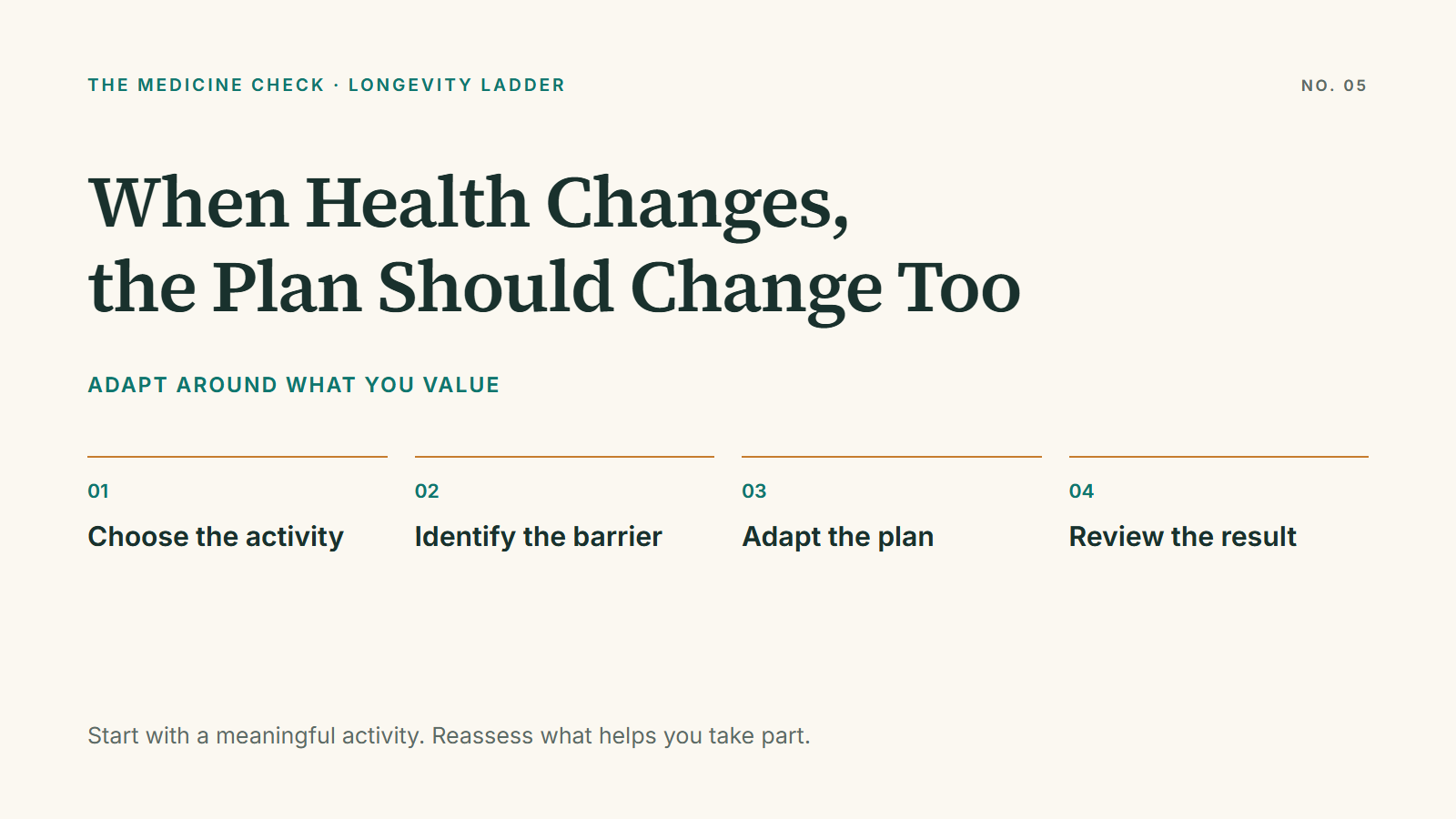
An adaptation is useful when it improves the chosen activity without creating a new problem. Can you complete the task with less pain, fatigue, fear, or help? Is the change easy to use correctly? Did it create another hazard? Would training, repair, or a different tool make more sense?
Measure what you can observe: preparing a full meal, reaching the bathroom without crossing a dark room, attending a weekly gathering with less exhaustion, or bathing with the amount of help you consider acceptable. If the activity does not improve, the adaptation may be a poor match, the symptom may need medical review, or the goal may need smaller parts.
Reassessment also has a time dimension. Health conditions change, devices wear out, helpers become unavailable, and priorities shift. WHO rehabilitation guidance includes goal setting and repeated evaluation because the plan should respond to the person, not freeze the person inside the plan.
Practical Takeaway: Adapt Around What You Value
When health or circumstances change, use five questions:
- What changed, and which ordinary activity do I most want to preserve?
- Is the main barrier the task, the environment, symptoms, medication effects, or missing support?
- Could a change in lighting, layout, equipment, technique, rehabilitation, timing, or help from another person make the activity more manageable?
- Does a new symptom, diagnosis, fall, or medication concern need review with a clinician, pharmacist, or rehabilitation professional?
- After trying an adaptation, what would show that it is helping, and when will I reassess it?
Aging well does not require holding every routine still. When the conditions change, a thoughtful adjustment can preserve what the routine was for: nourishment, movement, contribution, privacy, connection, work, or pleasure. The goal is not to prove that you need no help. It is to keep as much of your life available to you as possible.
Evidence verdict
Moderate. Current WHO guidance supports treating function as an interaction between a person's capacities and environment, and it recognizes rehabilitation, assistive products, environmental modifications, and goal review as ways to optimize participation. A randomized trial of a specific multidisciplinary home program improved self-reported basic daily-activity disability in a defined high-risk population. A Cochrane review found that professionally supported home fall-hazard interventions reduce falls most clearly in older adults selected for higher fall risk.
The CAPABLE trial cannot identify the effect of any single component and has limited generalizability. Fall-prevention findings apply most clearly to people at higher fall risk and do not establish that a home change preserves independent living. Assistive-technology trials do not support a universal device recommendation. Cost, housing control, caregiver availability, cognition, and access to trained professionals can change feasibility and benefit.
Keep Building Your Healthspan
Build your strongest foundation with the Longevity Ladder. See the practical habits that can help you move better, stay stronger, and support a longer, healthier life.
See how well you are aging with the Age Well Score. Get a whole-person snapshot of the health, function, and lifestyle factors that shape aging well.
Take a deeper look with the Healthspan Checkup Calculator. Review the key measures that influence long-term health, independence, and quality of life.
Become a member for access to member-specific resources.
Sources
Official guidance reviewed. World Health Organization. Healthy ageing and functional ability. Published October 26, 2020. Reviewed October 17, 2026.
Official guidance reviewed. World Health Organization. Rehabilitation. Published September 30, 2024. Reviewed October 17, 2026.
Official guidance reviewed. World Health Organization. Assistive technology. Published January 2, 2024. Reviewed October 17, 2026.
Official guidance reviewed. Centers for Disease Control and Prevention. STEADI Clinical Resources. Published May 15, 2024; updated July 27, 2025. Reviewed October 17, 2026.
Official guidance reviewed. National Institute on Aging. Home Safety Tips for Older Adults. Updated June 5, 2025. Reviewed October 17, 2026.
Official guidance reviewed. U.S. Food and Drug Administration. 5 Medication Safety Tips for Older Adults. Publication or update date not displayed on the reviewed page. Reviewed October 17, 2026.
Full text reviewed. Szanton SL, Xue QL, Leff B, et al. Effect of a Biobehavioral Environmental Approach on Disability Among Low-Income Older Adults: A Randomized Clinical Trial. JAMA Internal Medicine. Published January 7, 2019; 179(2):204-211. DOI: 10.1001/jamainternmed.2018.6026. Full text reviewed October 17, 2026.
Full text reviewed. Clemson L, Stark S, Pighills AC, et al. Environmental interventions for preventing falls in older people living in the community. Cochrane Database of Systematic Reviews. Published March 10, 2023; Issue 3:CD013258. DOI: 10.1002/14651858.CD013258.pub2. Full text reviewed October 17, 2026.
Full text reviewed. Fotteler ML, Mühlbauer V, Brefka S, et al. The Effectiveness of Assistive Technologies for Older Adults and the Influence of Frailty: Systematic Literature Review of Randomized Controlled Trials. JMIR Aging. Published April 4, 2022; 5(2):e31916. DOI: 10.2196/31916. Full text reviewed October 17, 2026.
Educational information only. This article does not provide individualized medical, medication, rehabilitation, assistive-device, or home-modification advice. Do not start, stop, or change a medicine without appropriate professional guidance. Review new or worsening symptoms, falls, medication tolerability concerns, or changes in daily function with a qualified clinician, pharmacist, or rehabilitation professional; urgent symptoms require urgent evaluation.