You are crossing a parking lot, walking a long hallway, or carrying groceries from the car, and a distance that once felt ordinary now asks for planning. You can still do it, but you move more slowly, you pause, or you look for a handrail. Those small changes can be early signs that your reserve is narrowing, which is one reason a new walking trial deserves a careful look.
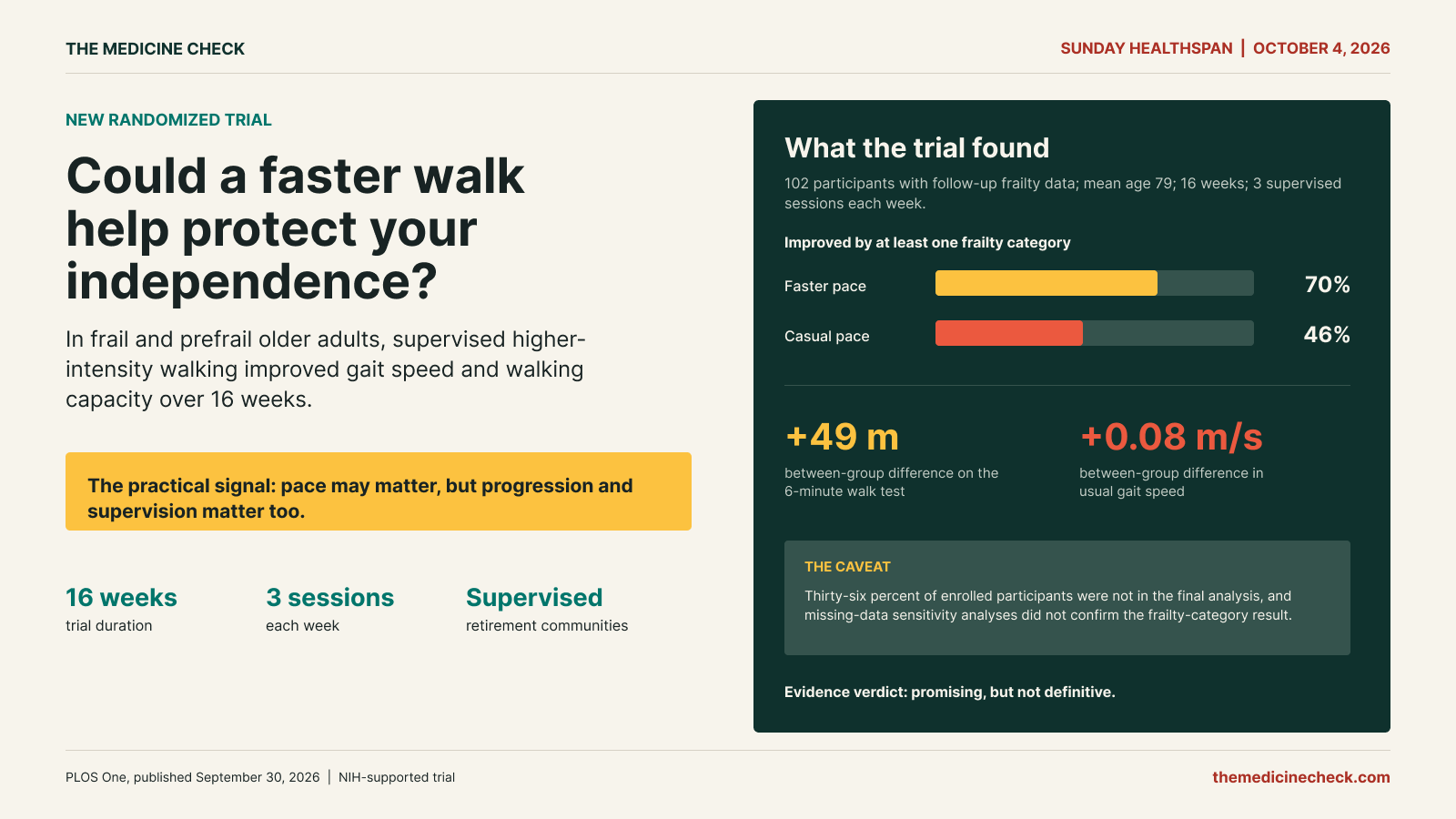
Published September 30 in PLOS One, the trial tested a practical idea: among older adults already living with prefrailty or frailty, would a supervised walking program performed at a more demanding pace improve function more than casual walking? The answer was encouraging for gait speed and walking capacity. The result for frailty status was promising too; however, substantial missing follow-up data keep it from being definitive.
My evidence verdict
Moderate confidence. I would treat the mobility gains as credible evidence that pace can be an important part of a supervised walking program. I would treat the apparent reversal of frailty as a signal that needs confirmation, not as a settled fact.
Frailty Is About Reserve, Not Age Alone
Frailty is a clinical state in which the body has less reserve to absorb illness, injury, or another stress. A person may notice slower walking, exhaustion, weakness, weight loss, or less physical activity, depending on the tool used to assess frailty. Prefrailty describes an earlier point on that spectrum. Neither label is a judgment about motivation, and neither is synonymous with being old.
The healthspan connection is direct because frailty can threaten the things many of us hope to preserve: getting up from a chair, walking through a store, recovering after an infection, living independently, and having enough capacity left for the people and activities we value. A treatment does not need to extend lifespan to be important if it helps protect those functions.
What the New Trial Actually Tested
Researchers randomized retirement communities, rather than individual residents, to one of two 16-week programs. Both groups met for 45-minute supervised sessions three times each week. The higher-intensity group worked toward about 70% of age-predicted maximum heart rate, while the casual-walking group stayed below 60%. The recorded averages were 71% and 59%, respectively, so the programs created a real difference in effort.
The study enrolled 165 adults age 60 or older who met the researchers' definition of prefrailty or frailty. Their mean age was 79, 79% were women, 75% were non-Hispanic White, and 65% used an assistive device. Forty-one percent were classified as frail at baseline, and the rest were prefrail. This was not a study of healthy recreational walkers; it focused on people for whom mobility and reserve were already relevant concerns.
Only 105 participants contributed any post-intervention data, and 102 had the follow-up frailty measure used for the primary analysis. That distinction becomes important when we interpret the results.
What Improved After 16 Weeks
Among participants with follow-up frailty data, 69.6% in the higher-intensity group improved by at least one frailty category, compared with 46.4% in the casual-walking group. The reported odds ratio was 2.91, with a 95% confidence interval from 1.19 to 7.13. In plain language, the observed difference was large enough to be interesting, but the wide interval tells us the exact size of the effect remains uncertain.
The function measures make the result more concrete. Compared with casual walking, higher-intensity walking produced a 0.08-meter-per-second greater improvement in usual gait speed and an approximately 49-meter greater improvement on the six-minute walk test. Participants in the faster group also accumulated about 985 more steps per day than those in the casual group. These are group averages, not promises for any one person, but they point in the same direction: the faster program improved how quickly and how far participants could walk.
I would not call those changes a transformation, and the study does not tell us whether they lasted after supervision ended. Still, better walking speed and endurance can translate into more room in daily life: crossing a street with less pressure, completing an errand with less fatigue, or reaching a destination without needing the same number of pauses.
The Missing-Data Caveat Changes the Frailty Claim
Thirty-six percent of enrolled participants were not included in the final analysis because they lacked post-intervention data. Those missing participants were slightly older and started with poorer function. When the researchers ran conservative and multiple-imputation sensitivity analyses to account for missing outcomes, the frailty-category difference was no longer statistically significant.
This does not erase the study. The measured gait-speed and walking-distance gains remain useful, and the frailty result may be real. It does mean that the strongest headline, that faster walking reversed frailty, outruns the evidence. People who dropped out may have responded differently from those who completed follow-up, and the study cannot fully resolve that possibility.
There are other limits. The intervention was supervised in retirement communities, the sample was not highly diverse, and follow-up lasted 16 weeks. The study did not establish fewer falls, fewer hospitalizations, longer independent living, or longer life. It also does not show that an unsupervised person should aim for the same heart-rate target.
Safety Was Reassuring, but Supervision Was Part of the Treatment
The trial reported one noninjurious fall judged definitely related to the higher-intensity program. A small number of knee-pain, cramping, back-pain, and knee-pain events were considered probably or possibly related. Thirteen serious adverse events occurred, but investigators judged all of them unrelated to the intervention.
That profile is reasonably reassuring for a supervised study; however, the supervision cannot be stripped away from the result. Staff helped participants progress, monitored effort, and worked with people who often used assistive devices. The useful lesson is not to turn every walk into a race. It is to recognize that intensity is one adjustable part of a program, alongside balance, strength, recovery, health conditions, and fall risk.
How This Fits the Broader Evidence
A 2026 network meta-analysis of 22 randomized trials and 2,055 participants found that exercise improved frailty scores, with the largest estimated benefit when exercise was combined with nutrition support. I reviewed that paper through its abstract and metadata rather than full text, so I would not use it to settle detailed questions about which program, dose, or population benefits most. It does reinforce a sensible theme: walking can be valuable, but frailty care is usually broader than walking alone.
Current U.S. physical-activity guidance for older adults recommends aerobic activity, muscle strengthening, and multicomponent activity that includes balance. The National Institute on Aging also advises starting gradually and matching activity to your abilities and health. That wider frame fits this trial better than a single-minded focus on speed.
What I Would Bring to a Clinician or Physical Therapist
If walking has become slower, less steady, or more tiring, I would use this study to start a specific conversation rather than to choose a heart-rate target on my own. Useful questions include:
- What is limiting my walking right now: strength, balance, pain, breathing, circulation, medication effects, vision, or something else?
- Would a physical therapist, cardiac rehabilitation program, or another supervised setting help me increase effort safely?
- How should I judge intensity given my medications, heart rhythm, blood pressure, mobility aid, or chronic conditions?
- What strength and balance work should accompany walking so that I am building a fuller reserve?
- Which outcome should we track: usual gait speed, six-minute walking distance, falls, fatigue, daily steps, or confidence outside the home?
A plan can begin below the study's target and progress as capacity improves. Stop and seek medical guidance if activity brings chest pain or pressure, marked dizziness, nausea, or another concerning symptom. If falls, unstable gait, or a recent health change are already present, an assessment before increasing pace is a reasonable first step.
The Practical Takeaway
This trial gives us a useful, restrained message. For older adults with prefrailty or frailty, a supervised walking program that gradually reached a higher intensity improved walking speed and capacity more than casual walking. It may also have improved frailty status, but the missing-data analyses leave that conclusion uncertain.
Walking more is familiar advice. This study adds a sharper possibility: once safety and individual limitations are addressed, how you walk may deserve attention alongside how often you walk. The goal is not a number on a watch. The goal is enough reserve to move through your day with more freedom.
Keep Building Your Healthspan
- Build your strongest foundation with the Longevity Ladder. See the practical habits that can help you move better, stay stronger, and support a longer, healthier life.
- See how well you are aging with the Age Well Score. Get a whole-person snapshot of the health, function, and lifestyle factors that shape aging well.
- Take a deeper look with the Healthspan Checkup Calculator. Review the key measures that influence long-term health, independence, and quality of life.
- Become a member for access to member-specific resources.
Sources
Full-Text Reviewed
Abstract and Metadata Reviewed
Guidance Reviewed
National Institute on Aging. Three Types of Exercise Can Improve Your Health and Physical Ability