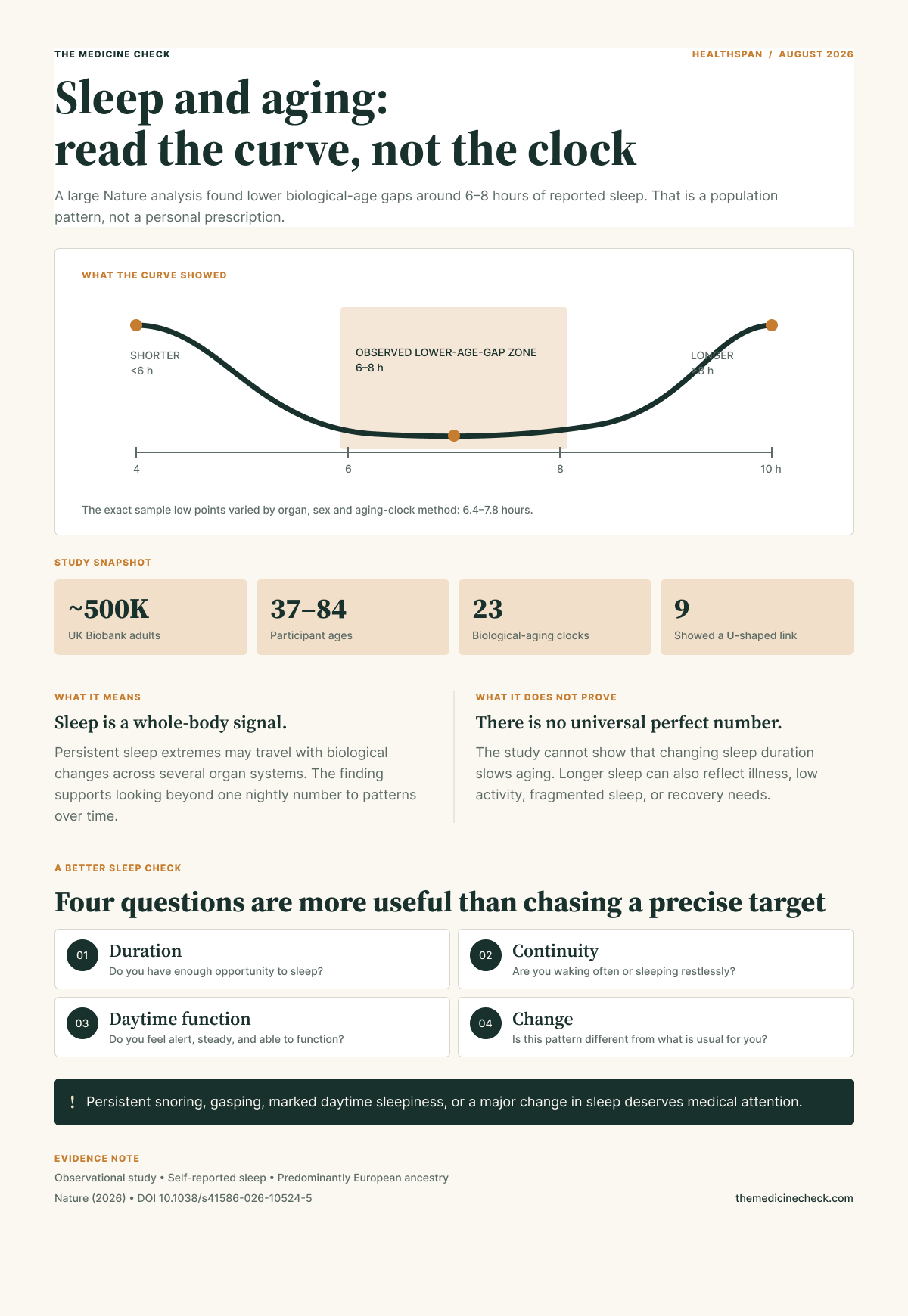
Sleep advice often gets reduced to a number. Seven hours. Eight hours. A new study in Nature gives that instinct fresh fuel: across several measures of biological aging, the lowest age gaps appeared within a range of roughly 6.4 to 7.8 hours of sleep.
That is an intriguing result, but it is easy to misuse. The study does not show that 6.4 hours is ideal for one organ, 7.8 is ideal for another, or that cutting sleep to fit the graph will make anyone biologically younger. Its more useful message is quieter: persistent sleep at either extreme can be a clue worth understanding, especially when it comes with poor daytime function or a change from your usual pattern.
What the study actually measured
Researchers analyzed data from the UK Biobank, a large research cohort of adults ages 37 to 84. Participants reported their usual sleep duration. The team compared those reports with 23 biological-aging clocks built from brain and body imaging, blood proteins, and metabolites. These clocks estimate whether a tissue or molecular profile looks older or younger than expected for a person’s calendar age.
Nine of the 23 clocks showed a statistically significant nonlinear, U-shaped relationship with sleep duration. In plain language, the estimated biological-age gap tended to be higher at both the short and long ends of the sleep range. The significant patterns involved the brain, lungs, liver, immune system, skin, endocrine system, adipose tissue, and pancreas. The sample-specific low points varied by sex, organ, and measurement method, falling between about 6.4 and 7.8 hours.
The researchers also found that self-reported sleep below six hours or above eight hours was associated with more disease diagnoses and higher all-cause mortality than sleeping six to eight hours. The analysis used several statistical and genetic approaches, but the core sleep-and-aging comparison remained observational.
Why the range is not a prescription
A biological-aging clock is a research tool, not a clinical endpoint. A difference in an imaging, protein, or metabolite pattern does not automatically mean someone will think more clearly, walk farther, avoid disability, or live longer. Those outcomes matter more to Healthspan than a biomarker alone.
The study also relied on a single self-report of usual sleep. It did not directly measure sleep stages, nighttime awakenings, circadian timing, or sleep apnea. The main comparisons were cross-sectional, so they cannot establish direction. Short sleep may contribute to poor health, but pain, caregiving, depression, medication effects, or an untreated sleep disorder can also shorten sleep. Long sleep can be a consequence of illness, low activity, depression, fragmented sleep, or recovery rather than a cause of aging.
The UK Biobank is also healthier and less diverse than the general population, and this analysis was predominantly limited to people of European ancestry. The researchers attempted replication in two smaller, older cohorts, but those samples were far too small to settle the question.
The broader evidence is consistent, but not conclusive
A 2026 umbrella review examined 13 systematic reviews on sleep duration, sleep quality, and cognitive decline. The better cohort-based reviews generally supported a U-shaped association: both short and long sleep were linked with worse cognitive outcomes. Yet most of the underlying evidence was rated low certainty. Observational consistency strengthens the signal, but it still does not prove that changing sleep duration prevents dementia.
Current public guidance remains a better starting point than a single study’s curve. The National Institute on Aging says older adults generally need about seven to nine hours per night, while the CDC lists seven to eight hours for adults 65 and older. Those are population ranges, not pass-fail thresholds. Individual sleep need varies, and sleep quality and daytime function matter alongside duration.
A better sleep check for healthy aging
Instead of trying to hit one exact number, look for a stable pattern that supports function. Four questions are more useful than a nightly score:
- Duration: Are you regularly getting enough opportunity to sleep, or are obligations repeatedly cutting the night short?
- Continuity: Are you waking often, staying awake for long stretches, or spending much more time in bed than asleep?
- Daytime function: Do you feel reasonably alert, steady, and able to think and move through the day without unintended dozing?
- Change: Has your sleep become substantially shorter, longer, or more fragmented than your established pattern?
A persistent change can be more informative than whether last night landed at 6.9 or 7.6 hours. New loud snoring, gasping, morning headaches, restless legs, dream-enactment behavior, frequent nighttime urination, marked daytime sleepiness, or repeated falls deserves medical attention. These symptoms can point to treatable conditions or medication effects.
What is reasonable to do now
Protect enough time for sleep, keep wake time reasonably consistent, get daylight and physical activity during the day, and reduce late-evening alcohol or caffeine when they disrupt sleep. These are low-risk foundations, but they are not substitutes for evaluating a sleep disorder.
For chronic insomnia, multicomponent cognitive behavioral therapy for insomnia, or CBT-I, has a strong recommendation from the American Academy of Sleep Medicine. Sleep hygiene alone is not considered an adequate treatment. Medication decisions require an individualized discussion because benefits, side effects, falls risk, interactions, and other health conditions vary, especially with age.
The Healthspan takeaway
The new study expands the case that sleep reflects biology across the body, not only in the brain. Its 6-to-8-hour zone is best read as a population signal. It should prompt curiosity about persistent extremes, poor-quality sleep, and daytime impairment, not anxiety about optimizing to the decimal.
The practical goal is restorative sleep that supports cognition, metabolic health, mood, mobility, and independence. If your pattern changes or stops supporting those functions, the next step is to look for the reason rather than simply move the clock.
Keep building your Healthspan
Explore sleep, nutrition, and recovery on the Longevity Ladder for practical habits that support restorative sleep and healthy aging.
Take the Age Well Score for a whole-person snapshot of the health, function, and lifestyle factors that shape aging well.
Use the Healthspan Checkup to review sleep, recovery, movement, and other foundations of independence.
Sources
Full-text reviewed research. The MULTI Consortium et al. Sleep chart of biological ageing clocks in middle and late life. Nature. 2026. DOI: 10.1038/s41586-026-10524-5.
The MULTI Consortium et al. Author Correction: Sleep chart of biological ageing clocks in middle and late life. Nature. July 30, 2026. DOI: 10.1038/s41586-026-10920-x.
Abstract and metadata reviewed. Harbishettar V, et al. Duration and Quality of Sleep as Risk Factors for Cognitive Impairment: An Umbrella Review of Systematic Reviews. International Journal of Geriatric Psychiatry. 2026;41(3):e70206.
Edinger JD, et al. Behavioral and psychological treatments for chronic insomnia disorder in adults: an American Academy of Sleep Medicine clinical practice guideline. Journal of Clinical Sleep Medicine. 2021;17(2):255-262.
Current public guidance. National Institute on Aging: Sleep and Older Adults; Centers for Disease Control and Prevention: About Sleep.
Educational information only. This article does not diagnose or treat a sleep disorder and does not provide individualized medical advice. Persistent snoring, gasping, marked daytime sleepiness, or a major change in sleep deserves clinical evaluation.