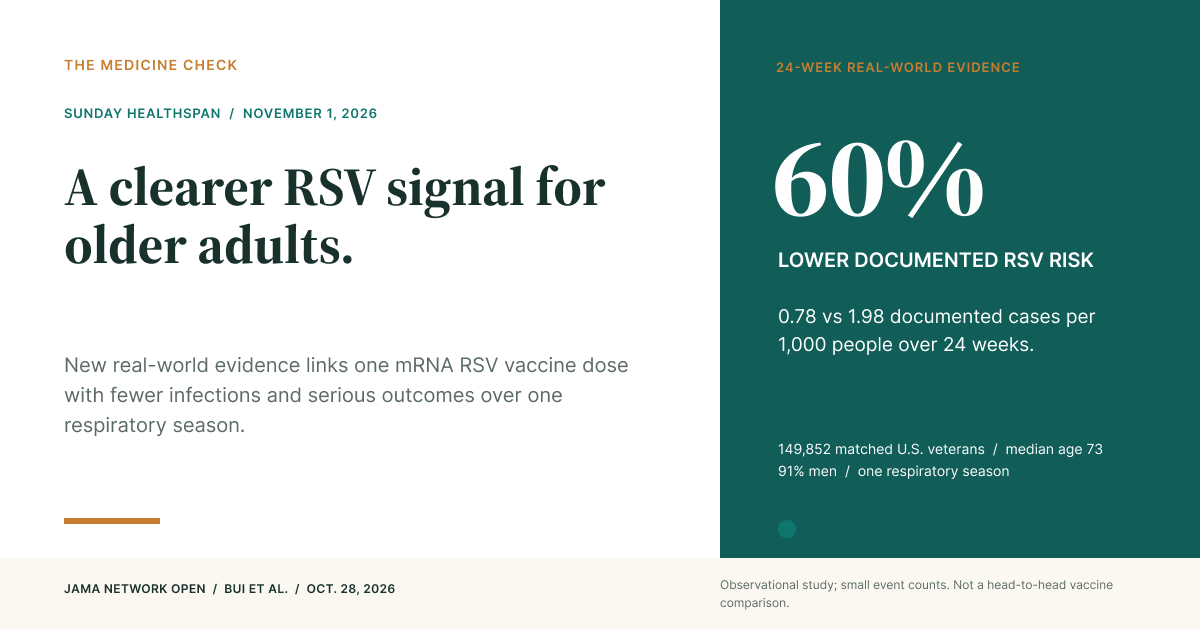
The reported total of 149,852 is weighted: 74,926 vaccinated veterans were matched to 286,425 unique unvaccinated controls, weighted to represent another 74,926 people.
You wake up with a cough in December and begin doing the usual math: Is this a passing cold, will it cancel the visit with your grandchildren, or could it become the kind of respiratory illness that sends you to urgent care? For many younger adults, RSV is an inconvenience. For an older adult with heart disease, lung disease, diabetes, frailty, or reduced immune function, the same virus can become a much larger interruption to strength, mobility, and independence.
A new study published in JAMA Network Open on October 28, 2026, gives us useful real-world evidence about one of the available RSV vaccines. Among nearly 150,000 matched U.S. veterans, one dose of Moderna’s mRNA RSV vaccine was associated with fewer documented infections, fewer RSV-related emergency or urgent care visits, and fewer hospitalizations over 24 weeks.
I think the result is encouraging because it moves the evidence beyond the controlled setting of a clinical trial and asks whether protection appears in ordinary care. It does; however, the study cannot tell us that vaccination caused every difference, the serious outcomes were uncommon, and the population was overwhelmingly male. The useful conclusion is narrower than a headline such as “82% effective against hospitalization” may suggest.
What the Study Actually Did
The researchers used Veterans Health Administration records to emulate a series of monthly clinical trials from October 2025 through January 2026. Adults age 50 and older who received Moderna’s mRNA-1345 vaccine, sold as mResvia, were matched with similar adults who had not received an RSV vaccine. The team then followed them through May 31, 2026, or for 24 weeks after the vaccination date.
This was not a randomized trial. It was a target-trial emulation, an observational method designed to make a health-record study resemble the trial we would have liked to run. The investigators matched and weighted participants on many measured features, including age, medical conditions, prior healthcare use, and vaccination history. They also ran an active-comparator analysis, comparing people who received the RSV vaccine and influenza vaccine on the same day with people who received influenza vaccine alone. That second analysis produced similar results, which makes a simple “healthy vaccinee” explanation less likely, though it cannot remove unmeasured confounding.
The matched analysis included 74,926 vaccinated veterans and 286,425 unique unvaccinated controls. The controls were weighted to represent 74,926 people, producing a weighted total of 149,852. Their median age was 73, 91.3% were men, and many had chronic health conditions. Median follow-up was 160 days.
The Relative Benefit Was Large and the Absolute Difference Was Small
At 24 weeks, the estimated vaccine effectiveness was 60.3% against documented RSV infection, 60.2% against an RSV-related emergency or urgent care visit, and 81.8% against RSV hospitalization. Those are relative estimates. They tell us how the vaccinated and unvaccinated groups compared, but they do not tell us how many events occurred.
The absolute numbers complete the picture:
- Documented RSV occurred in 0.78 per 1,000 vaccinated participants and 1.98 per 1,000 unvaccinated participants, an absolute difference of 1.19 cases per 1,000 people over 24 weeks.
- RSV-related emergency or urgent care visits occurred in 0.62 versus 1.55 per 1,000, an absolute difference of 0.93 visits per 1,000.
- RSV hospitalizations occurred in 0.05 versus 0.27 per 1,000, an absolute difference of 0.22 hospitalizations per 1,000.
Only three vaccinated participants were hospitalized with RSV during the study period. The hospitalization estimate therefore has a wide confidence interval, from 58.1% to 99.9%, and it should be read as a promising signal rather than a precise promise. During a season with more RSV transmission, or in a person with a higher baseline risk of severe disease, the absolute benefit could be larger; during a mild season, or in a lower-risk person, it could be smaller.
The Oldest Adults Need More Evidence, Not a Negative Verdict
The age subgroup deserves careful reading. Estimated effectiveness against documented infection was 82.9% in adults age 50 to 59, 66.3% from 60 to 69, 64.0% from 70 to 79, and 28.6% in adults age 80 and older. The confidence interval for the oldest group ran from a possible 12% increase in risk to a 60% reduction, which means the study could not determine the effect with confidence.
It would be a mistake to read 28.6% as proof that the vaccine offers little benefit after age 80. Older immune systems may respond differently, and the authors raise that possibility; however, fewer events and less statistical precision can also produce an unstable subgroup estimate. The study was not designed to settle whether protection truly declines at a specific birthday, and current recommendations should not be replaced by one imprecise subgroup result.
What This Study Does Not Tell Us
The findings answer one useful question: did people who received this mRNA vaccine experience fewer RSV outcomes during one respiratory season? They do not answer several others:
- Whether mResvia is more or less effective than the protein-based RSV vaccines, because this was not a head-to-head comparison.
- How long protection lasts beyond 24 weeks or across later RSV seasons.
- Whether vaccination preserved mobility, cognition, or independence after infection, because the study did not measure those outcomes.
- How well the estimate applies to women, people who receive most of their care outside the Veterans Health Administration, or populations with different patterns of illness and healthcare use.
- The balance of side effects and rare harms, because this effectiveness study did not evaluate vaccine safety.
Care received outside the VA may have been missed, residual confounding remains possible, and there were few severe events. Those limits do not erase the result; they set the boundaries around it.
How the New Evidence Fits Current RSV Guidance
Current CDC guidance recommends a single RSV vaccine dose for every adult age 75 and older who has not already received one, and for adults age 50 to 74 who have an increased risk of severe RSV disease. Higher-risk conditions include chronic heart or lung disease, complicated diabetes, severe obesity, kidney disease requiring dialysis, immune compromise, frailty, residence in a nursing home, and neurologic or neuromuscular conditions that make it harder to clear respiratory secretions.
The CDC does not prefer one licensed RSV vaccine over another. RSV vaccination is not currently an annual shot, and people who have already received a dose are not advised to receive another dose at this time. Late summer and early fall are generally the best times in most of the continental U.S.; however, an eligible person who missed that window can still be vaccinated at another time.
This new study strengthens the real-world evidence for the mRNA product specifically. It does not show that someone should switch products, repeat a dose, or choose mResvia over Arexvy or Abrysvo. Product choice can depend on availability, medical history, preferences, and a clinician’s assessment of benefits and risks.
My Takeaway for Your Healthspan
Respiratory prevention can sound less important than strength training, blood pressure control, or cancer screening because it is seasonal and easy to postpone. But a serious infection can interrupt movement, appetite, sleep, social contact, and the routines that hold function together. This study did not measure those downstream effects, so I will not claim that the vaccine preserved independence; I will say that preventing an urgent visit or hospitalization is a reasonable part of protecting it.
If you are 75 or older and have not received an RSV vaccine, the current recommendation is straightforward. If you are 50 to 74, your health conditions and living situation shape the decision. Ask three concrete questions: Am I at increased risk of severe RSV? Have I already received an RSV vaccine? Which available product makes sense for me after reviewing benefits, side effects, and the limits of the evidence?
My reading is that the new study adds a credible piece of reassurance: the mRNA RSV vaccine appears to work in ordinary care, not only in a trial. The estimate is not equally certain in every age group, the absolute event differences were modest in this season, and a single observational study is not the final word. It is still useful evidence for a prevention decision that many older adults are making now.
Keep Building Your Healthspan
- Build your strongest foundation with the Longevity Ladder. See the practical habits that can help you move better, stay stronger, and support a longer, healthier life.
- See how well you are aging with the Age Well Score. Get a whole-person snapshot of the health, function, and lifestyle factors that shape aging well.
- Take a deeper look with the Healthspan Checkup Calculator. Review the key measures that influence long-term health, independence, and quality of life.
- Become a member for access to member-specific resources.
Sources
Full text reviewed: Bui DP, Yan L, Li Y, et al. Effectiveness of the mRNA-1345 Vaccine Against Respiratory Syncytial Virus in US Veterans. JAMA Network Open. Published October 28, 2026;9(10):e2640981. doi:10.1001/jamanetworkopen.2026.40981. Source link Methods, results, tables, subgroup analyses, limitations, funding, and disclosures reviewed. Accessed November 1, 2026.
Guidance reviewed: Centers for Disease Control and Prevention. RSV Vaccine Guidance for Adults. Source link Reviewed for age thresholds, risk factors, timing, product neutrality, and the current single-dose recommendation. CDC page dated February 24, 2026; accessed November 1, 2026.
Regulatory information reviewed: U.S. Food and Drug Administration. MRESVIA product information and prescribing information. Source link Reviewed for product identity and current FDA labeling context.
Evidence verdict
Moderate confidence in the real-world association. Observational design, few severe events, one season of follow-up, and a predominantly male veteran population limit causal conclusions, precision, and generalizability.
Educational information only. Review eligibility, prior RSV vaccination, medical history, and product-specific benefits and risks with a qualified clinician or pharmacist. This article does not recommend a specific product or an additional dose.