Most supplement headlines ask a simple question: does it work? Healthy aging requires a better one: does it help people keep doing the things that make an independent life possible?
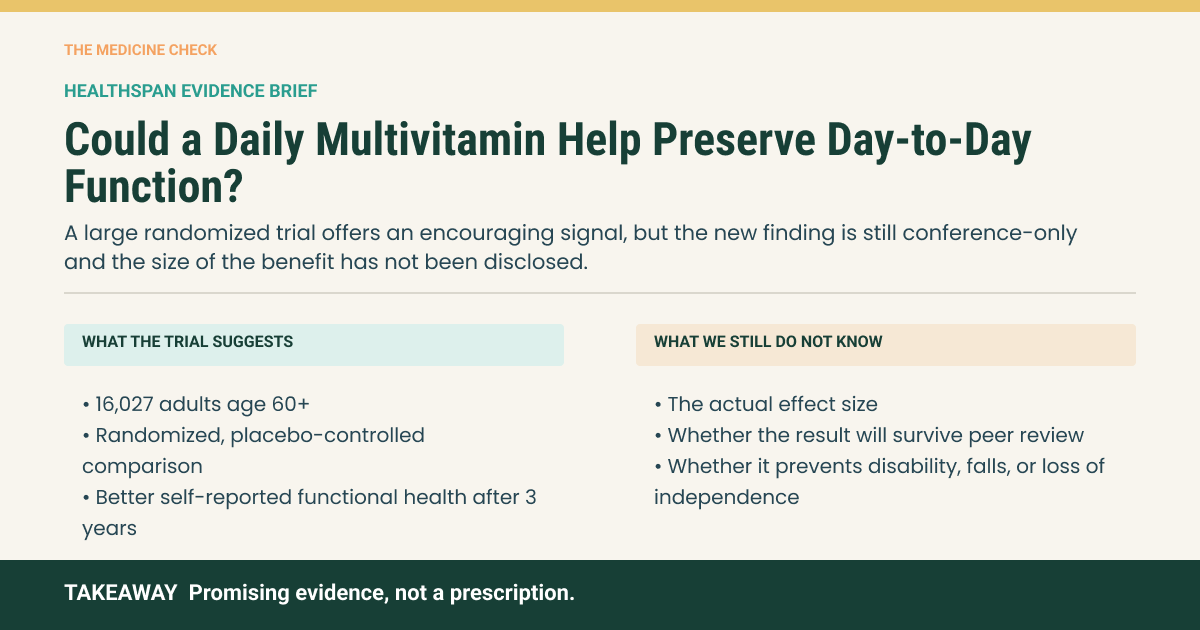
A new analysis from the Cocoa Supplement and Multivitamin Outcomes Study, better known as COSMOS, points in an encouraging direction. Researchers reported that older adults assigned to a daily multivitamin had better self-reported functional health after three years than those assigned to placebo.
That sounds practical and important. Function is closer to Healthspan than a laboratory marker. It includes whether symptoms and limitations interfere with walking, climbing stairs, household tasks, and other parts of daily life.
But the new result, presented July 27 at the American Society for Nutrition's NUTRITION 2026 meeting, has not yet been published in a peer-reviewed journal. The public report also does not provide the size of the difference between groups. Without that number, we cannot tell whether the average benefit was large enough for participants to notice or small enough to matter mainly in statistical analysis.
The responsible takeaway is neither "multivitamins do nothing" nor "everyone over 60 should take one." This is a promising signal from a strong trial design that still needs a complete paper.
What the researchers studied
COSMOS was a randomized, double-blind, placebo-controlled trial involving 21,442 U.S. adults. Women were age 65 or older and men were age 60 or older. Participants were assigned to a daily multivitamin, cocoa extract, both, or matching placebos.
The newly reported secondary analysis included 16,027 participants who completed annual functional-health questionnaires over three years. Researchers used the Kansas City Cardiomyopathy Questionnaire, or KCCQ, which asks about physical limitations, symptoms, quality of life, and social limitations related to cardiovascular health.
Randomization is a major strength. In a typical observational supplement study, people who take a multivitamin may also eat differently, exercise more, have better access to care, or make other health choices that are difficult to separate from the pill itself. Random assignment makes those background differences less likely to explain the result.
The size of the study is another strength. More than 16,000 participants gives researchers substantial power to detect differences between groups.
Still, this was a secondary analysis rather than the trial's original primary question. COSMOS was designed mainly to test whether cocoa extract or a multivitamin could prevent cardiovascular disease and cancer. Secondary analyses can generate useful findings, but they deserve extra attention to how many outcomes were tested, how missing data were handled, and whether the result remains persuasive after complete peer review.
What the study found, and what the public report leaves out
According to the conference report, participants assigned to the multivitamin had statistically better overall functional-health scores after three years than participants assigned to placebo. The researchers described the improvement as modest.
The missing detail is clinical magnitude. A statistically significant result means the observed difference is unlikely to be explained by chance under the study's assumptions. It does not tell us whether the difference was meaningful in daily life.
That distinction matters especially here because the KCCQ was developed and validated as a disease-specific measure for people with heart failure. Its questions touch real symptoms and limitations, but applying it across a generally healthy older population is not the same as directly measuring gait speed, falls, disability, bathing and dressing, or the ability to live independently.
The public report does not establish that the multivitamin:
- reduced falls or fractures;
- improved objective strength, balance, or walking speed;
- prevented disability or loss of independence;
- reduced heart attacks, strokes, cancer, or death; or
- produced a benefit that an individual participant would necessarily notice.
Those are not technical footnotes. They define what the finding can responsibly mean.
Why this still matters for Healthspan
Healthspan is not simply the absence of a diagnosis. It is the preservation of strength, mobility, cognition, metabolic health, independence, and quality of life across aging.
That makes functional health a worthwhile research target. A modest intervention that reliably delays functional decline could matter at a population level, particularly if it is inexpensive and easy to use. The new COSMOS analysis also fits with prior findings from cognitive substudies of the same trial.
In COSMOS-Web, 3,562 older adults completed internet-based cognitive testing for three years. The multivitamin group performed better on the study's primary immediate-recall measure at one year, with a small benefit that persisted on average across follow-up. The multivitamin did not significantly improve the study's secondary measures of memory retention, executive function, or object recognition.
Another COSMOS cognitive analysis reported a modest benefit in global cognition and episodic memory. Taken together, these studies suggest a possible pattern rather than a settled answer: broad micronutrient supplementation may modestly support selected aspects of cognitive or self-reported functional health in some older adults.
The parent COSMOS trial also supplies an important counterweight. Over a median 3.6 years, the multivitamin did not significantly reduce total invasive cancer, total cardiovascular events, or all-cause mortality. A supplement can show a signal on one outcome without becoming a general anti-aging treatment.
Why a multivitamin might help some people more than others
Older adults are not nutritionally identical. Appetite, food access, restrictive diets, alcohol use, gastrointestinal conditions, surgery, and medications can all affect nutrient intake or absorption. Vitamin B12 absorption, for example, can decline with age and can be affected by medicines such as metformin and acid-suppressing drugs.
That makes it biologically plausible that a multivitamin could help people with one or more unrecognized nutrient gaps more than people who already meet their needs through food. The current public report does not tell us which participants, if any, drove the average benefit. A full paper should help clarify baseline diet, deficiency risk, medication use, adherence, subgroup findings, and the role of missing questionnaires.
This is also why a positive trial cannot identify the best choice for every reader. Multivitamin formulations differ. Some contain nutrients at or near daily recommended amounts; others add high doses, herbs, or specialty ingredients that were not tested in COSMOS.
Should older adults start taking a multivitamin?
This result alone is not enough to make a universal recommendation.
The U.S. Preventive Services Task Force has concluded that evidence is insufficient to determine whether multivitamins prevent cardiovascular disease or cancer in generally healthy, community-dwelling adults. It specifically recommends against beta-carotene or vitamin E supplements for that purpose because of lack of benefit and, in some populations, potential harm.
The National Institutes of Health Office of Dietary Supplements also notes that multivitamins are not a substitute for a varied diet and can increase the chance of getting too much of some nutrients. Supplements may interact with medications, and taking more than one product can create unintended duplication.
For someone considering a multivitamin, a sensible conversation with a clinician or pharmacist can start with four questions:
- Is there a medical, dietary, or medication-related reason I may be missing a nutrient?
- Does this product duplicate anything already in my prescriptions or supplements?
- Does any ingredient interact with my medicines or medical conditions?
- Is the dose close to ordinary nutritional needs, or is it a high-dose product making claims that extend beyond the evidence?
A multivitamin should not displace the foundations with far stronger evidence for healthy aging: regular physical activity, resistance training, adequate protein and overall diet quality, blood-pressure and metabolic risk management, restorative sleep, social connection, vaccination, and appropriate screening.
The evidence verdict
Preliminary but promising. The randomized, double-blind, placebo-controlled design and large sample make this more credible than a typical supplement headline. The outcome is also relevant to Healthspan because it focuses on how people feel and function.
Confidence is limited because the functional-health result is conference-only, the effect size has not been disclosed, the measure was originally developed for heart failure, and objective outcomes such as mobility, activities of daily living, falls, and independence have not been reported. The analysis should be treated as an encouraging signal, not a practice-changing conclusion.
A reasonable takeaway
The most interesting part of this study is not the pill. It is the outcome researchers chose to examine. Healthy aging research becomes more useful when it asks whether an intervention helps people maintain the ability to think, move, participate, and live independently.
The new COSMOS finding earns attention because it comes from a large randomized trial and points toward function. It has not yet earned a universal recommendation. The next step is straightforward: publish the full analysis, show the effect size, explain the missing data and subgroup results, and test whether the difference appears in objective measures that people can feel in daily life.
Until then, a basic multivitamin may be reasonable for some adults after considering diet, deficiencies, medications, and total nutrient exposure with a health professional. It should be viewed as a possible nutritional backstop, not a shortcut to a longer Healthspan.
Keep building your Healthspan
Explore the Longevity Ladder for practical habits that support strength, movement, recovery, and a longer healthier life.
Take the Age Well Score for a whole-person snapshot of the health, function, and lifestyle factors that shape aging well.
Use the Healthspan Checkup Calculator to review key measures that influence long-term health, independence, and quality of life.
Sources
New development: abstract and conference report only. American Society for Nutrition. A Daily Multivitamin May Help Older Adults Maintain Functional Health. NUTRITION 2026 conference report, July 27, 2026. This result has not yet been peer reviewed; the public report does not provide the full effect size or complete methods and limitations.
Full-text reviewed research. Sesso HD, Rist PM, Aragaki AK, et al. Multivitamins in the Prevention of Cancer and Cardiovascular Disease: The COSMOS Randomized Clinical Trial. American Journal of Clinical Nutrition. 2022;115(6):1501-1510.
Yeung LK, Alschuler DM, Wall M, et al. Multivitamin Supplementation Improves Memory in Older Adults: A Randomized Clinical Trial. American Journal of Clinical Nutrition. 2023;118(1):273-282.
Baker LD, Manson JE, Rapp SR, et al. Effects of Cocoa Extract and a Multivitamin on Cognitive Function: A Randomized Clinical Trial. Alzheimer's & Dementia. 2023;19(4):1308-1319.
Green CP, Porter CB, Bresnahan DR, Spertus JA. Development and Evaluation of the Kansas City Cardiomyopathy Questionnaire. Journal of the American College of Cardiology. 2000;35(5):1245-1255.
Current consumer guidance. U.S. Preventive Services Task Force guidance on vitamin, mineral, and multivitamin supplementation; NIH Office of Dietary Supplements multivitamin fact sheet; and National Institute on Aging guidance for older adults.