Independent walking is not merely an exercise milestone. It is one of the clearest ways to see whether strength, balance, endurance, cognition, confidence, and the surrounding environment are still working together well enough to preserve everyday choice.
A study published August 31 in Nature Aging adds useful detail to that idea. Researchers reanalyzed data from the randomized SPRINTT trial, focusing on 1,199 community-dwelling adults age 70 or older who had physical frailty, sarcopenia, and at least two chronic conditions. Over as long as three years, people assigned to a sustained, individualized program of physical activity, nutrition counseling, and activity monitoring were less likely to develop major mobility disability or die than those assigned to healthy-aging education and simple stretching.
The finding matters because the outcome was concrete: whether a person could independently complete a 400-meter walk within 15 minutes. That is closer to the demands of daily life than a change in a laboratory marker, and it reflects a capacity that can shape shopping, appointments, social connection, and the ability to remain at home. The new analysis also asks a harder question: does the mix of chronic conditions change who benefits? The honest answer is that the study raises that possibility but does not prove it.
What the New Analysis Found
The participants had a median age of 79, 71% were women, and the typical participant had six chronic conditions. Researchers grouped their conditions into four patterns: an unspecific pattern that included 55% of participants, a psychiatric pattern that included 24%, a cardiometabolic pattern that included 13%, and a respiratory pattern that included 7%. These labels describe clusters in this dataset. They are not diagnoses a reader should try to assign at home.
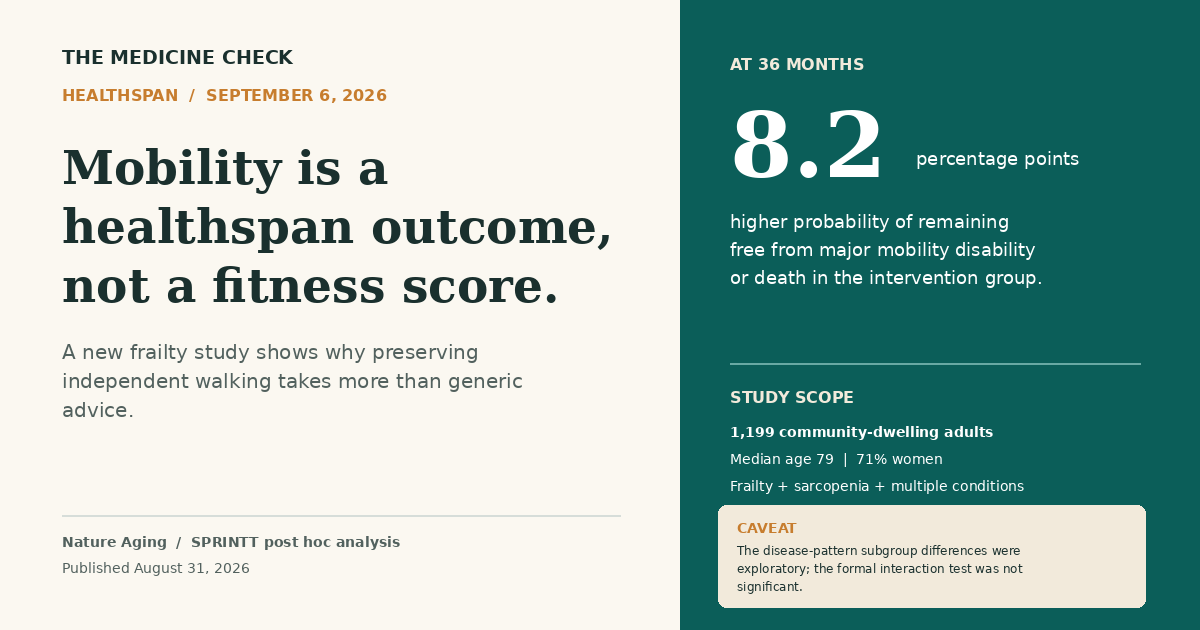
Across the full study population, the intervention reduced the relative hazard of major mobility disability or death by 22% compared with the control program, with a hazard ratio of 0.78 and a 95% confidence interval from 0.66 to 0.92. The absolute picture is more useful: the estimated probability of remaining free from the composite outcome was 5.3 percentage points higher at 12 months, 7.5 points higher at 24 months, and 8.2 points higher at 36 months. Over those three years, the intervention group also gained an average of about 2.1 months free from mobility disability or death.
That is a meaningful functional result in a population already at high risk. It is not a promise that every participant avoided disability, and the composite outcome means the analysis combined two events that differ greatly in cause and consequence.
What the Program Actually Involved
This was not a test of one mobility drill or a short burst of motivation. The SPRINTT intervention combined aerobic activity, resistance work, flexibility, and balance training. It included twice-weekly center sessions, home activity up to four times weekly, personalized nutrition counseling, and feedback from a thigh-worn activity monitor. The comparison group received healthy-aging education and simple stretching.
The design points toward a practical principle: in older adults whose mobility is already vulnerable, the useful unit of care may be a sustained program that addresses several constraints at once. A walking plan cannot fully compensate for inadequate leg strength. Resistance work may stall when pain, undernutrition, fear of falling, medication effects, or an unsafe home environment remain unaddressed. The study does not tell us which component did the most work, but it argues against reducing mobility preservation to step counts alone.
The Subgroup Finding Is a Hypothesis, Not a Prescription
The researchers saw clearer estimates of benefit in the unspecific and psychiatric patterns than in the smaller cardiometabolic and respiratory groups. It would be tempting to turn that observation into a rule about who should or should not receive a mobility program. The statistics do not support that move. The formal test of whether treatment effect differed across the four patterns was not significant, with a P value of 0.870, and the study was not powered for confident comparisons among those subgroups.
The smaller groups also produced wide confidence intervals, so an uncertain estimate should not be mistaken for no benefit. The authors estimated that 6,000 to 7,000 participants would be needed to test these interactions with adequate power. For now, the disease-pattern analysis is best treated as a map for future research, not a screening tool and not a reason to withhold a broadly appropriate program.
Mobility Disability Is Not the Same as Falling
The September theme is bone, joint, and fall prevention, which makes one distinction especially important: this trial measured loss of walking independence, not fractures or falls. In the parent SPRINTT trial's primary analysis group, at least one fall was recorded in 13.2% of participants assigned to the multicomponent intervention and 8.2% assigned to healthy-aging education, a risk ratio of 1.62 with a 95% confidence interval from 1.16 to 2.27. The authors concluded that the program may not be adequate for preventing falls in frail older adults.
A program can help preserve walking capacity without addressing every factor that causes a fall. Fall prevention often requires a separate assessment of prior falls, medications, vision, blood pressure symptoms, feet and footwear, cognition, home hazards, and specific balance or gait deficits. The U.S. Preventive Services Task Force recommends exercise interventions for community-dwelling adults age 65 or older who are at increased risk of falls, while multifactorial interventions should be individualized. The lesson is not that exercise failed. It is that mobility training and fall prevention overlap without being interchangeable.
Who These Results Apply To
The participants were community-dwelling adults age 70 or older with frailty, low muscle function or mass, and multiple chronic conditions. Many healthier older adults, people living in institutions, and people with substantial cognitive impairment were not represented. The findings therefore should not be generalized to every adult who searches for mobility exercises, and they do not establish the ideal program for a person with a recent fracture, unstable heart or lung disease, severe pain, or another condition that changes exercise safety.
The new paper is also a post hoc analysis of trial data collected from 2016 through 2019. Its central intervention comparison remains randomized, but the chronic-disease patterns and subgroup comparisons were defined for this later analysis. That distinction is why the overall mobility result deserves more confidence than the pattern-specific claims.
A Practical Mobility Check-In
A reader does not need a research-grade 400-meter course to notice that mobility is changing. The useful signal is a trend: walking less because of fatigue or fear, needing the arms to rise from a chair, pausing on stairs, avoiding uneven ground, taking longer to cross a parking lot, or becoming less willing to leave home. Those changes deserve attention before a crisis makes the problem obvious.
- Describe the function that changed. Tell a clinician what has become harder, when it began, and whether pain, breathlessness, dizziness, weakness, or fear is the limiting factor.
- Ask what needs assessment. Depending on the situation, that may include gait and balance, fall history, medication review, vision, nutrition, footwear, home hazards, bone health, or referral to physical therapy.
- Build more than one capacity. Aerobic, resistance, balance, and flexibility work each solve a different part of the mobility problem. The mix and level should reflect current ability and medical context.
- Treat nutrition as part of function. Unintended weight loss, low intake, and inadequate protein or energy can make strength training harder to tolerate and recover from, particularly in frail older adults.
- Track what matters in life. Steps can be useful, but the ability to rise, walk at a usual pace, carry something safely, reach a destination, and recover without excessive fatigue may be more meaningful measures of progress.
The Reasonable Takeaway
This study strengthens a straightforward Healthspan message: even in later life, and even when several chronic conditions are present, mobility disability is not always a fixed trajectory. A tailored, sustained program that combines movement, strength, balance, nutrition, and follow-through can preserve independent walking for some high-risk older adults. The effect is meaningful enough to discuss, but not broad enough to justify disease-cluster prescriptions or promises about fall prevention.
The best moment to protect mobility is usually before independence is lost. That does not mean pushing through new symptoms or copying a trial protocol without guidance. It means treating a change in function as clinically important, identifying the barriers that are actually present, and building a plan that can be continued long enough to matter.
Keep Building Your Healthspan
Build your strongest foundation with the Longevity Ladder and see the practical habits that can help you move better, stay stronger, and support a longer, healthier life.
Take the Age Well Score for a whole-person snapshot of the health, function, and lifestyle factors that shape aging well.
Use the Healthspan Checkup Calculator to review the key measures that influence long-term health, independence, and quality of life.
Become a member for access to member resources.
Sources
Full text reviewed. Vetrano DL, Gregorio C, Triolo F, et al. Multimorbidity patterns influence mobility disability prevention in frail older adults from the SPRINTT trial. Nature Aging. Published August 31, 2026. Post hoc analysis. DOI: 10.1038/s43587-026-01188-x.
Full text reviewed. Bernabei R, Landi F, Calvani R, et al. Multicomponent intervention to prevent mobility disability in frail older adults: randomised controlled trial. The BMJ. 2022;377:e068788. DOI: 10.1136/bmj-2021-068788.
Full recommendation reviewed. U.S. Preventive Services Task Force: Falls Prevention in Community-Dwelling Older Adults. June 4, 2024.
Full webpage reviewed. Centers for Disease Control and Prevention: What Counts as Physical Activity for Older Adults. Accessed September 6, 2026.
Full webpage reviewed. World Health Organization: Healthy ageing and functional ability. Accessed September 6, 2026.
Educational information only. This article provides general health information and does not replace individualized medical evaluation. New or rapidly worsening weakness, falls, chest symptoms, breathlessness, dizziness, or neurologic symptoms warrant prompt clinical attention.