You see a headline that a familiar blood-pressure pill may turn on “good fat,” raise energy use, and improve metabolism. If losartan already sits in your pill organizer, or if weight and metabolic health have become harder with age, the leap is easy: has an old drug become a new longevity tool?
Not yet.
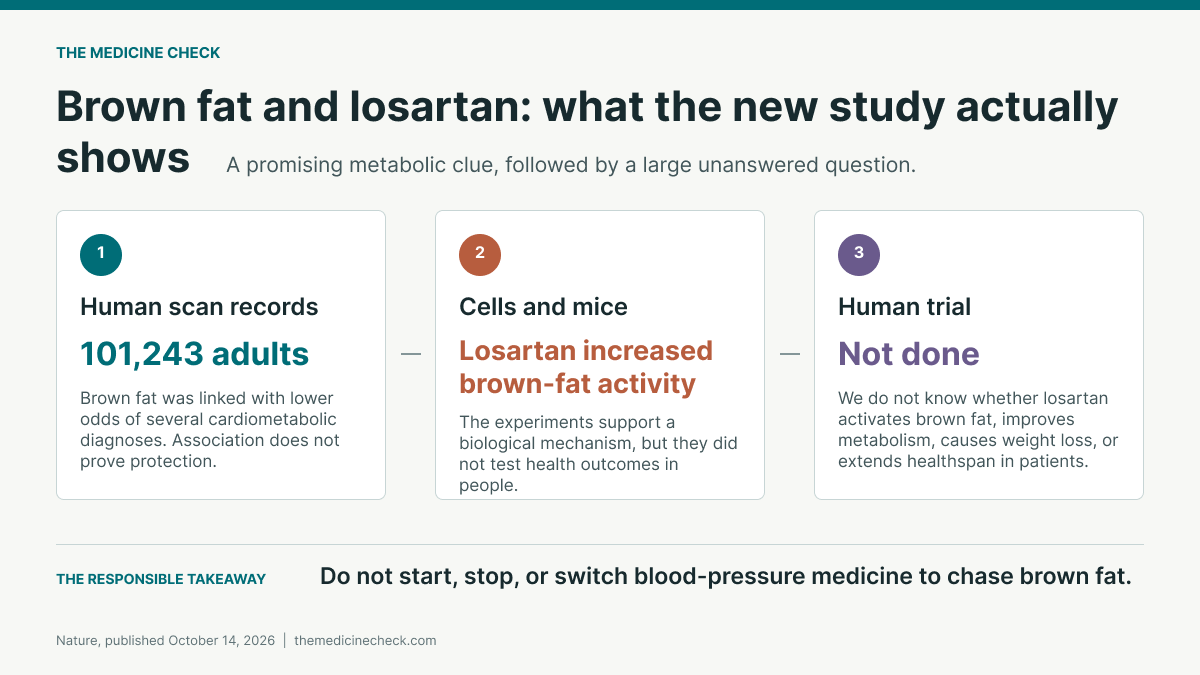
A study published October 14 in Nature offers one of the largest and most detailed looks at brown adipose tissue, usually called brown fat, in adults. The researchers found that detectable brown fat was associated with lower odds of many cardiometabolic diagnoses, then used clinical records, cell experiments, and mouse studies to identify losartan as a possible brown-fat activator. It is thoughtful, ambitious work. It is also a chain of evidence that stops before the step patients care about most: a human trial showing that losartan activates brown fat and produces a meaningful health benefit.
Here is what the study found, where the uncertainty begins, and how I think you should read the result if metabolic health and healthy aging are your goals.
What brown fat does
Most body fat is white adipose tissue, which stores energy. Brown fat is different because its mitochondria can burn fuel to produce heat, a process called thermogenesis. Adults retain brown fat mainly around the neck and upper chest, although the amount and activity vary with age, body composition, temperature, medications, and other factors.
That biology has made brown fat an attractive target for obesity and metabolic research. If a treatment could increase energy expenditure or improve glucose and lipid handling without unacceptable harms, it might become useful. The phrase “might become” is doing important work here, because a plausible mechanism is not the same as a treatment that improves how people feel, function, or age.
What the study found in people
The investigators analyzed clinical records linked to PET/CT imaging from 101,243 adults treated at Memorial Sloan Kettering Cancer Center. These scans can reveal metabolically active brown fat because the tissue takes up a glucose-like tracer. The researchers identified 8,897 people with detectable brown fat and 92,346 without it; they then built a matched analysis comparing all 8,897 brown-fat-positive participants with 17,405 participants similar in age, sex, body mass index, and ambient temperature.
Across 511 diagnostic categories, 98 were significantly associated with brown-fat status after adjustment, and 92 were less common among people with detectable brown fat. The adjusted odds ratio for type 2 diabetes was 0.42, for chronic ischemic heart disease 0.53, for disorders of lipoprotein metabolism 0.76, and for primary hypertension 0.79. In plain language, these diagnoses were less prevalent in the brown-fat group after the measured differences were accounted for.
The wording matters: lower odds in a retrospective clinical-record analysis do not mean brown fat prevented these conditions. People with more active brown fat may differ in ways the records could not capture, disease and treatment may affect brown fat, and a single scan can miss tissue that was present but inactive on that day.
The research team also used an artificial intelligence system to quantify brown-fat activity in roughly 8,700 of the brown-fat-positive scans. Higher activity followed a stepwise pattern with lower prevalence of several cardiometabolic conditions and with a healthier distribution of body fat. This dose-response pattern makes the association more interesting, but it still cannot establish cause and effect.
Where losartan enters the story
The investigators next examined medication records to look for drugs associated with detectable brown fat. Angiotensin receptor blockers, a class used to treat high blood pressure and certain kidney and cardiovascular conditions, stood out. Losartan then became the lead candidate for laboratory testing.
In cultured human fat cells, losartan increased UCP1, a protein central to heat production in brown fat, along with other thermogenic genes. The researchers reported a mechanism involving PPAR-gamma that appeared independent of losartan's usual angiotensin receptor target. In mice, short-term losartan treatment increased markers of brown-fat thermogenesis, oxygen use, carbon dioxide production, and energy expenditure, including during cold exposure.
The mice did not lose weight or body fat during the short experiment. More important, people were not treated with losartan to see whether it activated brown fat, altered glucose control, changed body composition, improved physical function, or affected any healthspan outcome.
Why the result is promising and still preliminary
The study brings several strong pieces together: a very large imaging-linked dataset, careful matching, automated measurement of tissue activity, a medication signal, a plausible cellular mechanism, and experimental confirmation in mice. Each step strengthens the biological hypothesis.
Several limitations keep the clinical conclusion narrow. The human analysis was retrospective, so unmeasured differences and reverse causation remain possible. The cohort came from a cancer center rather than a representative community sample. Participants were not deliberately exposed to cold before imaging, which likely caused some active brown fat to go undetected. Medication use can also reflect the illnesses being treated, so an association between a drug class and brown fat may arise partly from who receives the drug.
Some of the broad diagnostic associations, including lower odds of anxiety, depressive episodes, and sleep disorders, are best treated as hypothesis-generating. They may point toward real biology, but the analysis was not designed to show that activating brown fat prevents or treats those conditions.
My evidence verdict is strong for discovery and limited for treatment. The study gives researchers a credible reason to test losartan and related pathways in people; it does not give patients a reason to use losartan for weight loss, metabolic enhancement, or longevity.
What this means if you take losartan
Losartan is an established prescription medicine for specific indications, including hypertension and certain kidney and cardiovascular contexts. Brown-fat activation, weight loss, metabolic enhancement, and longevity are not approved indications. The current label also carries clinically important warnings and monitoring considerations, including pregnancy risk, low blood pressure, kidney function, and potassium.
Do not start, stop, switch, or change a blood-pressure medicine because of this study. If you already take losartan, the new paper does not show that you are receiving an extra metabolic benefit, and it does not make the medicine more appropriate for someone who does not otherwise need it.
A useful medication conversation remains grounded in the reason the drug was prescribed: Is my blood pressure controlled? Is this medicine still a good fit for my kidney and cardiovascular health? Are kidney function and potassium being monitored when appropriate? Are side effects, other medicines, or supplements changing the risk-benefit balance? Those questions are ready for clinical use now. Brown-fat optimization is not.
What would need to happen next
A responsible next step would be a prospective, randomized human trial that confirms whether losartan activates brown fat under standardized imaging conditions and separates that effect from blood-pressure lowering. Researchers would then need to test outcomes that people can recognize: glucose control, lipids, body composition, physical function, adverse effects, and durability. Because prior brown-fat research has raised questions about bone health in some settings, a longer trial should also watch bone-related outcomes rather than focusing only on energy expenditure.
Comparing losartan with another blood-pressure medicine or another angiotensin receptor blocker could help determine whether the signal is specific to one drug, shared by the class, or explained by the patients who receive it. Without that work, a compelling mechanism can still lead to a disappointing treatment.
The Healthspan takeaway
Brown fat may become a useful metabolic target, and this study gives the field a better map for testing it. For now, the practical lesson is about how to read early translational science: follow the evidence from association to mechanism to experiment, then notice where the chain ends.
Your current healthspan plan does not need to wait for a brown-fat drug. Controlling blood pressure, maintaining muscle and aerobic capacity, eating in a way that supports metabolic health, sleeping well, avoiding tobacco, and using prescribed medicines for established reasons already address outcomes that shape independence and quality of life. Those actions are less novel than a repurposed-drug headline, but they rest on human evidence that is much closer to the outcomes you care about.
The new study is a reason to watch the research, not a reason to change your prescription.
Keep Building Your Healthspan
- Build your strongest foundation with the Longevity Ladder. See the practical habits that can help you move better, stay stronger, and support a longer, healthier life.
- See how well you are aging with the Age Well Score. Get a whole-person snapshot of the health, function, and lifestyle factors that shape aging well.
- Take a deeper look with the Healthspan Checkup Calculator. Review the key measures that influence long-term health, independence, and quality of life.
- Become a member for access to member-specific resources.
Sources
- Full text reviewed: Gómez-Banoy N, et al. Artificial intelligence-enabled clinical phenotyping of human brown fat. Nature. Published October 14, 2026. doi:10.1038/s41586-026-11162-7. https://doi.org/10.1038/s41586-026-11162-7
- Abstract and metadata reviewed: Becher T, et al. Brown adipose tissue is associated with cardiometabolic health. Nature Medicine. 2021;27:58-65. doi:10.1038/s41591-020-1126-7. https://doi.org/10.1038/s41591-020-1126-7
- Official drug label reviewed: DailyMed. Losartan potassium tablet, film coated. Label revised February 2026. https://dailymed.nlm.nih.gov/dailymed/drugInfo.cfm?setid=c4b81f90-bcd0-45d0-99ce-35ca998d473a
Educational information only. This article does not provide individualized medical advice. Do not start, stop, switch, or change a medicine because of this study. Discuss medication questions with a qualified clinician.