You finish a walk and wonder whether it was enough. Should you go farther? Add weights? Work on balance? Copy the workout your younger neighbor does, or accept that a slower pace is simply what happens after 60?
I want to move that decision away from your birthday and toward something more useful: what can you do now, what has changed, and what do you want to keep doing?
On November 10, The Lancet Healthy Longevity published a three-paper series on physical activity in older adults. The series does not overturn current exercise guidance, and it does not identify one perfect routine; however, it brings wearable research, exercise trials, and implementation studies into a practical framework centered on function. The strongest message is that exercise can preserve or restore functional ability across a wide range of older adults, but the program should be matched to the person, the setting, and the starting level.
A plan can be too easy, too hard, or simply mismatched
Two people can both be 72 and need very different exercise plans. One may hike, carry groceries upstairs, and recover well after a hard session. The other may have slowed after a hospitalization, feel unsteady when turning, or need both hands to rise from a chair. Age alone does not describe either person well enough.
The new series uses the World Health Organization concept of intrinsic capacity, which combines a person’s physical and mental capacities, including locomotion, cognition, psychological health, vitality, and sensory function. In plain language, it asks whether you have the capacity to do what you need and value, within the environment where you live.
The exercise review found the most consistent benefits in locomotion and physical function. The authors concluded that tailored, multicomponent programs combining progressive strength, aerobic activity, and balance work produce the broadest benefits across community-dwelling older adults, hospitalized patients, people with frailty, and long-term-care residents.
This is not a reason to build the most complicated workout possible. It is a reason to stop treating walking, strength, balance, and function as interchangeable.
Movement and exercise are related, but they are not the same
The first paper in the series reviewed newer evidence from wearable devices, which can capture light activity, brief bursts of movement, intensity, and long periods of sitting more accurately than memory-based questionnaires. This matters because people commonly overestimate activity and underestimate sedentary time when asked to recall a typical week.
The wearable evidence supports a useful idea: movement accumulated through ordinary life can contribute to health, even when it comes in short bouts. Light activity has been associated with mobility and other healthy-aging outcomes, and replacing some sedentary time with movement is reasonable when a full exercise session is not possible.
But the details require restraint. Much of this wearable evidence is observational, so it cannot prove that adding a particular number of minutes will produce a particular benefit. Healthier people may move more because they are already healthier, which creates reverse causation. The review also found stronger associations for moderate-to-vigorous activity than for light activity on several outcomes.
My reading is simple: light movement counts, but it does not make strength, balance, or appropriately challenging aerobic work optional. A short walk after dinner can be useful; it does not train every capacity you may need for stairs, a stumble, a suitcase, or recovery from illness.
Function should set the starting point
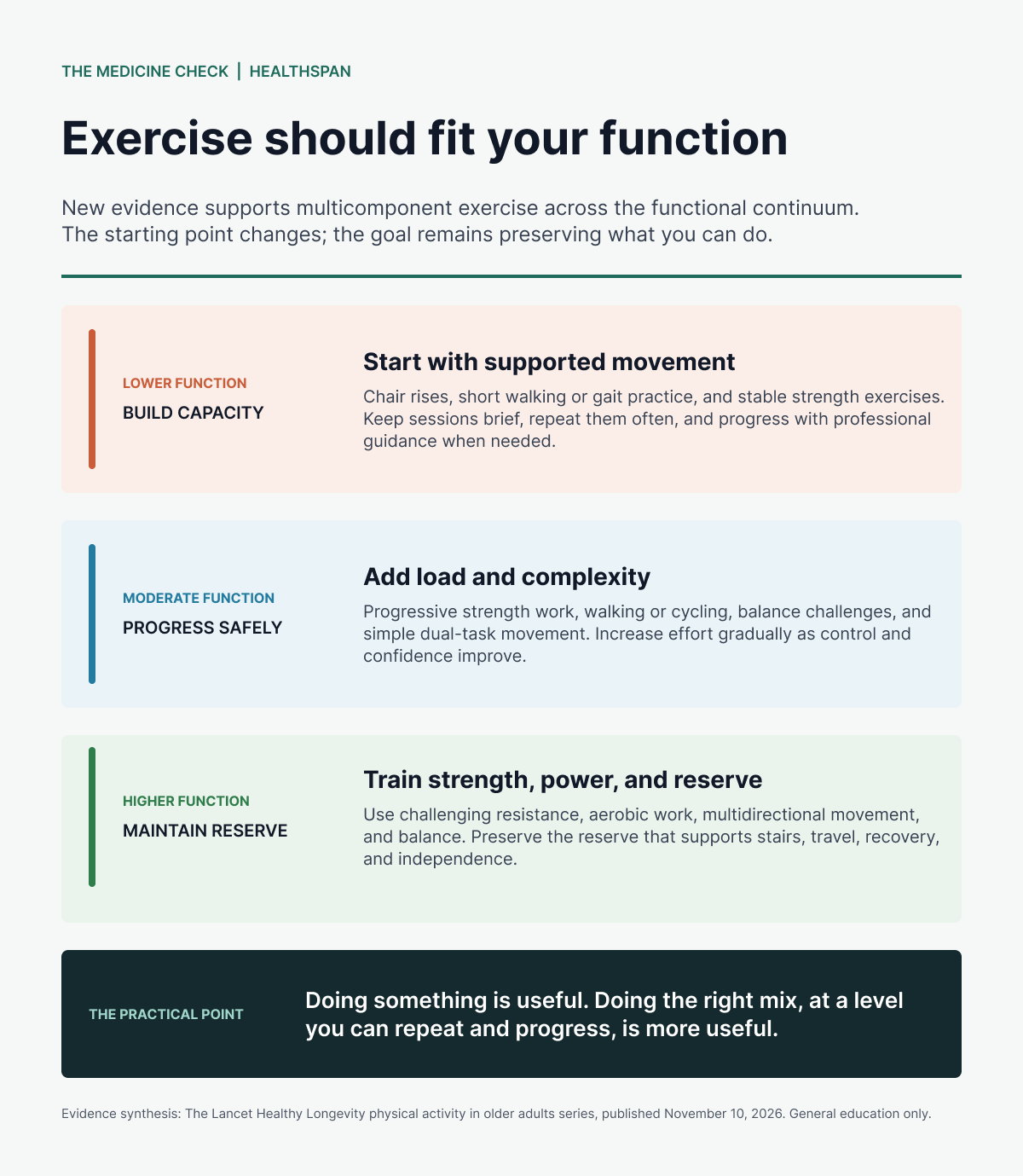
The second paper translated exercise evidence across three broad settings, and its most practical contribution was a progression based on functional capacity.
For someone with lower function, the starting point may include supported chair rises, short bouts of walking or gait practice, stable strength exercises, and close attention to safety. For someone with moderate function, the plan can add resistance, longer aerobic sessions, balance challenges, and more complex movement. For someone with higher function, the goal shifts toward preserving reserve through heavier resistance, power when appropriate, aerobic intensity, multidirectional movement, and cognitive-motor challenge.
These are not rigid categories, and they are not self-prescriptions. Function can differ by task and change after illness, medication changes, pain, a fall, poor sleep, or a period of inactivity. A person may have strong legs but poor balance, good endurance but new dizziness, or a normal walking pace with difficulty getting up from the floor.
The review also examined hospitalized older adults, a setting where inactivity can accelerate decline. It reported that roughly one-third experience hospital-associated disability and that many spend most of the admission in bed, even when they can walk. Trials and meta-analyses suggest that multicomponent in-hospital exercise can help preserve activities of daily living and physical performance; however, walking alone has not produced consistent benefits, and any hospital program must fit the acute illness, medical restrictions, and supervision available.
The strongest evidence is about function, not immortality
The evidence verdict is strong for the practical conclusion that tailored, multicomponent exercise can improve or preserve physical function across many older-adult populations. It is moderate for broader claims involving cognition, vitality, quality of life, and long-term outcomes, because the evidence varies by intervention, population, measurement, and setting.
The series does not prove that one routine extends lifespan. It does not show that a wearable can determine the right program by itself. It does not establish that brief movement breaks replace structured exercise, or that every older adult should train at the same intensity.
The exercise paper is also a narrative review, not a formal systematic review, and the authors acknowledge possible selection bias. The implementation paper used a scoping meta-review, which is useful for mapping a field but does not combine all effects into one precise estimate. Adults over 80, people with multimorbidity, and populations in low- and middle-income countries remain underrepresented in important parts of the evidence.
Those limits do not erase the central conclusion. They tell us how far to carry it.
A function-first exercise check-in
Before you decide that your plan needs more minutes, ask whether it covers the capacities you want to preserve.
Movement: How much of your day is spent sitting, and where could ordinary movement fit without creating a new barrier?
Strength: Can you rise from a chair, carry groceries, climb stairs, and get up from the floor as well as you could a year ago?
Balance: Have you become less steady while turning, stepping over an obstacle, walking in dim light, or standing on an uneven surface?
Aerobic capacity: Do familiar walks or household tasks make you more breathless or tired than before?
Recovery: Are pain, dizziness, unusual shortness of breath, falls, medication effects, or a recent hospitalization changing what is safe?
Progression: Is the plan still challenging enough to create adaptation, and can you repeat it consistently without losing function elsewhere?
Current U.S. guidance for adults 65 and older still provides a useful population target: at least 150 minutes of moderate-intensity aerobic activity each week, muscle-strengthening activity on at least two days, and balance work. If chronic conditions or limitations make that target unrealistic, the guidance advises being as active as abilities and conditions allow.
Population guidance is the frame; your function determines how the picture is filled in. A clinician or physical therapist can help when you have a recent fall, new weakness, chest symptoms, dizziness, severe pain, a major medical change, or uncertainty about how to progress safely. The answer may be more exercise, a different exercise, treatment of an underlying problem, or all three.
Build the plan you can progress
I do not want you to leave this article asking only, “Did I get enough minutes?” I want you to ask whether your exercise protects the tasks that support your life.
Can you stand, carry, climb, turn, recover, and keep doing what matters to you? What has changed? Which part of the plan is missing?
The new series strengthens a practical Healthspan principle: movement is valuable, structured exercise is powerful, and the best program begins with current function. Start where you are, use the right mix, and progress with enough challenge to preserve the capacity you want tomorrow.
Keep Building Your Healthspan
Build your strongest foundation with the Longevity Ladder. See the practical habits that can help you move better, stay stronger, and support a longer, healthier life.
See how well you are aging with the Age Well Score. Get a whole-person snapshot of the health, function, and lifestyle factors that shape aging well.
Take a deeper look with the Healthspan Checkup Calculator. Review the key measures that influence long-term health, independence, and quality of life.
Become a member for access to member-specific resources.
Sources
Full-text reviewed
1. Koemel NA, Valenzuela PL, D’Amore C, et al. “Physical activity, sedentary behaviour, and healthy ageing in older adults.” The Lancet Healthy Longevity. Published online November 10, 2026. doi:10.1016/j.lanhl.2026.100913. https://doi.org/10.1016/j.lanhl.2026.100913
2. Sánchez-Sánchez JL, Valenzuela PL, Izquierdo M, et al. “Physical exercise interventions to promote healthy ageing in older adults: from research to clinical implementation.” The Lancet Healthy Longevity. Published online November 10, 2026. doi:10.1016/j.lanhl.2026.100914. https://doi.org/10.1016/j.lanhl.2026.100914
3. King AC, Rodriguez Espinosa P, Rovzar CM, de la Vega-Taboada E, Stathi A. “Building the future for active ageing: a scoping meta-review of progress and prospects for physical activity promotion in later life.” The Lancet Healthy Longevity. Published online November 10, 2026. doi:10.1016/j.lanhl.2026.100915. https://doi.org/10.1016/j.lanhl.2026.100915
4. Centers for Disease Control and Prevention. “Older Adults: Adding Activity Recommendations.” Updated December 4, 2025. https://www.cdc.gov/physical-activity-basics/adding-older-adults/index.html
Abstract-only reviewed
5. Tang Q, Shan S, Chen H, Zhou W. “Interventions for promoting physical activity and reducing sedentary time among people aged 55 years and older: an overview of systematic reviews.” Age and Ageing. 2026;55. doi:10.1093/ageing/afag045. Consensus detailed record reviewed; full article text was not used for detailed claims.
This article provides general educational information. It does not diagnose functional status or provide an individual exercise prescription. Readers with a recent fall, new weakness, dizziness, chest symptoms, unusual shortness of breath, severe pain, a major medical change, or uncertainty about exercise safety should seek appropriate clinical guidance.