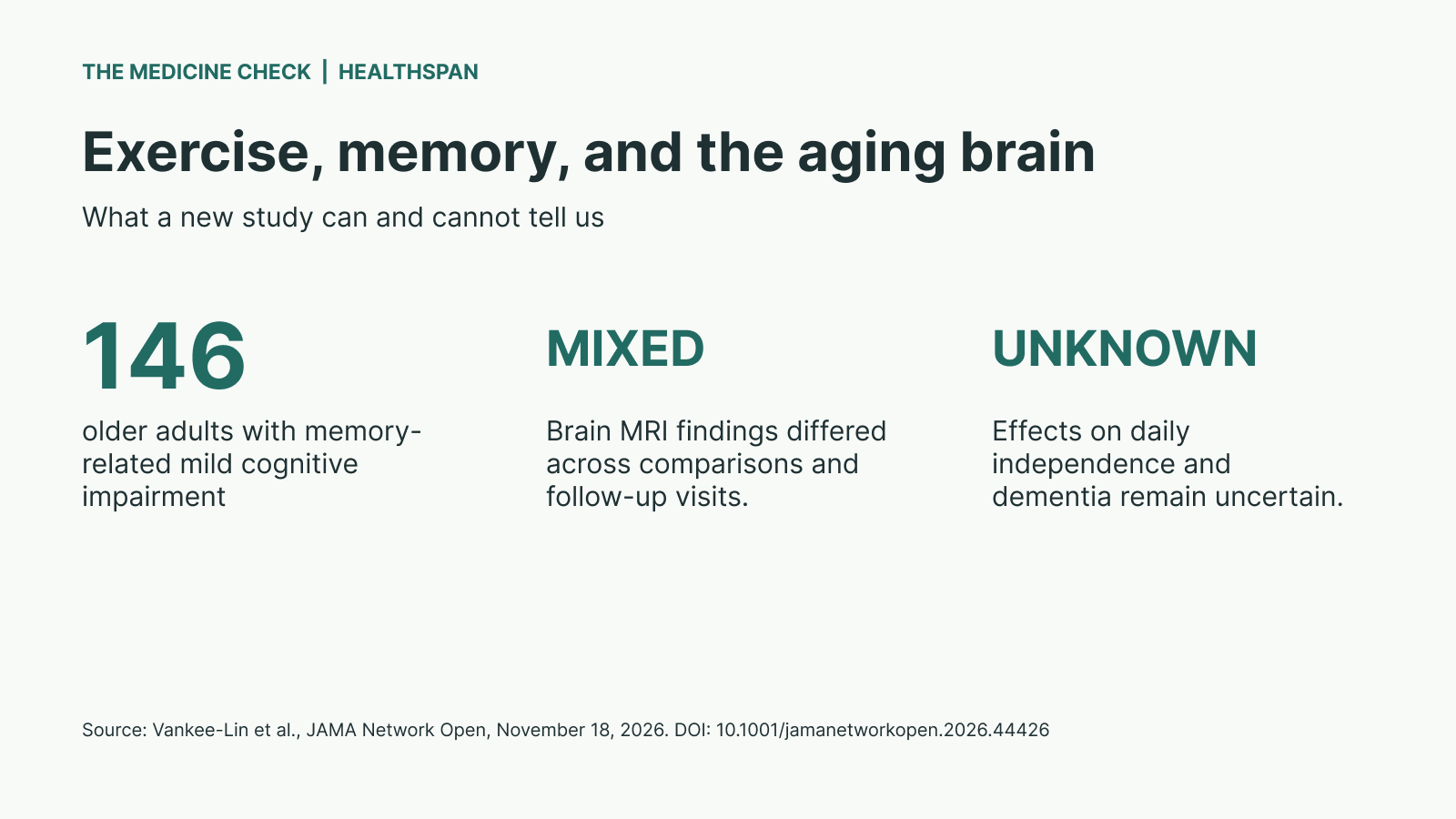
You hear that exercise and brain games can protect your memory, and the promise sounds appealing. But what did researchers actually measure? Did people remember more, stay independent longer, or avoid dementia? I want to walk you through a new study because its brain scans offer an interesting signal, while the outcomes you care about remain unanswered.
The November 18 study in JAMA Network Open looked at older adults with memory-related mild cognitive impairment, or MCI. People assigned to aerobic exercise plus cognitive training had more favorable changes in one brain-imaging measure than some comparison groups at certain follow-up visits; however, results were inconsistent, and the study does not establish that the program prevented dementia or improved everyday function. [1]
What the researchers studied
The researchers analyzed brain scans from 146 adults, average age nearly 74, who had amnestic MCI: measurable memory difficulty with daily function generally preserved and without dementia. Participants were randomly assigned to six months of combined aerobic exercise and cognitive training, cycling alone, speed-of-processing training alone, or mental leisure activities and stretching. Follow-up scans were scheduled through 18 months. [1]
The team examined cortical thickness in brain regions often affected by Alzheimer disease and areas of white-matter change visible on MRI. A scan measure can help researchers investigate a biological question, but it is a surrogate: a change on an image does not by itself tell you whether someone can manage medications, recall a conversation, or live independently.
The results were selective, not a clear win across the board
In the main analysis, the combined group had a more favorable change in cortical thickness than the speed-training group at 18 months and the mental-leisure-and-stretching group at 12 months. Other comparisons were not statistically significant, including the comparison with cycling alone, and none of the main white-matter comparisons reached statistical significance. A finding at one visit should not be treated as a proven lasting benefit at every visit. [1]
The researchers used statistical methods to account for missing scans, which became more common during follow-up. Results were not consistently reproduced in analyses restricted to people with available scans. The groups were small, the study included several comparisons, and most participants were White and highly educated. These limits make chance, missing data, and applicability to other populations important considerations.
Participants had a clinical diagnosis of MCI, not confirmation that Alzheimer-related proteins caused their symptoms. The study cannot establish that the program altered Alzheimer disease, and it did not establish that these scan differences translated into better cognition or daily function. Findings linking attendance to scans were exploratory and cannot show that attending more sessions caused a benefit. [1]
How this fits with other research
A larger but different study gives us useful context. In the 2025 U.S. POINTER randomized trial, 2,111 adults ages 60 to 79 at increased risk of cognitive decline were assigned to a structured lifestyle program or a less intensive, self-guided program. Both encouraged exercise, healthy eating, cognitive and social activity, and cardiovascular monitoring. The structured group improved slightly more on a composite of cognitive tests over two years; the clinical importance of that difference and longer-term effects remain uncertain. [2]
Most POINTER participants did not have MCI, and its two groups both received active lifestyle guidance. Its results do not prove that the exact exercise-and-training combination in the new imaging study works, or that either program prevents dementia. Taken together, the studies support continued research and a practical interest in sustainable habits, not a guarantee of a particular brain outcome.
What you can do now
If you notice a persistent change in memory or thinking, bring a specific example to your clinician, such as a missed bill or repeated difficulty remembering an appointment. Memory symptoms have several possible causes, and a clinical evaluation can help identify what needs attention. [3]
If you are considering a new activity plan, choose movement that fits your abilities and discuss safety with your clinician when health conditions, symptoms, or fall risk make the right starting point uncertain. For adults 65 and older, CDC guidance includes aerobic activity, muscle strengthening, and balance work; a common target is 150 minutes of moderate aerobic activity per week, with strengthening at least two days per week. Start within your abilities, and remember that some activity is better than none. [4]
Choose mentally and socially engaging activities you enjoy, such as a class, a conversation group, or learning a skill. You do not need to purchase a brain-training product to act on this study, and the research does not tell us that any particular game prevents dementia. Continue discussing blood pressure, sleep, hearing, medications, and other health concerns with your care team.
A practical takeaway
I would use this study as a reason to keep asking better questions about brain health, not as a prescription for an MRI or a promise that one routine will preserve memory. You can work toward movement and meaningful engagement while taking memory changes seriously, because protecting your healthspan includes both the habits you practice and the care you seek when something changes.
Keep Building Your Healthspan
Become a member for access to member-specific resources.
Sources
1. Vankee-Lin F, et al. Multicomponent Lifestyle Intervention and Brain Aging: A Secondary Analysis of a Randomized Clinical Trial. JAMA Network Open. November 18, 2026. Full text reviewed. Read source 1
2. Baker LD, et al. Structured vs Self-Guided Multidomain Lifestyle Interventions for Global Cognitive Function: The US POINTER Randomized Clinical Trial. JAMA. 2025. Full text reviewed. Read source 2
3. National Institute on Aging. What Are the Signs of Alzheimer’s Disease? Read source 3
4. Centers for Disease Control and Prevention. Older Adult Activity: An Overview. Read source 4
General educational information only. This article does not replace individual medical care.