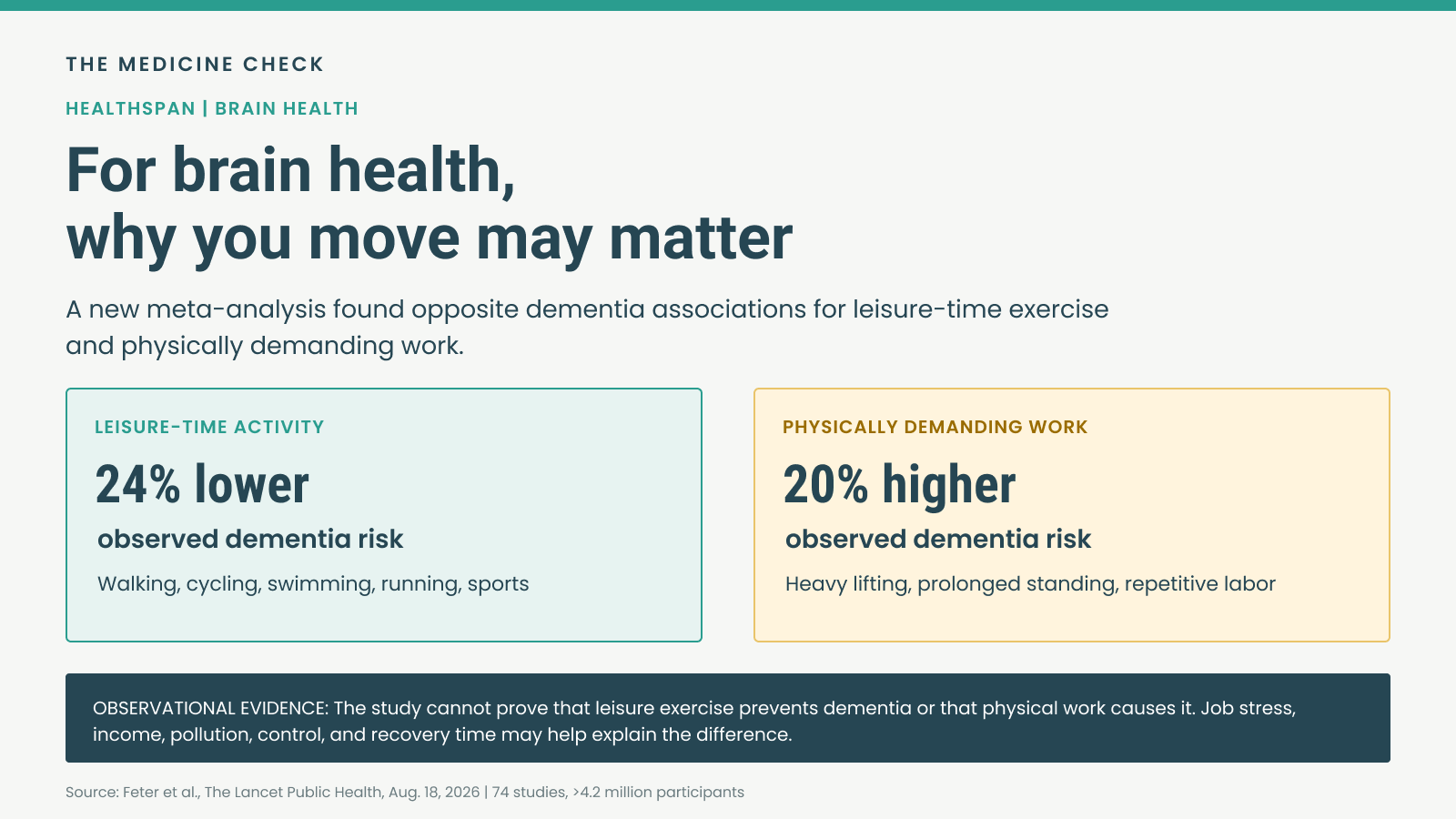
Physical activity is one of the most reliable habits we have for supporting health across aging. But a new review suggests that, for brain health, the setting of that activity may matter. Movement chosen during leisure time was associated with a lower risk of dementia. Physical activity performed as part of a demanding job showed the opposite pattern.
That does not mean manual work causes dementia, and it does not mean an after-work walk guarantees protection. The evidence is observational. Still, the contrast is important because it challenges a common assumption: an exhausting workday and a purposeful exercise session may add similar minutes to an activity total, but they are not necessarily the same biological or social experience.
What the new study found
The systematic review and meta-analysis, published August 18 in The Lancet Public Health, combined 74 cohort and case-control studies with 4,227,297 participants. Their median age was 67.3 years, and they were followed for a median of 10 years. Researchers examined all-cause dementia, Alzheimer disease, and vascular dementia.
Across the full evidence base, higher physical activity was associated with lower dementia risk. But the result changed when the researchers separated activity by domain:
- High leisure-time physical activity was associated with a 24% lower risk of all-cause dementia compared with low activity.
- Occupational physical activity was associated with a 20% higher risk.
- Household activity appeared protective, but that estimate came from only one study.
- Active commuting was associated with a modestly higher risk, but that result came from only two studies.
The leisure-time finding is the most dependable part of the comparison because it drew on 20 studies. The occupational result came from five. The researchers graded the certainty of evidence across domains as low to very low, so the percentages should be treated as estimates, not promises.
Why a hard workday may not act like exercise
A brisk walk, bike ride, swim, or strength session is usually self-paced, limited in duration, and followed by recovery. It may also provide enjoyment, social connection, and stress relief. Those features can influence cardiovascular health, sleep, metabolic function, and cognitive resilience.
Physical work can look very different. It may involve repeated lifting, prolonged standing, awkward positions, long shifts, noise, air pollution, heat, low control over pace, and too little time to recover. The activity may be tiring without producing the same cardiorespiratory training effect as a progressive exercise session.
Just as important, physically demanding occupations are tied to income, education, health-care access, job security, sleep schedules, stress, and other conditions that also shape dementia risk. Statistical adjustment cannot fully separate those influences. The occupational signal may therefore reflect the whole work environment more than movement itself.
The caveats are not a footnote
This review pooled observational studies. It can show a pattern, but it cannot prove that leisure exercise prevented dementia or that physical labor caused it. Other limitations matter:
- Most studies relied on people reporting their own activity, which can misclassify both amount and intensity.
- The study results differed substantially from one another, suggesting that populations and measurement methods were not interchangeable.
- Ninety-three percent of the studies were conducted in high-income countries, limiting how confidently the findings apply elsewhere.
- Early, subtle cognitive changes can reduce activity years before dementia is diagnosed, creating reverse causation even in long studies.
- The final journal article was reviewed through its detailed abstract and metadata; the final full-text tables and supplementary analyses were not available for independent review.
This is why the responsible conclusion is narrower than the headline version. Leisure-time activity is consistently associated with better brain-health outcomes. Physically demanding work should not automatically be counted as an equivalent substitute, and the work conditions surrounding that activity deserve attention.
Evidence verdict
Moderate for the leisure-time association; limited for occupational harm. The overall evidence base is large, and the leisure-time result draws on 20 studies, but the data remain observational and highly variable. The occupational estimate comes from only five studies and may reflect job conditions, socioeconomic factors, and recovery as much as the movement itself.
A practical Healthspan interpretation
For someone with a sedentary job, the message is straightforward: build regular movement outside work. For someone whose job is physically demanding, the study is not a reason to blame the work or pile on intense exercise when the body is already strained. It is a reason to think about the qualities that work activity may lack: choice, progression, recovery, enjoyment, balance, and cardiovascular conditioning.
Federal guidance for adults age 65 and older recommends a weekly mix of aerobic activity, muscle strengthening, and balance work. The usual target is at least 150 minutes of moderate aerobic activity, or 75 minutes of vigorous activity, plus muscle-strengthening activity on at least two days and regular balance activity. People who cannot meet those targets should be as active as their abilities and health conditions allow.
The new review does not identify a perfect exercise prescription for preventing dementia. It does reinforce a useful distinction: activity totals are only part of the story. A Healthspan-oriented routine should support the brain, heart, muscles, sleep, and recovery together.
The reasonable takeaway
Do not dismiss the value of movement at work. It supports function, energy expenditure, and less sitting. But do not assume a physically exhausting job supplies every benefit of purposeful exercise. Leisure-time movement may add something different because it can be chosen, dosed, varied, and recovered from.
The study also points beyond individual behavior. Safe places to walk, affordable recreation, predictable schedules, adequate rest, and healthier working conditions are brain-health interventions too. Protecting Healthspan is not only about telling people to move more. It is also about creating the time and conditions in which movement can actually restore rather than deplete.
Keep building your Healthspan
Build your strongest foundation with the Longevity Ladder and see the practical habits that can help you move better, stay stronger, and support a longer, healthier life.
Take the Age Well Score for a whole-person snapshot of the health, function, and lifestyle factors that shape aging well.
Use the Healthspan Checkup Calculator to review the key measures that influence long-term health, independence, and quality of life.
Sources
Abstract and metadata reviewed. Feter N, Iso-Markku P, Markarian T, et al. Domain-specific physical activity levels and risk of dementia: a systematic review and meta-analysis. The Lancet Public Health. Published online August 18, 2026. PMID: 42612650.
Full-text supporting research reviewed. Iso-Markku P, Kujala UM, Knittle K, et al. Physical activity as a protective factor for dementia and Alzheimer's disease: systematic review, meta-analysis and quality assessment of cohort and case-control studies. British Journal of Sports Medicine. 2022;56(12):701-709.
Su S, Shi L, Zheng Y, et al. Leisure Activities and the Risk of Dementia: A Systematic Review and Meta-analysis. Neurology. 2022;99(15):e1651-e1663.
Current public guidance. Centers for Disease Control and Prevention: Older Adults - Adding Activity Recommendations. Updated December 4, 2025; accessed August 23, 2026.
Educational information only. This article does not diagnose, prevent, or treat dementia and does not provide individualized medical or exercise advice. Activity needs and safe intensity vary with health, symptoms, medications, function, and recovery.