You have a COVID vaccine appointment on Friday, an arthritis injection due on Saturday, and one practical worry: should you delay the medicine so your immune system has more room to respond? The idea sounds plausible, and for some immune-suppressing medicines there is evidence behind a carefully timed pause; however, a new randomized trial shows why the name of the medicine matters more than the broad label “immune suppressant.”
The COVER trial, published online October 5 in JAMA Internal Medicine, tested a routine two-week hold after a COVID supplemental dose in 840 adults with inflammatory arthritis taking selected TNF inhibitors, IL-17 inhibitors, abatacept, or JAK inhibitors. The hold did not meaningfully improve the antibody response. It did increase short-term arthritis flares.
My reading is straightforward: this trial argues against treating a medication pause as a harmless default for the drugs studied. It does not settle the timing question for every arthritis medicine, every vaccine, or every patient.
The result in one sentence
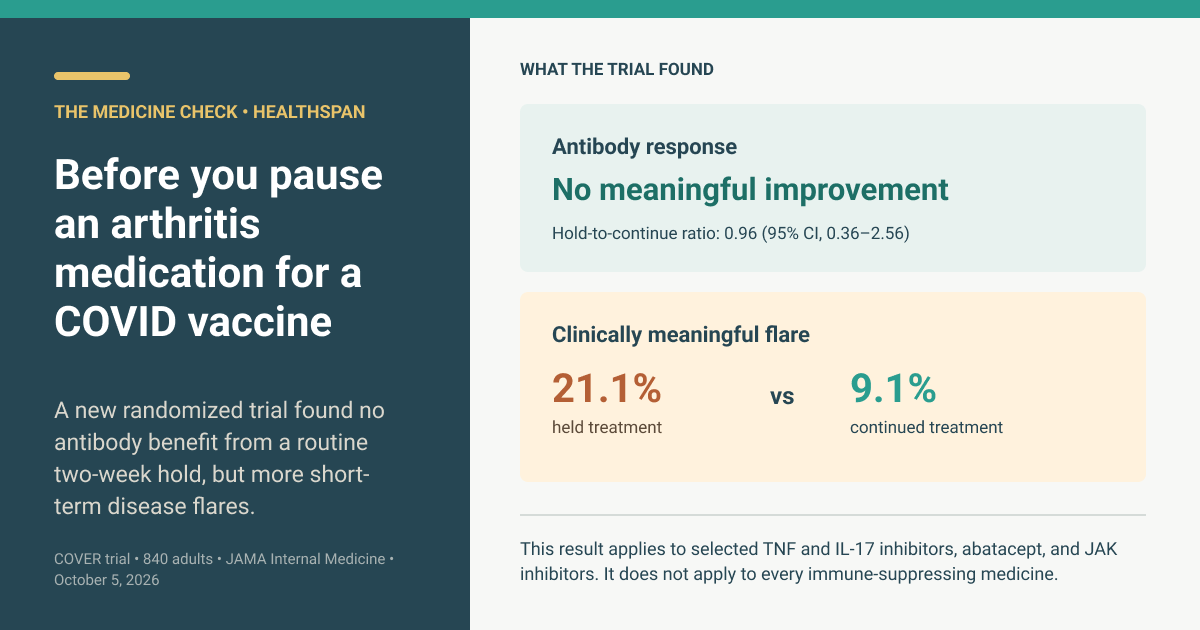
Among adults with stable inflammatory arthritis taking the selected medicines, holding treatment for two weeks after a COVID supplemental dose produced essentially the same antibody response as continuing treatment, while clinically meaningful symptoms of flare were reported by 21.1% of people in the hold group and 9.1% in the continue group during the early follow-up period. On that questionnaire, the comparison was 54 of 256 participants versus 23 of 253; these percentages do not use all 840 randomized participants as the denominator.
The antibody comparison was expressed as a hold-to-continue geometric mean fold-rise ratio of 0.96, with a 95% confidence interval from 0.36 to 2.56. In plain language, the study did not find the immune-response boost the medication hold was intended to create.
What the COVER trial tested
COVER was a pragmatic, multicenter, open-label randomized trial conducted at 29 rheumatology sites. Participants had rheumatoid arthritis, psoriatic arthritis, or axial spondyloarthritis, and their disease and treatment were stable when they enrolled. Their average age was about 60, and most participants were women.
The researchers assigned participants either to continue treatment as usual or to hold it for two weeks after a COVID supplemental vaccine dose. For injected or infused medicines, vaccination was scheduled near the end of the usual dosing interval. The study included selected TNF inhibitors, IL-17 inhibitors, abatacept, and JAK inhibitors, which are distinct drug groups with different mechanisms and dosing schedules.
The primary outcome was the change in antibodies against the virus spike protein six weeks after vaccination. The study also tracked patient-reported disease activity and adverse effects, including flare symptoms.
What changed when people held treatment
Antibodies did not improve in a meaningful or statistically persuasive way, and the investigators did not find evidence of benefit when they examined the medication groups separately. The flare signal moved in the other direction. The odds of flare were more than twice as high in the hold group, and the clearest patient-reported measure showed a 12 percentage point absolute difference: 21.1% with a hold versus 9.1% with continued treatment.
The reassuring part is that the difference was temporary. By six weeks, the groups had returned to similar disease-activity levels. The less reassuring part is that a temporary flare is not automatically trivial. More pain, stiffness, or fatigue can interrupt walking, exercise, sleep, work, caregiving, and the ordinary routines that keep strength and mobility intact. A short-lived tradeoff may be reasonable when it buys a meaningful benefit; in this trial, the intended antibody benefit did not appear.
General symptoms were also more common in the hold group, including fatigue and muscle or body aches. Those symptoms overlap with both vaccine reactions and inflammatory disease, which makes attribution difficult, but they reinforce the practical point that a pause can create a real burden even when a flare later settles.
Why the medication name changes the answer
It would be a mistake to turn this finding into “never hold arthritis medicine.” Methotrexate was not tested in COVER. Earlier randomized trials, including the VROOM study, found that a two-week pause in methotrexate after a COVID booster increased antibody levels, although flares were more common in the first month. Rituximab and other B-cell-depleting therapies create a different timing problem because they directly affect the cells that make antibodies. Steroids, combination therapy, live vaccines, and vaccines against other infections also require their own evidence and clinical judgment.
This is why a class-level instruction can fail you. Two medicines can both be called immune suppressing while having different effects on vaccine response, different consequences when treatment is interrupted, and different risks if the underlying disease becomes active. The useful question for your clinician is specific: what do we know about this vaccine and this medicine, at this dose and point in my treatment cycle, given how stable my disease is?
What this study cannot tell us
First, the researchers measured antibodies, not infections, hospitalization, severe COVID, disability, or survival. Antibody response is a useful immune marker, but it is not the same as a clinical outcome, and the trial did not measure cell-mediated immunity.
Second, participants knew whether they were holding treatment, and flare was largely self-reported. Expectations could have influenced symptom reporting. The investigators used multiple methods to address missing data, and physician-scored disease activity at six weeks did not show an important difference; however, the study did not systematically capture every rescue treatment or healthcare visit during a flare.
Third, the trial ran from late 2021 through 2024, across vaccine formulations and viral variants that differ from those in circulation now. The study was not designed to give a separate answer for older adults, frail adults, or people with unstable disease, and its six-week follow-up was short.
Finally, several pharmaceutical companies funded the trial, and multiple authors reported industry relationships. The paper states that sponsors had no role in the design, conduct, analysis, or publication decision. Randomization and the null primary result strengthen confidence in the main finding, but the funding and conflicts still belong in a transparent reading of the evidence.
A better conversation before your vaccine
Current CDC guidance says COVID vaccination generally should not be delayed solely because someone is taking immune-suppressing therapy, while also recognizing that timing may need to reflect the treatment, the underlying condition, and the likely immune response. That is a framework for shared planning, not a universal calendar.
Before the appointment, bring the exact medication name, dose, route, and schedule. Then ask:
- Was my medicine actually studied, or are we borrowing evidence from another drug?
- How stable is my disease, and what would a flare cost me in pain, sleep, mobility, or function?
- Are we trying to improve an antibody result, or is there evidence that timing changes infection or hospitalization risk?
- If a pause is reasonable, what symptoms should prompt me to restart treatment or call the office?
- Who will coordinate the timing among rheumatology, primary care, and the pharmacy?
Do not stop, delay, or reschedule a prescription medicine on your own. A vaccine plan should protect against infection without casually trading away disease control, and the balance can change with the medicine, your recent symptoms, other health conditions, and the vaccine being considered.
My takeaway
COVER gives us a useful negative result. For the selected TNF and IL-17 inhibitors, abatacept, and JAK inhibitors studied, a routine two-week hold after a COVID supplemental dose did not deliver the antibody advantage researchers hoped to see, and it caused more short-term flares. Continuing treatment should not be read as a rule for every person; it should be the starting point for a medicine-specific conversation rather than an automatic pause based on a broad category.
For Healthspan, the aim is not simply to maximize one laboratory number. It is to reduce infection risk while preserving the disease control, mobility, sleep, strength, and daily function that let you keep living your life.
Keep Building Your Healthspan
- Build your strongest foundation with the Longevity Ladder. See the practical habits that can help you move better, stay stronger, and support a longer, healthier life.
- See how well you are aging with the Age Well Score. Get a whole-person snapshot of the health, function, and lifestyle factors that shape aging well.
- Take a deeper look with the Healthspan Checkup Calculator. Review the key measures that influence long-term health, independence, and quality of life.
- Become a member for access to member-specific resources.
Sources
Central evidence and guidance
- Curtis JR, Mudano AS, Cutter G, et al. Temporary Cessation of DMARD Therapy and COVID-19 Supplemental Dose Vaccine Immunogenicity in Patients With Inflammatory Arthritis: The COVER Randomized Clinical Trial. JAMA Internal Medicine. Published online October 5, 2026. doi:10.1001/jamainternmed.2026.4894.
- Centers for Disease Control and Prevention. COVID-19 Vaccination Guidance for People Who Are Immunocompromised. Updated September 23, 2026.
- Abhishek A, Boyton RJ, Peckham N, et al. Effect of a 2-week interruption in methotrexate treatment versus continued treatment on COVID-19 booster vaccine immunity in adults with inflammatory conditions: the VROOM study. The Lancet Respiratory Medicine. 2022;10(9):840-850. doi:10.1016/S2213-2600(22)00186-2.
- Curtis JR, Johnson SR, Anthony DD, et al. American College of Rheumatology Guidance for COVID-19 Vaccination in Patients With Rheumatic and Musculoskeletal Diseases: Version 5. Arthritis & Rheumatology. 2023;75(1):E1-E16. doi:10.1002/art.42372.
Evidence review note: The supplied draft reports full-text review of COVER, VROOM, ACR guidance, and CDC guidance. Before publication, the COVER abstract and current CDC guidance were independently checked against the reported central findings. Last reviewed October 11, 2026.
Evidence strength: Moderate to strong for the narrow conclusion that a routine two-week hold of the selected biologic and JAK therapies did not improve the measured antibody response and increased short-term flare risk. Confidence is lower for clinical protection, older or frail subgroups, current variants and formulations, longer-term outcomes, and medicines not studied.
Educational information only. Do not stop or delay a prescription medicine without guidance from the prescribing clinician. The results concern the selected medicines and antibody response, not a demonstrated reduction in infections or hospitalization.