You are standing at the pharmacy counter with a prescription for an overactive bladder medicine, and the warning you remember is not about dry mouth or constipation. It is about memory. Perhaps you have read that anticholinergic medicines may raise dementia risk, or perhaps a clinician suggested a newer beta-3 agonist partly because it seemed less likely to affect the brain. Then a large new study appears to point in the opposite direction. What are you supposed to do with that?
My answer is straightforward: use the new study to improve the medication conversation, but do not use it as permission to declare either drug class cognitively safe, harmful, or protective. The result is important because it challenges an assumption that had begun to feel settled; however, the study design leaves several credible explanations for what the researchers observed, and those explanations matter before anyone changes care.
What the new study found
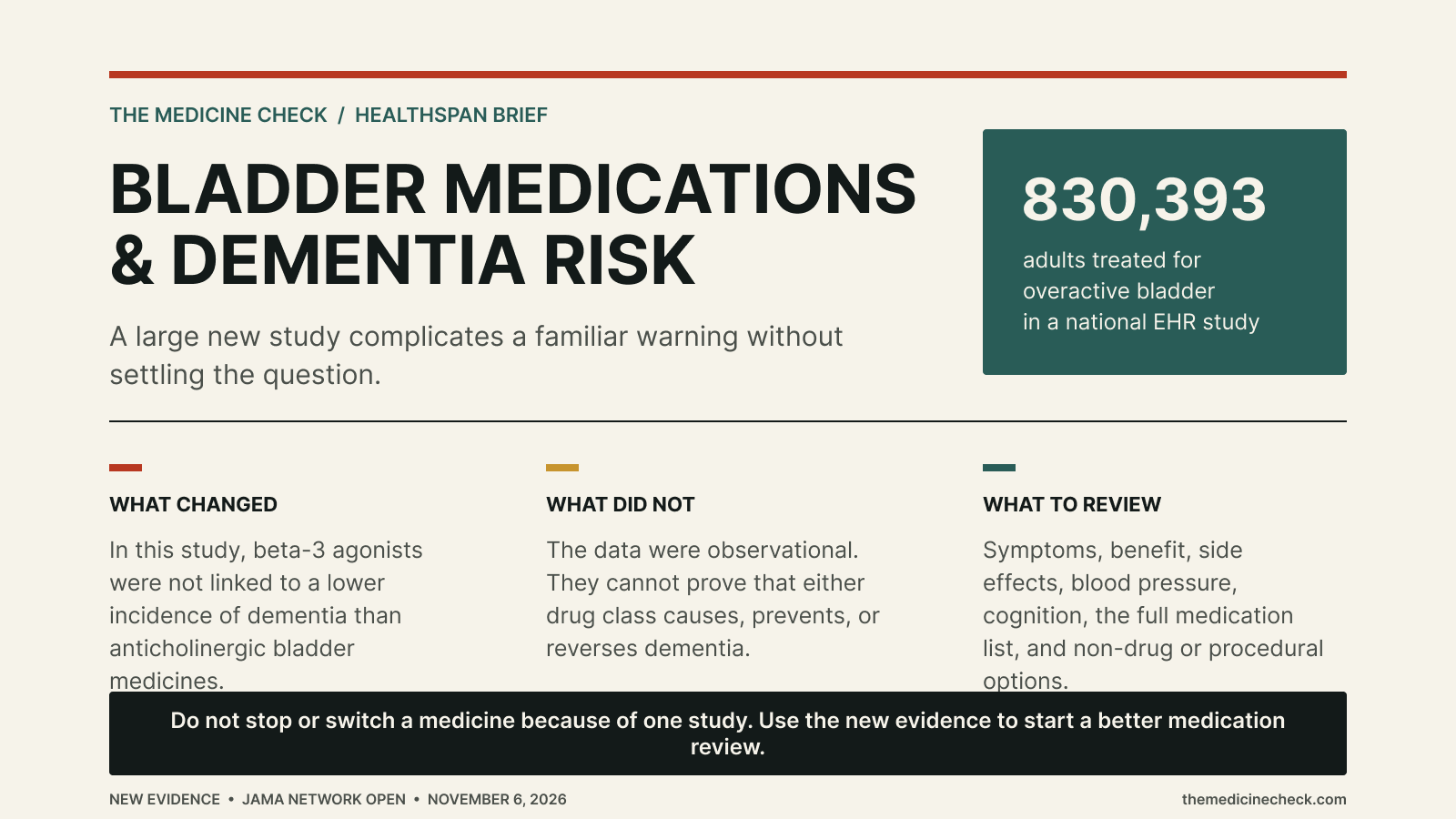
Published November 6 in JAMA Network Open, the study used a national electronic health record database to follow 830,393 adults, ages 40 to 90, who started drug treatment for overactive bladder between 2012 and 2025. The median age was 67. Researchers compared three groups: 208,312 people who started a beta-3 agonist, 49,592 who started an anticholinergic classified as lower cognitive risk, and 572,489 who started an anticholinergic classified as higher cognitive risk.
Over follow-up that was typically about three to four years, 65,134 people received a new dementia diagnosis. After statistical adjustment, the group taking higher-risk anticholinergics had a 10% lower recorded rate of dementia than the beta-3 group, and the lower-risk anticholinergic group did not differ clearly from the beta-3 group (hazard ratio 0.97; 95% confidence interval 0.93 to 1.01). The model estimated 10-year dementia risks of 20.0% with beta-3 agonists, 19.0% with lower-risk anticholinergics, and 18.1% with higher-risk anticholinergics.
Those numbers are surprising. They are not proof that anticholinergic bladder medicines protect the brain. They tell us that, in this health record analysis, the expected dementia advantage for beta-3 agonists did not appear. That is a reason to recheck the evidence, not to reverse the warning label in our heads.
Why the result is not a green light
This was an observational study, not a randomized trial. Clinicians and patients chose the treatments, and those choices were probably influenced by factors the database could not fully measure. A clinician who already worries about a patient’s memory, frailty, falls, or total anticholinergic burden may preferentially prescribe a beta-3 agonist. If that patient was already on a path toward dementia, the beta-3 group could accumulate more diagnoses even when the medicine itself did not increase risk. Researchers call this channeling bias or confounding by indication.
Overactive bladder can also precede or accompany neurologic and vascular disease. Urgency, nocturia, sleep disruption, mobility limits, and early cognitive change may travel together before dementia is formally diagnosed. Electronic records capture diagnoses and prescriptions reasonably well, but they do not capture every early symptom, adherence pattern, nonprescription medicine, cumulative exposure before entry, or clinician judgment that shaped the choice. The authors calculated that even modest unmeasured confounding could erase the apparent difference between groups.
There are other reasons to stay cautious. Follow-up differed between treatment groups, dementia diagnosis in routine care is imperfect, and a modeled 10-year risk extends beyond the typical observed follow-up. The study is large and thoughtfully analyzed, but size does not convert a nonrandomized comparison into a causal experiment.
Why earlier studies do not give one clean answer
Earlier observational studies have often found the association people expect. Cohorts from Ontario and Japan reported roughly 22% to 23% higher dementia rates with anticholinergic bladder medicines than with beta-3 agonists. A 2025 meta-analysis also reported higher risk, but the studies disagreed sharply with one another, with statistical heterogeneity above 95%. A Danish study found higher dementia risk when anticholinergics were compared with nonuse, yet not when they were compared directly with mirabegron, a beta-3 agonist. Comparator choice can change the answer because people who receive no treatment, an anticholinergic, or a beta-3 agonist may differ before treatment begins.
This is exactly the kind of evidence problem that deserves humility. A biological concern remains plausible because strongly anticholinergic medicines can affect attention and cognition, especially when several such medicines are combined. At the same time, long-latency dementia is difficult to study, prescribing is not random, and the conditions that lead to a prescription may themselves be associated with cognitive decline. We do not yet have a large, long randomized trial designed to settle dementia incidence across these treatments.
What current guidance still says
The 2024 American Urological Association and SUFU guideline recommends that clinicians discuss the potential dementia and cognitive risks of antimuscarinic medicines and use shared decision-making around side effects. It also recommends bladder training and behavioral therapies for everyone with overactive bladder, and it recognizes minimally invasive procedures when medicines do not work or are not tolerated. The American Geriatrics Society Beers Criteria lists bladder antimuscarinics among strongly anticholinergic medicines; oxybutynin has the strongest evidence for adverse cognitive effects, while the criteria advise caution with the entire group.
Beta-3 agonists avoid anticholinergic effects, but they are not consequence-free. Mirabegron can raise blood pressure and is not recommended for people with severe uncontrolled hypertension; beta-3 agonists can also contribute to urinary retention in susceptible patients, and cost or insurance coverage may influence whether a treatment is practical. A medicine can be preferable for one person without being universally safer for every outcome.
A better medication review
If you take an overactive bladder medicine, the useful next step is not to rank drug classes from a headline. It is to review the whole treatment decision, because the healthspan goal is larger than avoiding one theoretical risk. You are trying to reduce urgency, leakage, disrupted sleep, falls on the way to the bathroom, social restriction, and the loss of confidence that can shrink daily life, while also limiting side effects and preserving cognition, blood pressure control, bowel function, and independence.
- Start with benefit. What has changed since the medicine began: urgency, leakage, nighttime trips, sleep, confidence, activity, and quality of life?
- Review the complete medication list. Bladder medicines are only one source of anticholinergic burden; some sleep aids, antihistamines, antidepressants, and other prescriptions or over-the-counter products can add to it.
- Name possible harms. New confusion, daytime sedation, dry mouth, constipation, blurred vision, difficulty emptying the bladder, dizziness, or falls deserve attention, especially after a new medicine or dose change.
- Match monitoring to the treatment. Blood pressure and urinary retention may matter with beta-3 agonists; cognition, bowel function, dry mouth, and total anticholinergic exposure may matter with antimuscarinics.
- Ask about non-drug options. Bladder training, fluid and caffeine timing, pelvic floor therapy, constipation treatment, mobility support, and selected procedures may reduce symptoms or the need for medication, depending on the cause and severity.
- Revisit the decision. A medicine that was reasonable three years ago may deserve another look after new diagnoses, falls, blood pressure changes, cognitive symptoms, kidney changes, or additions to the medication list.
Do not stop or switch a prescription on your own because of this study. Sudden changes can restore urgency, leakage, and nighttime bathroom trips, and those symptoms have their own consequences. Bring the article, the bottle, and an updated medication list to the clinician or pharmacist who can weigh your history and alternatives.
My read on the evidence
The new study earns attention because it is large, recent, and directly compares treatments that patients actually use. It weakens the claim that current observational evidence proves beta-3 agonists reduce dementia risk relative to anticholinergic bladder medicines. It does not establish the reverse, and it does not erase the known short-term anticholinergic effects or the reason older-adult prescribing guidance remains cautious.
For now, the most defensible position is neither alarm nor reassurance. Treat bladder symptoms because they affect sleep, mobility, participation, and independence; review anticholinergic burden because cognitive and functional side effects can be meaningful; and choose among behavioral care, medicines, and procedures through an individualized discussion that can be revisited as your health changes. Better evidence may eventually sharpen the dementia answer. Today, a better review is the action the evidence can support.
Keep Building Your Healthspan
- Build your strongest foundation with the Longevity Ladder. See the practical habits that can help you move better, stay stronger, and support a longer, healthier life.
- See how well you are aging with the Age Well Score. Get a whole-person snapshot of the health, function, and lifestyle factors that shape aging well.
- Take a deeper look with the Healthspan Checkup Calculator. Review the key measures that influence long-term health, independence, and quality of life.
- Become a member for access to member-specific resources.
Sources
Source review: November 8, 2026.
Review status key: “Full text reviewed” means the complete article or guidance document was examined. “Abstract-only reviewed” means interpretation was limited to the available abstract and metadata.
Drug Therapies and Incidence of Dementia Among Adults With Overactive Bladder [Full text reviewed] JAMA Network Open. Published November 6, 2026. DOI: 10.1001/jamanetworkopen.2026.42026.
Comparative Safety of Overactive Bladder Treatments: Unexpected Results in Context [Full text reviewed] Invited commentary. JAMA Network Open. Published November 6, 2026. DOI: 10.1001/jamanetworkopen.2026.42034.
AUA/SUFU Guideline on the Diagnosis and Treatment of Idiopathic Overactive Bladder [Full text reviewed] American Urological Association and Society of Urodynamics, Female Pelvic Medicine & Urogenital Reconstruction, 2024.
American Geriatrics Society 2023 Updated AGS Beers Criteria [Full text reviewed] Medication-safety guidance for older adults, including strongly anticholinergic bladder medicines.
Mirabegron prescribing information [Full text reviewed] DailyMed label information on blood pressure and urinary retention warnings.
Risks of Dementia Associated With Anticholinergic Medication Compared to Beta-3 Agonist Medication [Abstract-only reviewed] 2025 Japanese LIFE cohort; adjusted hazard ratio 1.22 for anticholinergics versus beta-3 agonists.
Increased Risk of Dementia Among Patients With Overactive Bladder Treated With an Anticholinergic Medication Compared to a Beta-3 Agonist [Abstract-only reviewed] 2020 Ontario cohort; adjusted hazard ratio 1.23.
Bladder Drugs and Risk of Dementia: Danish Nationwide Active Comparator Study [Abstract-only reviewed] 2025 study illustrating how the association changed with comparator choice.
Risk of Dementia or Cognitive Impairment With Anticholinergic Use for Overactive Bladder: Systematic Review and Meta-analysis [Abstract-only reviewed] 2025 meta-analysis; higher pooled risk estimates with very high between-study heterogeneity.
Educational information only. This article does not provide individualized medical advice. Review personal treatment decisions with your clinician or pharmacist.