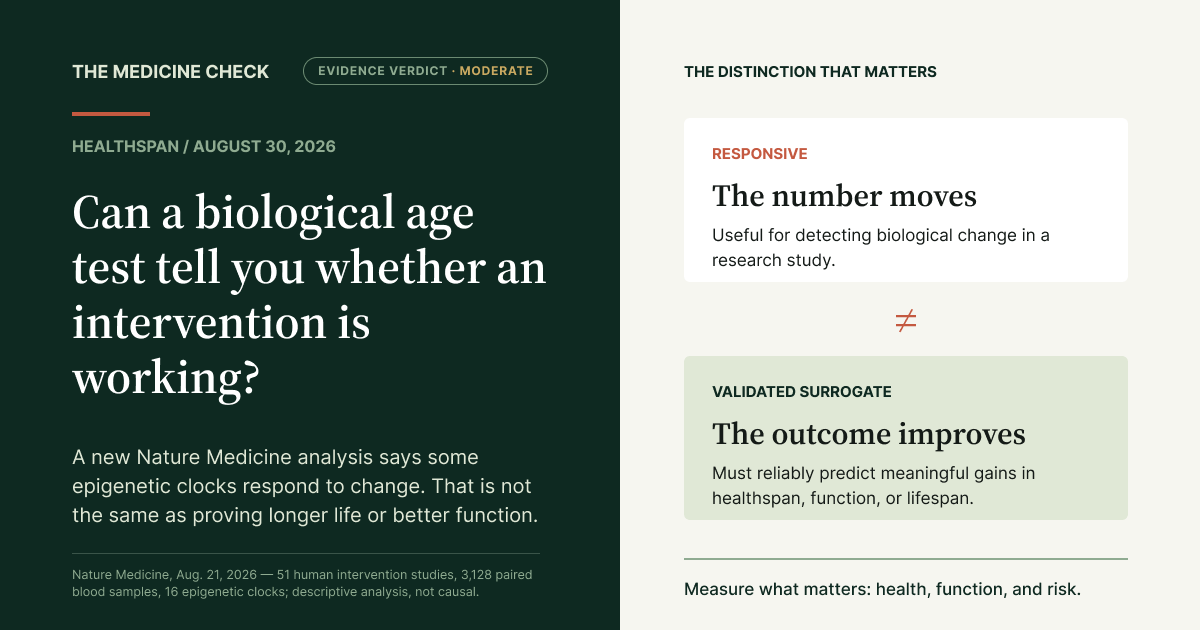
A biological age test can produce a precise-looking number, sometimes down to a decimal place, and that number may rise or fall after a new diet, exercise program, supplement, or medication. The temptation is obvious: if the score falls, the intervention must be slowing aging. A new Nature Medicine study gives us a better basis for judging that claim, and its message is both encouraging and limiting.
Some DNA methylation clocks do respond when biology changes, especially newer clocks trained to estimate mortality risk or the pace of aging. They may become useful research tools for detecting signals over months or years rather than waiting decades for disease, disability, or death. Yet responsiveness is only the first test of a biomarker. The study did not show that lowering an epigenetic age score makes a person live longer, preserves mobility, prevents dementia, or improves quality of life.
That distinction matters because a number can move for reasons that are biologically interesting without being a reliable report card for Healthspan. For now, biological age tests are better understood as research measurements than as verdicts on whether your personal longevity plan is working.
What the New Study Tested
Researchers assembled TranslAGE, a harmonized collection of 51 longitudinal human intervention studies with 3,128 pre- and post-intervention blood samples. The studies differed widely: some involved lifestyle changes, diets, supplements, medical procedures, or medications. Participants also varied in age, health status, study duration, and underlying disease.
The team recalculated the same 16 prominent epigenetic clocks across the available data, along with 94 additional DNA methylation biomarkers that help explain what may be driving a clock's score. This common pipeline is the study's main strength. Instead of comparing a diet study that used one clock with a medication study that used another, the researchers asked how the same set of measures behaved across many interventions.
An epigenetic clock looks at chemical tags called methyl groups attached to DNA. These tags can reflect chronological age, smoking exposure, inflammation, metabolic health, blood-cell composition, and other influences. Different clocks are trained to predict different targets, so two tests can give different answers for the same person without either laboratory having made a simple arithmetic error.
What Changed, and What Did Not
The newer second-generation clocks, including measures designed around mortality risk or pace of aging, were generally more responsive than first-generation clocks built mainly to estimate calendar age. DunedinPACE showed comparatively large responses, while PCGrimAge produced many statistically significant results. Several system-specific clocks also helped show whether an apparent change tracked inflammation, metabolism, or another pathway.
Across broad categories, pharmacologic and lifestyle interventions produced the clearest average reductions in epigenetic-age measures, while supplements did not show the same reliable category-level effect. The investigators also found consistent clock changes in studies of anti-TNF drugs used for inflammatory disease and in several metformin datasets. Those findings should not be translated into a recommendation to take either treatment for longevity. Treating active inflammation or metabolic disease may change signals embedded in a clock, and the analysis was not designed to establish that these drugs slow aging in healthy people.
This is why the paper is more useful for designing trials than for choosing a personal intervention. It suggests which clocks may be sensitive enough to detect change, which populations may produce a measurable signal, and how study duration affects responsiveness. It does not rank treatments by their ability to extend life or preserve independence.
Responsive Is Not the Same as Validated
A responsive biomarker changes after an intervention. A validated surrogate endpoint goes much further: a treatment-induced change in the marker must reliably predict the magnitude of change in a meaningful outcome. Blood pressure can serve as a surrogate in some cardiovascular contexts because lowering it through proven therapies predicts fewer events. Epigenetic age has not cleared that bar for Healthspan or lifespan.
The study's authors state this limitation directly. There is no empirically established minimal clinically important difference for an epigenetic clock, meaning we do not know how large a change must be before it matters to function, disease risk, or survival. A clock may also respond because one of its ingredients, such as an inflammation-related signal, improved. That can be welcome, but it does not prove that the underlying rate of aging changed as a whole.
The pooled studies also varied in quality, sample size, duration, population, and design, and preprocessing was not fully harmonized across every dataset. The authors used paired pre-post comparisons and multiple-testing corrections, but their purpose was descriptive rather than causal. The analysis tells us which instruments detect movement. It does not tell us whether the movement caused better aging.
How to Read a Personal Biological Age Result
A commercial biological age result may still be interesting, particularly if it motivates a thoughtful conversation about health, but it deserves the same questions we would ask of any measurement sold with a large promise:
- Which clock is being used? A clock trained to estimate chronological age is not equivalent to one trained on mortality risk or pace of aging.
- How reproducible is it? Ask about test-retest reliability, laboratory variation, and whether a change exceeds expected measurement noise.
- What outcome has it been validated against? Prediction of risk in a population is different from proving that changing the score changes an individual's outcome.
- Could ordinary biology explain the shift? Illness, inflammation, smoking status, weight change, medications, and the mixture of blood-cell types can influence methylation measures.
- Will the result change a sound decision? Do not start, stop, or substitute a prescription medicine or supplement because a clock moved without discussing the underlying health question with a qualified clinician.
Measure What Matters for Healthspan
The most useful Healthspan dashboard is still built from outcomes and risk factors with clearer clinical meaning: blood pressure, lipid and glucose control when relevant, tobacco exposure, vaccination and screening status, cardiorespiratory fitness, strength, gait and balance, sleep, cognitive concerns, and the ability to do the things that matter in daily life. These measures are not as novel as a single biological-age score, but they are closer to the outcomes we are trying to protect.
The new study is an important step because longevity trials need faster ways to identify promising signals. Better biomarkers could shorten studies, reduce cost, and help researchers decide which interventions deserve larger trials. The responsible sequence, however, is to prove that a clock is responsive, then show that intervention-driven changes predict meaningful outcomes, and only then decide how it belongs in clinical care.
The Reasonable Takeaway
Epigenetic clocks are becoming more capable research instruments, and this analysis helps separate the more responsive clocks from the less informative ones. That progress should not be mistaken for proof that a consumer test can certify age reversal. A lower score may be a signal worth studying. It is not yet evidence that you have added healthy years to your life.
If a biological age result supports curiosity without displacing proven care, it can be one piece of information. The larger goal remains less glamorous and more consequential: preserve function, reduce established risks, and keep enough physical and cognitive reserve to remain independent.
Keep Building Your Healthspan
Build your strongest foundation with the Longevity Ladder and see the practical habits that can help you move better, stay stronger, and support a longer, healthier life.
Take the Age Well Score for a whole-person snapshot of the health, function, and lifestyle factors that shape aging well.
Use the Healthspan Checkup Calculator to review the key measures that influence long-term health, independence, and quality of life.
Become a member for access to member resources.
Sources
Sehgal R, Borrus D, Kasamato J, et al. Responsiveness of epigenetic aging biomarkers to longevity interventions in humans. Nature Medicine. Published August 21, 2026. Full text reviewed.
Moqri M, Herzog C, Poganik JR, et al. Biomarkers of aging for the identification and evaluation of longevity interventions. Cell. 2023;186(18):3758-3775. Full text reviewed.
Cummings SR, Kritchevsky SB. Endpoints for geroscience clinical trials: health outcomes, biomarkers, and biologic age. GeroScience. 2022;44:2925-2931. Full text reviewed.
Educational information only. This article does not recommend biological-age testing or the use of metformin, anti-TNF therapy, supplements, or any other intervention for longevity. Medication decisions require individualized clinical care.