Evidence verdict
Moderate. A large synthesis of randomized trials supports small, site-specific bone-density benefits from exercise; modality rankings, dose thresholds, and fracture estimates remain less certain.
For bone health, the most useful exercise question is not which single activity won a ranking; it is whether a weekly routine gives the skeleton enough loading, gives the muscles enough resistance, and gives balance enough attention to reduce the chance that a stumble becomes a fracture.
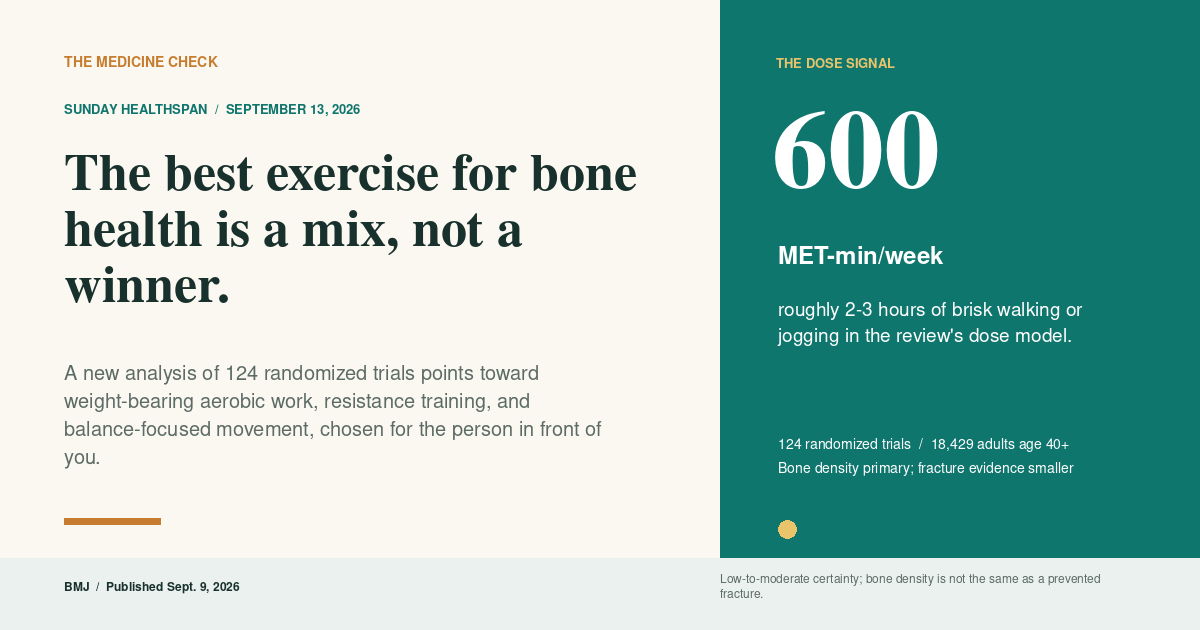
A review published in The BMJ on September 9, 2026, helps sharpen that question. Researchers combined 124 randomized trials involving 18,429 adults age 40 and older, compared several forms of structured exercise, and modeled how exercise type and weekly dose related to bone mineral density at the lumbar spine, femoral neck, and total hip. The results support exercise as part of bone-health care, but they also argue against a simplistic winner.
What the new review found
Brisk walking or jogging and programs that combined aerobic and resistance exercise produced some of the most favorable estimates for lumbar-spine bone mineral density. Brisk walking or jogging also ranked favorably at the femoral neck and total hip, while mind-body exercise, a category that can include practices such as tai chi, showed a favorable estimate at the femoral neck.
The average changes were modest and site-specific. Compared with a nonexercise control, the estimated improvement in lumbar-spine bone mineral density was 0.013 grams per square centimeter for both brisk walking or jogging and combined aerobic-resistance exercise; at the femoral neck, the estimate was 0.009 for brisk walking or jogging and 0.007 for mind-body exercise. At the total hip, brisk walking or jogging had the most favorable estimate, 0.021, but that comparison was supported by only 68 participants across three trials, which makes the ranking less secure than the headline may imply.
The researchers also modeled dose. Their estimates suggested that a clinically meaningful change might begin around 400 MET-minutes per week for the lumbar spine and roughly 600 for the femoral neck and total hip; the paper translated 600 MET-minutes to about two to three hours of brisk walking or jogging per week. MET-minutes combine intensity and time, so 600 is not simply a step count or a prescription for three identical workouts.
The dose curves were generally shaped like an upside-down U, with modeled benefits peaking around 900 to 1,060 MET-minutes per week depending on the bone site. That pattern is interesting, but it should not be read as evidence that more exercise becomes harmful after an exact threshold; dose-response modeling across different trials is less reliable than directly randomizing people to several well-defined doses.
Bone density is not the whole Healthspan outcome
Bone mineral density matters because it is related to bone strength and fracture risk, yet it remains a surrogate outcome. A fracture depends on the strength of the bone, the force and direction of a fall, muscle response, balance, vision, medications, home hazards, and other factors that a scan cannot capture.
Only 26 of the 124 trials, involving 11,132 participants, contributed fracture outcomes. Mixed aerobic exercise and mind-body exercise were associated with fewer fractures in that smaller analysis, but the evidence was rated low certainty; the review therefore gives more confidence that exercise can modestly influence bone density than that a particular modality will prevent a fracture for a particular person.
This distinction is central to healthy aging. A person can gain more from an exercise plan than a small change on a DXA scan: stronger legs can make stairs and chair rises easier, better balance can reduce falls, and aerobic capacity can preserve the reserve needed to recover from illness. Conversely, a person with very low bone density can have a well-designed exercise routine and still need evaluation and evidence-based medication.
Why the answer is a mix
The review compared categories, but real-world bone protection has several jobs. Weight-bearing activity loads the skeleton; resistance exercise creates muscular force across bone while supporting strength and function; balance and gait work reduce the chance of falling. A routine built around only one of those jobs can leave an important gap.
That broader interpretation also fits existing guidance. The Bone Health and Osteoporosis Foundation emphasizes both weight-bearing and muscle-strengthening activity, while federal physical activity guidance for older adults adds balance and functional training. The U.S. Preventive Services Task Force recommends exercise interventions for community-dwelling adults 65 and older who are at increased risk for falls; the programs it reviewed most often included gait, balance, functional training, and resistance work.
In other words, walking is useful, but walking is not the entire bone-health plan. Resistance work may be especially important for maintaining the strength that supports daily function, and balance work targets a pathway to fracture that bone density alone does not measure.
The important safety caveat
The paper groups brisk walking and jogging together, but those are not interchangeable for every reader. Jogging and other higher-impact activities may be reasonable for some adults; for people with osteoporosis, a prior fragility fracture, poor balance, severe joint pain, dizziness, substantial deconditioning, or a high risk of falling, they may be inappropriate without individualized assessment.
The Bone Health and Osteoporosis Foundation advises people who have had an osteoporosis-related fracture or are at high fracture risk to ask a clinician whether high-impact exercise should be avoided. It also warns that some repeated forward-bending, forceful twisting, or loaded spinal-flexion movements can be unsafe after vertebral fracture. A physical therapist can help select loading that is challenging enough to matter without creating avoidable risk.
This is not a reason to avoid movement; it is a reason to match movement to current capacity. Fast walking, stair climbing, sit-to-stands, bands, free weights, machines, tai chi, and supervised multicomponent programs can all play a role, but the safest mix depends on bone density, fracture history, strength, balance, pain, cardiovascular health, medications, and experience.
A practical bone-health check-in
Use the new study as a conversation starter, then build around four questions:
- Are you loading bone? Include a safe form of weight-bearing aerobic activity that raises effort above an easy stroll when your health and mobility allow.
- Are you building strength? Include progressive resistance for the hips, legs, back, and upper body, with technique and load adapted to fracture and joint risk.
- Are you training not to fall? Add balance, gait, and functional movements rather than assuming aerobic activity covers them.
- Do you know your baseline risk? A history of falls, a fracture after age 50, height loss, long-term glucocorticoid use, low body weight, or other risk factors should prompt a clinical conversation; exercise does not replace screening or treatment.
Current USPSTF guidance recommends osteoporosis screening for women 65 and older and for younger postmenopausal women at increased risk after clinical risk assessment. For men, the Task Force found insufficient evidence for a population-wide recommendation, so clinicians use individual judgment. Screening matters because only 40% to 60% of people who experience a hip fracture recover their prior mobility and ability to perform daily activities.
The most reasonable takeaway
The BMJ review strengthens the case that accessible, moderate amounts of structured exercise can help slow age-related bone loss; it does not prove that 600 MET-minutes is the correct target for everyone, that jogging is safe for everyone, or that one exercise category prevents fractures by itself.
The better Healthspan strategy is a durable mix: safe weight-bearing activity, progressive strength work, balance practice, and appropriate screening or treatment when risk is elevated. The goal is not merely a stronger scan. It is a body that can absorb load, recover balance, remain mobile, and preserve independence.
Keep Building Your Healthspan
- Build your strongest foundation with the Longevity Ladder. See the practical habits that can help you move better, stay stronger, and support a longer, healthier life.
- See how well you are aging with the Age Well Score. Get a whole-person snapshot of the health, function, and lifestyle factors that shape aging well.
- Take a deeper look with the Healthspan Checkup Calculator. Review the key measures that influence long-term health, independence, and quality of life.
- Become a member for access to member-specific resources.
Sources
1. Lu C, Li L, Zhang L, et al. Effect of exercise on bone health in middle aged and older adults: hierarchical network meta-analysis of randomised trials. BMJ. 2026;394:e100561. Published September 9, 2026. DOI: 10.1136/bmj-2026-100561. Source link Abstract and indexed article passages reviewed.
2. Feng H, Xie Z, Wang Y, et al. Effectiveness of different exercise types for improving bone mineral density in adults: a pairwise, network, and dose-response meta-analysis of 162 randomized controlled trials. Bone. 2026;118044. DOI: 10.1016/j.bone.2026.118044. Source link Abstract and indexed record reviewed.
3. U.S. Preventive Services Task Force. Falls Prevention in Community-Dwelling Older Adults: Interventions. June 4, 2024. Source link Full web guidance reviewed.
4. Bone Health & Osteoporosis Foundation. Weight-Bearing and Muscle-Strengthening Exercises; Starting a New Exercise Program. Source link Full web guidance reviewed.
5. Centers for Disease Control and Prevention. Preventing Falls and Hip Fractures. Updated January 27, 2026. Source link Full web guidance reviewed.
6. U.S. Preventive Services Task Force. Osteoporosis to Prevent Fractures: Screening. January 14, 2025. Source link Full recommendation reviewed.
Educational information only. This article provides general health and exercise information and does not replace individualized medical evaluation. Exercise needs and safe intensity vary with bone health, fracture history, symptoms, medications, function, and experience.