The warning inside the July jobs report
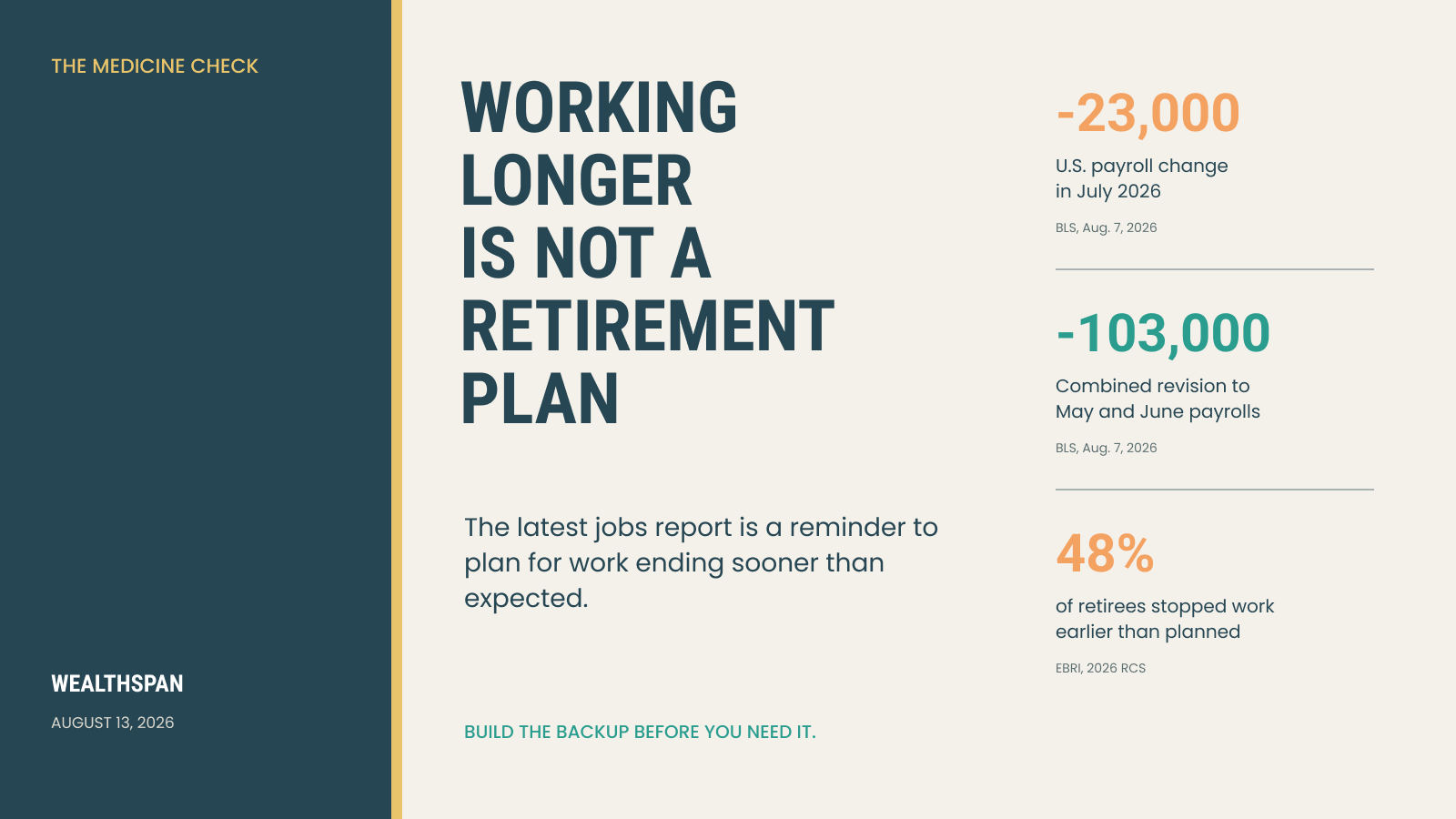
On August 7, the Bureau of Labor Statistics reported that U.S. nonfarm payrolls fell by 23,000 in July. The agency also revised May and June down by a combined 103,000 jobs. The unemployment rate was 4.1%, but labor-force participation had fallen 0.7 percentage point since January.
One monthly report cannot tell us that a recession has begun, and a large drop in local-government education employment may have been influenced by seasonal adjustment. Private payrolls still grew, layoffs remained low by historical standards, and health care added 22,000 jobs. The responsible conclusion is narrower: hiring has less momentum, and finding a new job may be harder than the headline unemployment rate suggests.
That matters to Wealthspan because many retirement plans contain an assumption that is rarely labeled as a risk: "I can always work a few more years." Work is a valuable asset. It can add savings, preserve employer health coverage, shorten the period a portfolio must support, and allow a later Social Security claim. But it is not a guaranteed asset.
Planned retirement age and actual retirement age are different numbers
The 2026 Retirement Confidence Survey from the Employee Benefit Research Institute and Greenwald Research makes the gap visible. Workers reported a median expected retirement age of 65. Retirees reported a median actual retirement age of 62.
Nearly half of retirees in the survey, 48%, said they retired earlier than planned. Among that group, 76% attributed the early exit to something outside their control. Health problems or disability were the most common reason, followed by being able to afford an earlier retirement and workplace changes such as downsizing, closure, or reorganization.
The survey does not prove that a weaker national jobs report will force any individual to retire early. It is self-reported, and the people surveyed differ in health, occupation, income, benefits, and household circumstances. Still, it captures a durable planning fact: the date someone expects to stop working is not always the date employment actually ends.
Why an older worker can have less room to recover
Job loss is disruptive at any age. Near retirement, the damage can spread across several parts of a plan at once: current income stops, retirement contributions pause, employer matching disappears, health coverage may change, and savings may be tapped sooner than expected.
Older workers may also face a longer search. AARP's review of June labor data found that adults ages 55 to 64 had been unemployed for an average of 32.3 weeks, compared with 23.7 weeks across all ages. A 2018 Urban Institute analysis of Health and Retirement Study data found that about half of full-time, full-year workers ages 51 to 54 experienced an employer-related involuntary job separation after age 50 that substantially reduced earnings for years or led to long-term unemployment.
Those findings come from different periods and should not be read as a forecast for today. Their value is structural: losing work late in a career can be harder to reverse because there is less time to rebuild earnings, benefits, and savings before retirement.
Build a retirement plan that can absorb an earlier exit
1. Separate the retirement date from the employment assumption
A retirement projection may show a target age, but the key question is what happens if full-time work ends one, three, or five years earlier. Run more than one scenario. The goal is not to predict the exact year; it is to see which parts of the plan fail first when earned income stops sooner.
Pay attention to essential spending, debt payments, health insurance, pension eligibility, Social Security timing, and the amount of savings that must be drawn before the original target date. A scenario is useful when it reveals a decision, not when it produces false precision.
2. Make the health-coverage bridge explicit
For someone who leaves work before Medicare eligibility, health insurance may be the largest immediate complication. COBRA, a spouse's plan, Marketplace coverage, retiree coverage, or another option can have very different premiums, networks, deductibles, and eligibility rules.
The backup plan should name the plausible coverage routes and estimate their total annual cost, not just the premium. It should also account for medications, ongoing care, dental and vision expenses, and the possibility that a health problem is the reason work ended in the first place.
3. Protect a liquid runway
A household may have substantial net worth and still lack accessible money for a job interruption. Retirement accounts, home equity, and other long-term assets do not all function like cash. A liquid reserve can reduce pressure to take retirement distributions, claim Social Security immediately, carry expensive debt, or sell investments solely because a paycheck stopped.
There is no universal reserve target. The appropriate amount depends on fixed expenses, insurance, job stability, household income sources, access to credit, taxes, and how quickly spending can adjust. The useful exercise is to estimate the first several months of essential costs and identify which resources are actually available without a major penalty or delay.
4. Treat employability as part of Wealthspan
A backup is not only a pile of money. It can include current credentials, a live professional network, comfort with job-search technology, knowledge of flexible or less physically demanding roles, and an honest view of what work remains sustainable.
The Government Accountability Office reported in March that workers 55 and older now represent 23% of the workforce, up from 15% two decades earlier. Older workers interviewed by GAO described wanting jobs that met financial needs while offering medical benefits, flexibility, purpose, and work that was less physically demanding. They also described barriers involving technology, skills, application processes, and possible age discrimination.
Keeping skills and relationships current does not guarantee reemployment. It does widen the set of choices available if a full-time role changes or ends.
What not to do after one weak report
This is not a case for abandoning long-term investments, rushing to claim Social Security, or assuming unemployment is imminent. The July numbers will be revised again, and monthly labor reports are noisy. Market and retirement decisions made from a single release can create more damage than the data justify.
The better use of the report is as a stress test. If a retirement plan works only when the current job continues to a precise age, the plan has a concentration risk. The response is to build flexibility across spending, liquidity, insurance, skills, and timing.
Make working longer the upside, not the rescue plan
Working longer can be one of the most powerful ways to improve retirement security. The problem begins when it is the only strategy available.
A resilient Wealthspan plan allows continued work to strengthen the outcome while preserving a reasonable path if health, caregiving, a reorganization, or a weaker labor market closes that option early. The question is not whether you intend to work longer. It is whether the rest of the plan can stand if you cannot.
Keep building your Wealthspan
Explore the Wealthspan Wheel to see how cash flow, savings, protection, healthcare planning, and long-term goals work together to support financial resilience.
Use the Retirement Healthcare Cost Calculator to estimate a major retirement expense.
Check your progress with the Retirement Readiness Calculator and see whether your current savings path may support the retirement you are working toward.
Take the Wealthspan Checkup to review the financial building blocks that can strengthen flexibility, independence, and confidence over time.
Sources
U.S. Bureau of Labor Statistics. The Employment Situation - July 2026. Released August 7, 2026.
Employee Benefit Research Institute and Greenwald Research. 2026 Retirement Confidence Survey. Online survey of 2,544 U.S. adults age 25 and older, including 1,007 workers and 1,045 retirees, plus a caregiver oversample.
U.S. Government Accountability Office. Older Americans Are Working Longer - How Do We Support Them? March 3, 2026.
Johnson RW and Gosselin P. How Secure Is Employment at Older Ages? Urban Institute, December 28, 2018.
Associated Press. A sudden stall in the U.S. job market: Employers cut 23,000 jobs in July. August 7, 2026. Secondary context on the monthly report and seasonal-adjustment caveat.
Educational information only. The July employment figures are preliminary and subject to revision. This article does not provide individualized financial, investment, retirement, insurance, tax, employment, legal, or medical advice.