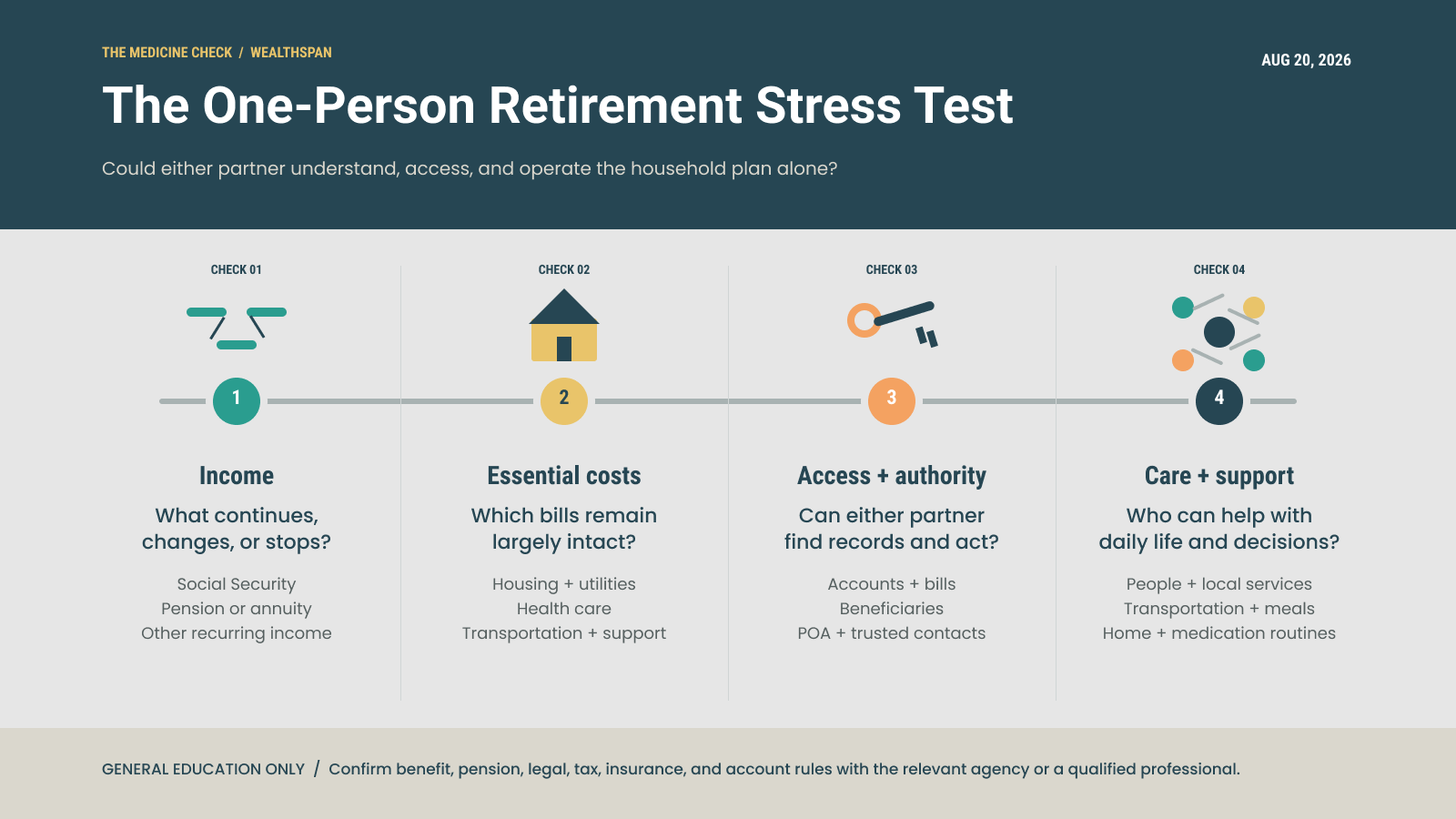
Retirement planning for couples usually starts with a shared picture: two Social Security records, perhaps two retirement accounts, one home, one household budget, and two people dividing the work of managing it all.
That picture may not last for the whole retirement.
One partner may die first. Illness or cognitive change may leave one person temporarily or permanently unable to handle money. A spouse who never managed the insurance, taxes, passwords, or monthly bills may suddenly need to take over. The plan can be well funded on paper and still be fragile in practice.
A useful retirement question is therefore not only, “Will our money last?” It is also, “Could either one of us understand, access, and run this plan alone?”
That is the one-person retirement stress test.
Why the one-person version matters
Living alone in later life is common, especially at older ages. The Administration for Community Living reported that 28% of community-dwelling adults age 65 and older lived alone in 2023. Among women age 75 and older, the share was 42%. Those figures describe living arrangements, not financial distress, but they show why a retirement plan should not assume that two people will always be present.
The financial cushion also differs across marital groups. KFF’s analysis of projected 2024 resources found median per-person savings of $173,500 among married Medicare beneficiaries, compared with $82,300 among widowed beneficiaries, $71,700 among divorced beneficiaries, and $29,250 among those who were single. These are modeled population estimates, not a forecast for any household, and the analysis divides household resources equally between spouses when calculating married beneficiaries’ per-person amounts. Even with that limitation, the gap is a reminder that later-life financial resilience is uneven.
The planning conversation itself is often incomplete. Fidelity’s 2026 Couples & Money Study surveyed 3,193 married or partnered adults and found that 69% were not regularly talking about long-term finances. The study is a survey, not proof that more conversations produce better retirement outcomes. Still, silence creates an obvious operational risk when only one partner knows how the household works.
The household income may change, but the household costs do not split in half
When one spouse dies, two Social Security payments do not simply continue. An eligible surviving spouse may receive a survivor benefit based on the deceased worker’s record, but Social Security generally pays the higher eligible benefit rather than adding a full retirement benefit and a full survivor benefit together. The amount and timing depend on age, work history, and other eligibility rules.
Other income sources can change too. A pension may continue in full, continue at a reduced survivor amount, or stop, depending on the option selected and the plan terms. An annuity, employer retiree benefit, or insurance payment has its own contract rules. Account ownership and beneficiary designations determine what happens to many assets, but they do not automatically give a survivor immediate access to every account or document.
Meanwhile, the mortgage or rent, property tax, insurance, utilities, transportation, and home maintenance may fall only modestly. Medicare premiums and many health costs are individual expenses, not household expenses that disappear proportionally.
The practical implication is not that every couple needs a specific survivor-income target. It is that the retirement cash-flow plan needs a second scenario: one person, one set of benefits, and many of the same fixed costs.
The four-part one-person retirement stress test
1. Map what continues, changes, and stops
Create a one-page inventory of income sources: each Social Security benefit, pension, annuity, employment income, required or planned retirement-account withdrawals, and any other recurring payment.
For each item, record what is known about the one-person version:
- Does it continue?
- Does the amount change?
- Who owns it, and who is the current beneficiary?
- Which plan document, statement, or agency can confirm the rule?
This is an information-gathering exercise, not a reason to make a claiming, pension, insurance, tax, or investment decision from a generic checklist. Social Security, pension administrators, insurers, tax professionals, attorneys, and fiduciary financial professionals may be needed for household-specific questions.
2. Rebuild the essential monthly budget for one person
Start with the costs that preserve independence: housing, food, utilities, transportation, insurance, prescriptions, routine care, support at home, and basic technology. Then mark which costs are likely to remain, fall, or rise if one person runs the household.
The goal is not to predict grief, health, inflation, or care needs with false precision. It is to see whether the plan depends on two incomes while carrying costs that behave more like one largely intact household.
Run the same exercise for incapacity, not only death. If one person needs paid help, home modifications, transportation, or supervision, the household could temporarily face fewer work hours or more care costs while still supporting two people.
3. Test access and decision authority
Knowing that an account exists is different from being able to manage it.
Both partners should know where to find a current account list, insurance information, tax returns, recurring bills, professional contacts, and instructions for accessing important digital records. Password sharing alone is not a substitute for legal authority, secure account procedures, or institution-specific rules.
The Consumer Financial Protection Bureau distinguishes several tools that are often confused. A trusted contact may give a financial firm someone to call if it cannot reach the account holder or sees concerning activity, but that contact generally cannot transact. A durable financial power of attorney can give a chosen agent legal authority to manage money if needed, subject to state law and the document’s terms. Social Security also offers Advance Designation, which lets a beneficiary identify preferred candidates to serve as a representative payee if the agency later determines help is necessary.
These are different roles. A health care power of attorney does not automatically authorize financial decisions. Because legal documents and recognition rules vary, review them with a qualified attorney and the relevant financial institutions rather than assuming an old form will work everywhere.
4. Map the care and support system
A one-person plan is not only a smaller household budget. It is also a plan for who notices a problem and who can help.
Write down the people and services that could support bill paying, transportation, meals, medication routines, home maintenance, appointments, and urgent decisions. Include local options, not only relatives who live far away. The CFPB’s financial-caregiver guides and the Administration for Community Living’s Eldercare Locator can help families understand roles and find community resources.
Care coverage needs its own review. Medicare does not cover most long-term custodial care, whether it is provided at home, in the community, in assisted living, or in a nursing home. Medicaid eligibility, private coverage, household resources, and local services vary. The stress test should identify that exposure without pretending a general article can determine the right funding or insurance choice.
A plan both partners can operate is a stronger plan
The point of this exercise is not to turn widowhood or incapacity into a spreadsheet prediction. It is to remove avoidable confusion.
A retirement plan is more resilient when either partner can answer five basic questions: What income remains? Which essential costs remain? Where are the accounts and documents? Who has authority to act? Who can help with care and daily life?
Review the one-person version at least when a major account, pension choice, insurance arrangement, move, diagnosis, caregiving role, or estate document changes. The most useful result may be a short list of gaps: a pension detail to confirm, a beneficiary to review, a missing authority document, or a monthly bill only one person understands.
That is Wealthspan in practical form: preserving the ability to make decisions, pay for care, and maintain independence when the household changes.
Evidence Verdict
The demographic and financial case for survivor planning is strong: many older adults live alone, and official and institutional data show meaningful differences in income and savings across age, gender, and marital groups. The Fidelity communication findings are moderate survey evidence and do not establish that a particular conversation schedule improves outcomes. The four-part stress test is an evidence-informed planning framework, not a tested financial intervention or a personal recommendation.
Keep building your Wealthspan
Explore care and legacy planning on the Wealthspan Wheel to see how income, protection, health care, and decision support fit together.
Use the Retirement Healthcare Cost Calculator to estimate a major expense that may remain in a one-person household.
Use the Retirement Readiness Calculator to compare savings needs and test care-cost scenarios.
Take the Wealthspan Checkup to review liquidity, debt, protection, and planning foundations.
Sources
Administration for Community Living. 2023 Profile of Older Americans. Full-text PDF reviewed.
KFF. Income and Assets of Medicare Beneficiaries in 2024. Full webpage and methods reviewed.
Fidelity Investments. Fidelity Findings: Most Couples Feel Confident About Money - But There Could Be More To Talk About. May 19, 2026. Full press release and survey methods reviewed.
Official benefit guidance. Social Security Administration: Survivor benefits and Social Security Survivors Benefits: Protection for Your Family.
Official planning guidance. Consumer Financial Protection Bureau: Planning for diminished capacity and illness and Managing Someone Else's Money; Medicare.gov: Long-term care coverage.
Educational information only. This article does not provide individualized financial, investment, insurance, tax, legal, retirement, Social Security, or medical advice. Benefit rules, pension options, account access, legal authority, coverage, and household needs vary.