A retirement account fee of one percent can look almost too small to deserve attention; on a statement crowded with balances, returns, contributions, and market changes, it is easy to treat the fee as background noise. Time changes the meaning of that number. A fee is deducted repeatedly, and the dollars removed today also lose the chance to compound tomorrow, so a modest annual difference can eventually become a meaningful reduction in the money available for care, housing, family support, or simply the freedom to make choices without financial pressure.
That is why a new September analysis from the Employee Benefit Research Institute deserves a closer look. Using EBRI’s Retirement Security Projection Model, the researchers examined how modest changes in net investment returns can affect retirement adequacy, projected shortfalls, and surpluses among people with defined-contribution plans; EBRI’s public summary says workers with more years of future contributions may be especially sensitive to changes in market performance and fees. The detailed report is restricted to members, so its specific estimates cannot be independently assessed here; the broader mechanism, however, is well established and can be illustrated with fully accessible federal examples.
A Small Percentage Can Become a Large Dollar Difference
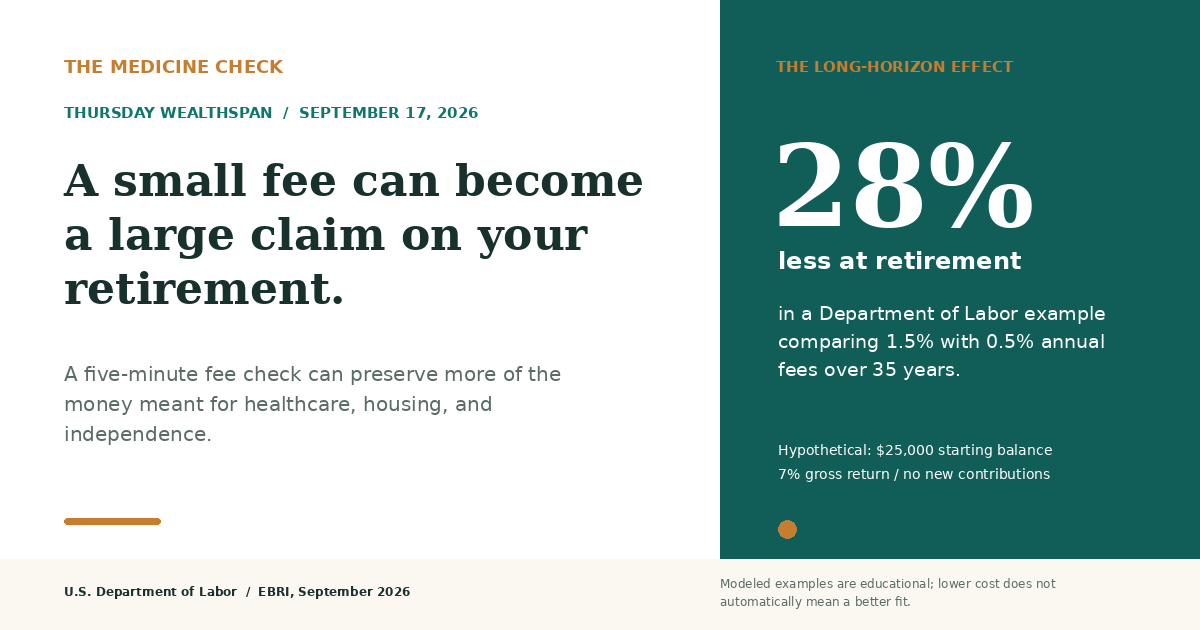
The U.S. Department of Labor offers a deliberately simple example: an employee has $25,000 in a 401(k), 35 years until retirement, no additional contributions, and investments that earn 7% before fees. If fees reduce the annual return by 0.5%, the account grows to about $227,000; if fees reduce it by 1.5%, the ending balance is about $163,000. That one-percentage-point difference leaves the higher-fee account with 28% less at retirement.
The Securities and Exchange Commission shows the same pattern over a shorter horizon. In its hypothetical, $100,000 earning 4% annually for 20 years grows to about $208,000 after a 0.25% annual fee, compared with about $179,000 after a 1% fee; the difference is nearly $30,000. Neither example predicts what any reader will earn, and neither includes the messy realities of contributions, changing markets, taxes, or different investment strategies. They isolate one point: costs lower net returns, and the effect compounds.
This is one reason fee awareness belongs inside Wealthspan. Fidelity estimates that a 65-year-old retiring in 2026 may need an average of $185,500 in after-tax savings for healthcare and medical expenses during retirement under its assumptions; that figure excludes most dental care, over-the-counter medications, and long-term care. The dollars preserved by a lower fee are not a dedicated healthcare account, and no one should equate a modeled fee difference with a medical-cost forecast; they are simply additional resources that may support the choices aging requires.
Know Which Fee You Are Looking At
“My 401(k) fee” is often not one number. A retirement account may include investment expenses, plan administration charges, advisory or managed-account fees, recordkeeping costs, sales charges, transaction costs, or fixed account fees; some appear as explicit deductions, while an expense ratio is generally taken from fund assets and reflected in the return you receive.
Commission-free does not mean cost-free. FINRA notes that exchange-traded products still have expense ratios and may involve other trading costs, including bid-ask spreads; mutual funds may have different share classes, sales loads, distribution fees, or account charges. The useful comparison is not “fee versus no fee,” but the total cost of comparable options that pursue a similar job with similar risk.
The word comparable matters. A stock index fund and a guaranteed-income product do not promise the same experience; an all-in-one target-date fund may cost more than one underlying index fund while providing automatic diversification and rebalancing. Advice, planning, tax coordination, and insurance features can have value. A lower price is attractive only when the alternative still meets the need.
The Five-Minute Retirement Fee Checkup
You do not need to redesign your portfolio to begin. Start by locating the most recent participant fee disclosure for a workplace plan, the prospectus or fund page for each investment, and any advisory agreement; then answer these questions in writing.
- What is the expense ratio for each fund? Convert the percentage into dollars per $10,000 invested so the number becomes easier to see.
- What additional plan, recordkeeping, advisory, managed-account, sales, transaction, or account fees apply? Check whether any fee is a flat dollar amount, because a fixed charge can weigh more heavily on a small balance.
- What service or protection am I receiving for each cost? Name the benefit rather than assuming every charge is waste or every service is valuable.
- Is there a genuinely comparable lower-cost option with similar investment exposure, risk, diversification, and convenience? Compare like with like.
- What would a difference of 0.25%, 0.50%, or 1% mean over my remaining time horizon? Investor.gov and FINRA offer calculators and fund-comparison tools for this purpose.
If the answers reveal a possible improvement, pause before acting. Selling in a taxable account may create a tax bill; moving money can trigger transaction or surrender charges; leaving an employer plan may change creditor protections, investment access, or the price of institutional share classes. In a workplace plan, the least expensive fund may also be a poor substitute for the diversified strategy you already hold. The next step is a focused comparison, not an automatic switch.
The Right Question Changes With Age
For someone early in a career, the long compounding runway makes recurring costs especially important, yet the basics still dominate: contribute consistently, capture any employer match, use a diversified allocation, and avoid abandoning the plan because its menu is imperfect. A fee review should improve the savings system, not interrupt it.
Near retirement, costs remain important but the decision becomes more layered. Account consolidation may simplify withdrawals and reduce the cognitive load of managing several institutions; professional planning may help coordinate Social Security, taxes, Medicare premiums, and spending. Those benefits can be worth paying for, but only when the service is clear, the price is understood, and the arrangement is reviewed periodically.
In retirement, the goal is not merely to minimize expenses; it is to support reliable income, manageable risk, liquidity, and a plan that remains usable if health or cognition changes. An account that is slightly more expensive but materially easier for a spouse or trusted contact to understand may strengthen resilience. Complexity has a cost too.
Why This Matters for Aging Well
Healthcare already places real pressure on older households. KFF reports that 49% of Medicare beneficiaries age 65 and older expected their healthcare costs to become less affordable in 2026; in the most recent spending data available, Medicare households devoted 14% of total household spending to healthcare, compared with 6% among non-Medicare households. These are population averages, not a forecast for any individual, but they explain why preserving optionality matters.
Aging well rarely follows a single spreadsheet line. A future household may need to absorb a larger Medicare premium, adapt a bathroom, pay for transportation after driving becomes difficult, reduce work hours to care for a spouse, or hire help that allows someone to remain at home. Investment fees do not cause those needs, and lowering them will not solve every retirement shortfall; avoidable costs simply deserve attention because they can quietly reduce the resources available when life becomes less predictable.
A Reasonable Takeaway
Treat fees as a recurring maintenance item, not a reason for panic. Once a year, identify the full cost of each retirement account, compare similar options, confirm what you receive for the price, and model the long-term difference; then consider taxes, risk, service, and simplicity before changing anything. That is a modest habit, but Wealthspan is often strengthened through modest habits performed consistently.
The aim is not to win a contest for the cheapest possible portfolio. It is to keep more of your money working in a plan you can understand, sustain, and use to protect the life you want as you age.
Keep Building Your Wealthspan
- Start with the Wealthspan Wheel. See how cash flow, savings, protection, healthcare planning, and long-term goals work together to support financial resilience.
- Estimate a major retirement expense with the Retirement Healthcare Cost Calculator. Get a clearer view of what future healthcare could mean for your retirement plan.
- Check your progress with the Retirement Readiness Calculator. See whether your current savings path may support the retirement you are working toward.
- Take a deeper look with the Wealthspan Checkup. Review the financial building blocks that can strengthen flexibility, independence, and confidence over time.
- Become a member for access to member-specific resources.
Sources
- Abstract-only reviewed: EBRI, “How Small Differences in Net Returns Impact Retirement Adequacy” (September 3, 2026) The public summary describes the model and scope; the detailed five-page report is member-restricted, so no report-specific numerical result beyond the public summary is used.
- Full text reviewed: U.S. Department of Labor, “A Look at 401(k) Plan Fees” Provides the 35-year, 28% hypothetical and explains plan and investment fees.
- Full text reviewed: Investor.gov, “Understanding Fees” Provides the 20-year $100,000 hypothetical and practical fee questions.
- Full text reviewed: FINRA, “Exchange-Traded Funds and Products” Explains expense ratios, trading costs, product risks, and the FINRA Fund Analyzer.
- Full text reviewed: Fidelity Investments, “25th Annual Retiree Health Care Cost Estimate” (July 21, 2026) Reports the $185,500 average estimate for a 65-year-old retiring in 2026 and states the assumptions and exclusions.
- Full text reviewed: KFF, “Key Facts About Health Care Affordability for People With Medicare” (May 27, 2026) Provides current affordability, spending, and Medicare-cost context.
Educational information only. This article provides general financial education, not individualized investment, tax, legal, or retirement advice. Fees, services, risks, guarantees, tax effects, and household circumstances vary. Review plan documents and consult qualified professionals before consequential changes.