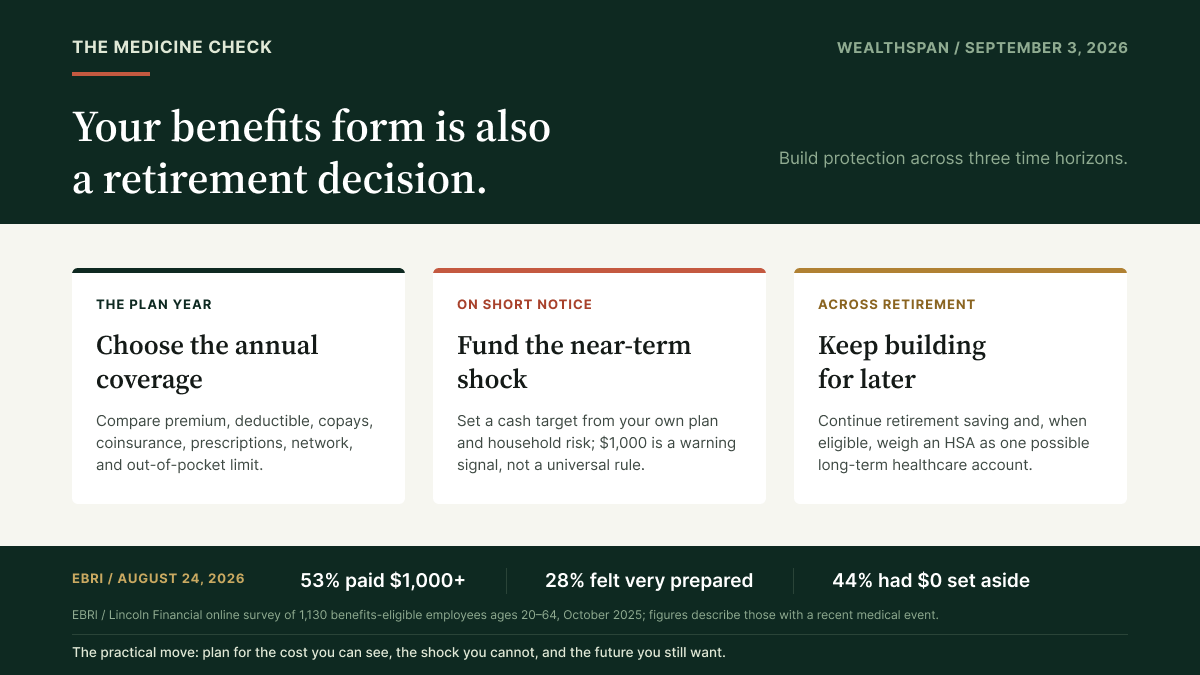
Open enrollment is usually presented as a once-a-year administrative task: compare premiums, click through a benefits portal, confirm a few elections, and move on. That framing is too narrow. The choices on that screen determine how much of next year's healthcare spending will be predictable, how much could arrive suddenly, which tax-advantaged accounts may be available, and whether a medical event is likely to interrupt retirement saving or push a household toward debt.
New research from the Employee Benefit Research Institute, published August 24 in collaboration with Lincoln Financial, makes the short-term risk unusually clear. Among benefits-eligible employees who had experienced a recent medical event, 53% reported paying at least $1,000 out of pocket, yet only 28% said they were very prepared for an unexpected expense of that size. Forty-four percent reported having no money set aside specifically for unexpected medical costs. Nearly half described at least moderate financial difficulty related to medical expenses, while 26% of all surveyed employees said they had delayed care because of cost within the previous year.
Those figures do not tell every household to save exactly $1,000, and they do not prove that one particular benefit or savings account would solve the problem. The survey was conducted online in October 2025 among 1,130 benefits-eligible employees ages 20 to 64, and the publicly available material is a detailed press-release summary rather than the complete research report. The results are self-reported, apply to employed people with access to at least some workplace benefits, and were produced through an EBRI-Lincoln Financial collaboration. Still, the central signal is useful: health insurance and financial readiness can fail at different points, so they should be reviewed together.
Open Enrollment Affects More Than Next Year's Premium
The least expensive premium can be the wrong reference point if a plan carries a deductible, drug formulary, network, coinsurance rate, or out-of-pocket limit that does not fit the household's likely care. HealthCare.gov advises comparing estimated total yearly costs, including premiums, deductibles, copayments, and coinsurance. The out-of-pocket maximum matters as well, but it is not a ceiling on every possible healthcare dollar because premiums, noncovered services, some out-of-network care, and charges above an allowed amount may sit outside it.
That distinction matters for Wealthspan because a plan is not simply a way to lower a bill. It is a risk-sharing contract that changes cash flow, emergency reserves, access to clinicians and medicines, tax choices, and the amount that can continue moving toward retirement. A higher-premium plan may reduce exposure when care is used. A lower-premium plan may preserve monthly cash but require a larger reserve. Neither structure is automatically better. The decision depends on the plan details and the household using it.
Use Three Time Horizons, Not One Savings Number
A practical review separates healthcare money into three layers. They can overlap, but they do different jobs.
- Annual coverage. Estimate the coming year's premium and likely cost sharing under more than one care-use scenario, then check the clinicians, facilities, prescriptions, and services that matter to the household. This is the layer chosen during enrollment.
- Near-term medical cash. Identify an amount that could be accessed without selling long-term investments at an inconvenient time or automatically reaching for a credit card. The EBRI survey's $1,000 finding is a useful stress test, but a stronger target begins with the actual deductible, out-of-pocket limit, prescription exposure, household cash flow, and the likelihood of out-of-network or noncovered care.
- Long-term healthcare funding. Keep retirement healthcare costs inside the broader savings plan. Fidelity's 2026 estimate suggests that a 65-year-old retiring this year may need an average of $185,500 after tax for healthcare and medical expenses across retirement, up 7.5% from 2025. The estimate assumes Original Medicare and Part D, and it excludes over-the-counter medicines, most dental services, and long-term care. It is a planning benchmark, not a personal invoice.
This three-layer view avoids a common mistake: using one large retirement estimate to describe every healthcare risk. The bill due next month, the maximum exposure next year, and the cost of coverage across a long retirement are related, but they require different time horizons and different forms of liquidity.
A Wealthspan Open Enrollment Checklist
Before confirming elections, work through the questions that can change both healthcare affordability and retirement resilience. The answers belong in one place, where partners or another trusted person can find them if health, work, or cognition changes.
- What will the plan cost in a low-, typical-, and high-use year? Add the annual premium to likely deductibles, copays, coinsurance, and prescription costs. Compare the total rather than the payroll deduction alone.
- What is covered before the deductible, and what has a separate deductible? Primary care, prescriptions, therapies, and other services may follow different rules. Read the Summary of Benefits and Coverage and the plan documents rather than relying on last year's memory.
- Which costs sit outside the out-of-pocket limit? Confirm how out-of-network care, noncovered services, premiums, and charges above the plan's allowed amount are treated. A stated maximum is meaningful only when its boundaries are understood.
- Are current clinicians, facilities, and medicines covered in a workable way? Check the network and formulary directly, including prior-authorization or step-therapy rules when relevant. Directories and formularies can change, so save the records used for the decision.
- Is an HSA or FSA available, and what will the employer contribute? For 2027, the IRS set the HSA contribution limit at $4,500 for self-only coverage and $9,000 for family coverage. Eligibility rules still matter, employer contributions use part of the limit, and FSAs follow different use and carryover rules, so verify the plan-specific details before electing an amount.
- What income-protection benefits deserve a fresh look? Disability insurance, paid leave, life insurance, and limited supplemental health products can affect financial resilience when illness changes work capacity. Supplemental policies have definitions, exclusions, benefit limits, and triggers. They do not replace major medical coverage, and increased interest after a plain-language description is not evidence that a product is good value for every worker.
- Will the decision protect or displace retirement saving? Review the employer match, current contribution rate, automatic increases, and beneficiaries alongside health elections. If a richer health plan or a larger cash reserve changes the budget, make that tradeoff explicit rather than letting retirement contributions fall unnoticed.
- Could the household pay an unexpected $1,000 bill without delaying care or taking on expensive debt? If not, choose a first achievable cash milestone and automate progress. After reaching it, reassess against the plan's deductible, out-of-pocket exposure, other emergency needs, and the household's income stability.
An HSA Can Help, but Access Still Matters
For someone who is eligible, an HSA can connect current healthcare spending with long-term retirement planning because contributions may receive favorable federal tax treatment, balances can carry forward, and qualified medical withdrawals can be tax free. Fidelity also notes that HSAs can be invested, which may support longer-horizon growth. That does not mean every HSA dollar should be invested or preserved for decades. Money intended for a near-term deductible needs to remain accessible and stable enough for that job. A household that would otherwise delay needed care or borrow at a high rate may reasonably value present access over a theoretical future benefit.
The same principle applies beyond HSAs. A cash reserve, health plan, disability benefit, retirement account, and long-term-care strategy are not competing answers to one question. They protect different parts of the household balance sheet. Wealthspan improves when each tool has a clear purpose and the plan still works after an ordinary disruption.
The Practical Takeaway
This open enrollment season, do more than ask which premium is lower. Ask what the plan will cost when care is actually used, what amount could be paid promptly without undermining the rest of the household, and whether retirement saving will continue after the election is made. The EBRI findings suggest that many workers have coverage but not enough financial room around it. Closing that gap may begin with a modest cash milestone, a clearer benefits comparison, or a better understanding of protections already offered at work.
The goal is not to predict every diagnosis or eliminate uncertainty. It is to make the financial response less brittle, so a medical bill is less likely to delay care, become high-cost debt, interrupt retirement saving, or narrow future choices. That is what turns an annual benefits task into a Wealthspan decision.
Keep Building Your Wealthspan
Start with the Wealthspan Wheel to see how cash flow, savings, protection, healthcare planning, and long-term goals work together to support financial resilience.
Use the Retirement Healthcare Cost Calculator to get a clearer view of what future healthcare could mean for your retirement plan.
Check your progress with the Retirement Readiness Calculator and see whether your current savings path may support the retirement you are working toward.
Take the Wealthspan Checkup to review the financial building blocks that can strengthen flexibility, independence, and confidence over time.
Become a member for access to member resources.
Sources
Employee Benefit Research Institute. New EBRI-Lincoln Financial Research Finds Many Employees Lack a Financial Cushion for Unexpected Medical Costs. August 24, 2026. Press-release PDF reviewed. The complete underlying report was not publicly accessible.
HealthCare.gov. Your total costs for health care: Premium, deductible, and out-of-pocket costs. Full web page reviewed.
U.S. Department of Labor, Employee Benefits Security Administration. Workers and Families. Full web page reviewed.
Internal Revenue Service. Revenue Procedure 2026-24, 2027 HSA inflation-adjusted amounts. Official IRS bulletin reviewed.
Fidelity Investments. Fidelity Investments Shares 25th Annual Retiree Health Care Cost Estimate. July 21, 2026. Estimate assumptions and exclusions retained.
Employee Benefit Research Institute. 2026 Retirement Confidence Survey. April 21, 2026. Public summary reviewed.
Educational information only. This article provides general financial and benefits education, not individualized medical, insurance, investment, legal, or tax advice. Plan terms, employer contributions, eligibility, networks, formularies, tax treatment, and household priorities vary. Verify current documents and consult qualified professionals when needed.