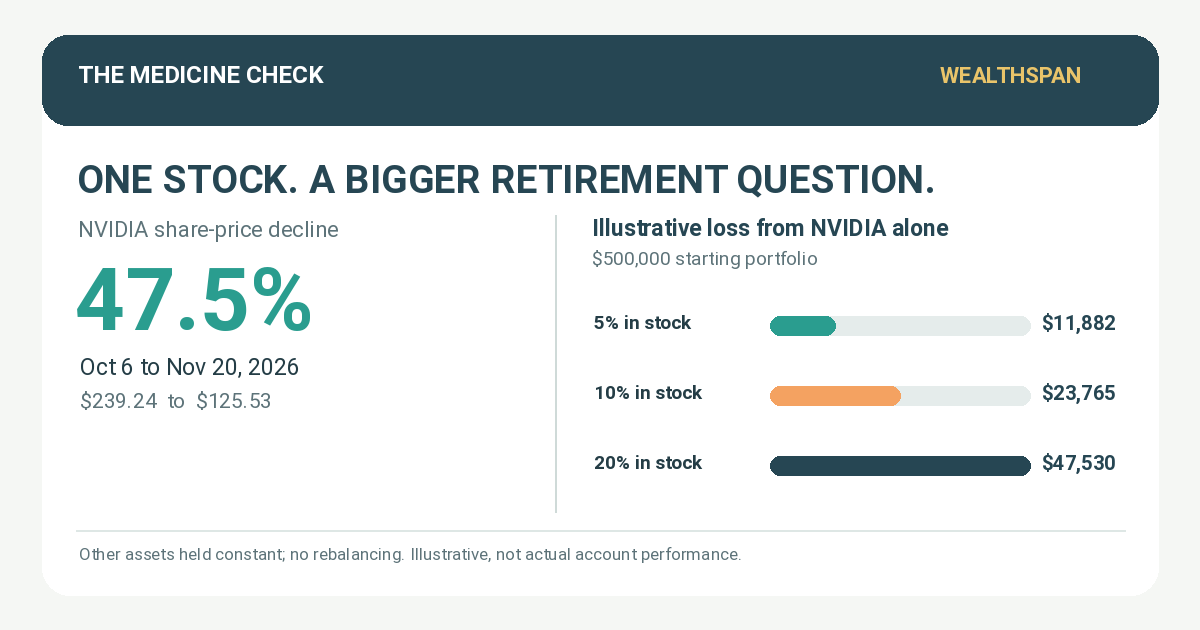
A strong company can still be a volatile investment. NVIDIA is a useful example. After closing at $239.24 on October 6, 2026, its shares finished November 20 at $125.53 - a 47.5% decline. On November 20 alone, the stock fell 14.01%. Those figures describe NVIDIA’s share price, not what happened to every investor's retirement or brokerage account.
The larger market was also having a difficult day: the S&P 500 fell 3.7%, according to the Associated Press. But a single stock dropping far more than a broad index offers a specific lesson for Wealthspan: the investments inside an account matter more than the label on the account.
Your retirement account is a container, not a diversification strategy
A 401(k), 403(b), IRA, or taxable brokerage account tells you how money is held and taxed. It does not tell you how much risk you are taking. You can hold a broad collection of investments inside one account, or place nearly all of its value in a single company. Those are very different retirement plans.
Exposure can be direct, through NVIDIA shares you own; indirect, through an index fund, target-date fund, or technology-sector fund; or both. A broad fund may own NVIDIA as one of many holdings. Owning that fund generally spreads company-specific risk, but it does not make an investor immune to a technology-sector selloff or a market-wide downturn.
What concentrated exposure could do to a $500,000 portfolio
Suppose you had $500,000 invested on October 6, when NVIDIA closed at $239.24. The table isolates the effect of its decline through November 20. It assumes NVIDIA began as the stated percentage of the portfolio, all other holdings were unchanged, and no rebalancing, contributions, withdrawals, dividends, or fees occurred.
| NVIDIA share of portfolio on Oct. 6 | Loss attributable to NVIDIA through Nov. 20 |
|---|---|
| 5% | $11,882 |
| 10% | $23,765 |
| 20% | $47,530 |
With 20% of the portfolio initially in one stock, the hypothetical decline from that holding alone is approximately $47,530. At 5% exposure it is about $11,882. These are arithmetic illustrations of concentration risk - not measured losses in real retirement plans, and not forecasts of what NVIDIA will do next.
The same logic applies whether shares sit in a brokerage account or in a retirement account. Tax treatment differs; exposure to the price movement does not. And the more a holding grows relative to everything else, the larger the risk it can become.
Diversification lowers avoidable risk, not all risk
There are at least two different problems to solve. Company-specific risk is what happens when one business has a setback or its valuation changes sharply. Broad ownership across companies, sectors, and geographies can reduce the impact of a single business. Market risk is different: when many stocks decline together, even a diversified stock fund can lose money.
That is why a portfolio review also asks how much is held in stocks, high-quality bonds, cash or cash equivalents, and other assets - and whether those amounts match the purpose and timing of the money. Several funds are not automatically diversified if they all own much of the same group of large technology companies.
Fidelity suggests that any single investment reaching 5% or more of total investments may warrant another look. That is a review prompt, not an absolute ceiling, and a diversified fund is not equivalent to an individual company stock. The SEC similarly emphasizes diversification both across and within asset classes.
Why this matters more as retirement gets closer
Volatility is not just a number on an account statement. Savings may need to pay for Medicare premiums, medications, hearing care, housing changes, family support, and the possibility of paid caregiving. Losing a large share of an account just before those bills arrive can narrow the options available later.
Fidelity's July 2026 estimate says one person retiring at age 65 in 2026 may need an average of $185,500 in after-tax savings for healthcare and medical costs over retirement, under its assumptions. The estimate includes Original Medicare and Part D-related costs but excludes long-term care, most dental services, and over-the-counter medications. It is a planning benchmark, not an individualized bill.
The timing of a downturn matters too. If you must sell investments to fund spending during an early-retirement market decline, fewer shares remain to participate in a possible recovery. This is called sequence-of-returns risk. It does not mean retirees should abandon growth investments; it means the portion needed soon deserves a different risk conversation than money intended for decades from now.
A 15-minute Wealthspan diversification check
- List everything together. Add 401(k)s, 403(b)s, IRAs, HSAs invested for the future, taxable brokerage accounts, and any employer stock. Check the whole portfolio, not each account in isolation.
- Find the biggest exposures. Identify direct stock positions and the top holdings of your major mutual funds and ETFs. Watch for overlapping investments and sector concentration.
- Calculate your single-stock weight. Divide the value of a direct stock holding by the value of your overall investment portfolio. If you also hold it indirectly, review fund fact sheets to assess the additional look-through exposure.
- Match the mix to the timeline. Ask which dollars support spending in the next few years and which are meant for the distant future. Review the balance among stocks, bonds, and liquid reserves, rather than reacting only to this week’s market price.
- Make any changes deliberately. Rebalancing, redirecting new contributions, or reducing a concentrated holding may help. A taxable brokerage sale can realize gains or losses; a trade within a tax-advantaged account is generally handled differently. Consider taxes, trading constraints, and professional advice before acting.
The point is not to predict NVIDIA
This is not a call to buy, sell, or avoid NVIDIA. Its future share price is uncertain. The better question is whether any one company or sector can change your ability to afford the life you want: filling prescriptions, adapting a home, supporting family, or choosing when and how to retire.
A durable Wealthspan plan does not require you to avoid every downturn. It requires you to understand the risks you have chosen, keep them proportionate to your goals, and preserve enough flexibility that a volatile week does not make the important decisions for you.
Make it practical: Start with the free Wealthspan Checkup, then explore the Retirement Savings Readiness Calculator and Retirement Health Care Cost Estimator to connect the portfolio to the spending it may need to support.
Educational information only; not individualized financial, tax, legal, or investment advice. Historical prices as of the November 20, 2026 market close. The illustrative scenario is not a backtest and excludes changes in all other holdings.
Sources and further reading
- NVIDIA historical prices (Oct. 6 and Nov. 20, 2026) - Yahoo Finance
- Nov. 20, 2026 market selloff - Associated Press
- Do you hold too much in one investment? - Fidelity Investments
- 2026 retiree health care cost estimate, July 21, 2026 - Fidelity Investments
- Asset allocation and diversification - U.S. Securities and Exchange Commission, Investor.gov
- What is sequence-of-returns risk? - Charles Schwab