You open the annual notice from your Medicare drug plan, see a new premium and deductible, and then hear that the national Part D average is barely changing. It would be reasonable to assume your plan should be about the same. For many people, that assumption could be expensive.
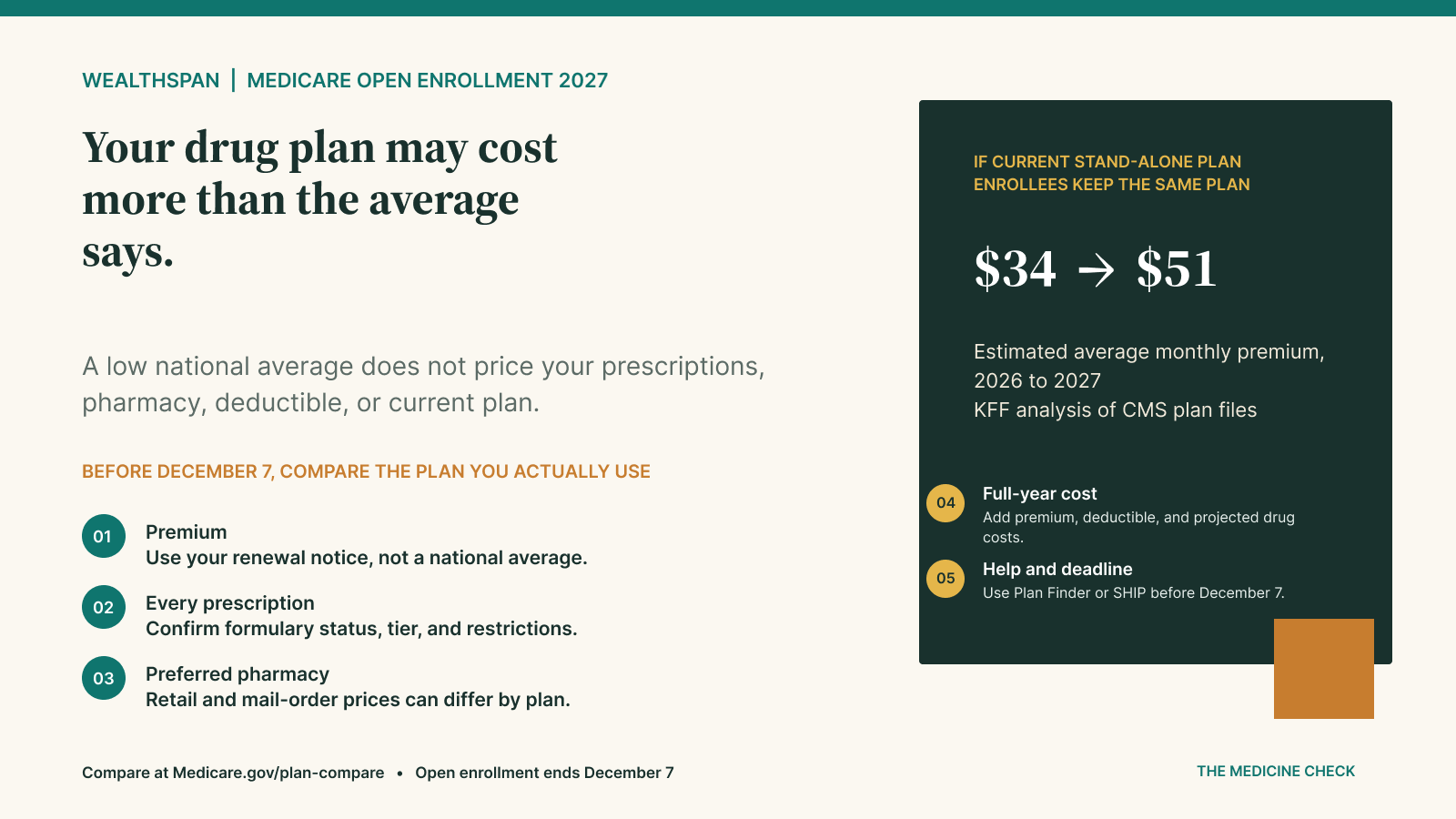
CMS estimates that the average monthly premium for stand-alone Part D coverage will be about $36 in 2027, less than one dollar above its 2026 estimate. KFF looked at the final plan files from a different angle and asked what current enrollees would pay if they stayed in the same plan; under that scenario, the enrollment-weighted average rises from $34 to $51 per month. KFF also estimates that 76% of people now enrolled in a stand-alone plan would pay a higher premium if they did not switch.
Those figures are not proof that every premium will rise by 50%, and they do not mean the CMS estimate is false. They answer different questions. The national estimate describes the market, but CMS did not explain its calculation method in the announcement; the KFF estimate holds current enrollment in place to show what renewal could look like before people shop. KFF expects the average actually paid in 2027 to be lower than $51 because some people will move to less expensive plans.
My practical takeaway is simple: a national average cannot price your prescriptions, your pharmacy, or your current plan. During Medicare open enrollment, which runs through December 7, the useful comparison is the one built around the care you actually use.
The average is answering a different question
A market average can be reassuring while an individual renewal is uncomfortable. CMS reports that most people without the low-income subsidy will have access to at least one low-premium option in 2027; access to an inexpensive plan, however, does not tell you whether that plan covers your drugs favorably, uses your pharmacy as preferred, or fits with the rest of your Medicare coverage.
The spread within the stand-alone Part D market is unusually wide. KFF estimates that, if current enrollees keep their plans, 55% of current stand-alone plan enrollees without low-income subsidies would pay less than $20 per month in 2027, while nearly 30%, about 3.9 million people, would pay at least $100. This is why a headline average can be directionally useful for policy and still be a weak budgeting number for a household.
Your annual notice of change gives you the starting point: next year's premium, deductible, formulary changes, and cost-sharing rules. Do not stop at the premium line. A lower-premium plan can cost more over the year if it places one of your medicines on a higher tier, charges coinsurance instead of a flat copay, or treats your usual pharmacy as non-preferred.
The Part D premium is not the entire bill
For 2027, the standard Part D deductible rises from $615 to $700, and the annual out-of-pocket threshold for covered Part D drugs rises from $2,100 to $2,400. KFF estimates that virtually all stand-alone plan enrollees will face a deductible, with an average of $643, and that percentage coinsurance remains common for preferred and non-preferred brand drugs.
The $2,400 threshold is valuable protection against very high spending on covered drugs; however, it does not include plan premiums, and it does not turn a non-covered drug into a covered one. Your timing can matter too. The Medicare Prescription Payment Plan can spread covered out-of-pocket drug costs across monthly bills instead of requiring the entire amount at the pharmacy, but it does not reduce the total price.
This is a good example of Wealthspan in practice. The aim is not merely to locate the smallest premium. It is to choose coverage that makes the household budget more predictable, preserves access to the medicines you and your clinician have chosen, and reduces the chance that a surprise bill forces a tradeoff elsewhere.
Five checks to complete before December 7
- Start with your renewal notice. Record the 2027 premium and deductible for the plan you have now. If you compare against an old premium or a national average, the rest of the exercise begins with the wrong number.
- Enter every prescription. Use the exact drug name, strength, amount, and frequency in Medicare Plan Finder. Confirm whether each medicine remains on the formulary, which tier applies, and whether prior authorization, step therapy, or quantity limits appear.
- Compare the pharmacy you really use. Plans can price the same medicine differently at preferred, standard, retail, and mail-order pharmacies. Compare a practical option you can reach and use consistently, not a distant pharmacy that looks inexpensive only on paper.
- Compare the full-year estimate. Look at premium, deductible, and projected drug costs together. Also inspect how spending is distributed across the year, especially if a large bill in January would strain cash flow even when the annual total is manageable.
- Ask for unbiased help when the choice is difficult. Medicare's Plan Finder is the main comparison tool, and State Health Insurance Assistance Programs offer free counseling. People with limited income and resources should also review eligibility for Extra Help; those with high early-year drug costs can ask whether the Medicare Prescription Payment Plan improves cash flow.
Do not let one drug-plan number decide your entire Medicare coverage
If you have Original Medicare, you can compare stand-alone Part D plans without changing your underlying medical coverage. If you are considering a Medicare Advantage plan because its drug premium looks lower, widen the review before you act: check clinician and hospital networks, prior authorization rules, maximum out-of-pocket exposure for medical care, supplemental benefits, and the rules that may affect later access to Medigap in your state.
A low drug premium may be a genuine advantage, but it is one component of a larger coverage decision. The best plan on a prescription spreadsheet can still be a poor fit if it disrupts the clinicians you rely on or shifts risk into another part of the household budget.
The reasonable Wealthspan takeaway
An annual Part D review is not glamorous, and most people would rather renew than rebuild the comparison. This year, the gap between the stable national average and the higher current-plan estimate gives you a specific reason to look again.
Use your renewal notice, enter the medicines you take, compare pharmacies you can actually use, and judge plans by the full year's cost. If the decision begins to sprawl, ask SHIP or Medicare for help before December 7. One careful hour can protect more than a monthly premium; it can preserve predictable access, financial flexibility, and the confidence to use your coverage when your health requires it.
Keep Building Your Wealthspan
- Start with the Wealthspan Wheel. See how cash flow, savings, protection, healthcare planning, and long-term goals work together to support financial resilience.
- Estimate a major retirement expense with the Retirement Healthcare Cost Calculator. Get a clearer view of what future healthcare could mean for your retirement plan.
- Check your progress with the Retirement Readiness Calculator. See whether your current savings path may support the retirement you are working toward.
- Take a deeper look with the Wealthspan Checkup. Review the financial building blocks that can strengthen flexibility, independence, and confidence over time.
- Become a member for access to member-specific resources.
SOURCES
- KFF, Medicare Part D Premiums and Cost Sharing in 2027, October 30, 2026
- Centers for Medicare & Medicaid Services, 2027 Medicare Advantage and Part D premiums and plan choices
- Centers for Medicare & Medicaid Services, 2027 Rate Announcement and Part D benefit parameters
- Medicare.gov, Open Enrollment
- Medicare.gov, Compare Medicare plans
- CMS, Medicare Prescription Payment Plan
- Medicare.gov, Help with drug costs
All sources reviewed as public full-text webpages or public CMS documents on November 8, 2026.
This article provides general educational information, not individualized insurance, medical, tax, or financial advice. Plan availability, formularies, pharmacy networks, and costs vary by location and person. Readers should verify current details with Medicare, the plan, and a qualified adviser or counselor before changing coverage.