The renewal notice looks simple, but the decision is not
You open the envelope, see the name of the Medicare drug plan you already have, and think, “I will let it renew.” The plan worked this year, your prescriptions have not changed much, and one fewer decision sounds good.
I understand the appeal; however, new 2027 plan data show why automatic renewal deserves a closer look. The monthly premium attached to your current plan may change, the deductible may change, a medication may move to a different tier, and the pharmacy you use may no longer produce the lowest total cost. None of those changes means your plan is bad. They mean last year’s answer may not be this year’s answer.
For Wealthspan, this is a small annual decision with a much larger purpose: preserving room in the retirement budget for the care, medications, and daily choices that help you remain independent.
Why the 2027 premium numbers seem to disagree
On September 28, the Centers for Medicare & Medicaid Services projected that the average monthly premium for a stand-alone Part D prescription drug plan would rise by less than $1, from $35.09 in 2026 to $36 in 2027. That sounds like broad stability.
Then, on October 30, KFF published a different estimate. Using 2026 enrollment and the 2027 premiums attached to those same plans, KFF calculated an average of $51 per month if current stand-alone Part D enrollees remained in their plans. Among enrollees who do not receive the Part D Low-Income Subsidy, KFF estimated that 76% would pay a higher premium if they made no change, and 2.4 million would see an increase of more than $50 per month.
Both estimates can be true because they answer different questions. KFF asks what happens if current enrollees stay where they are. CMS projects an average across expected 2027 enrollment, but KFF notes that CMS did not explain its calculation method. Switching toward lower-premium plans is one possible explanation for the difference. KFF also notes that its $51 estimate will likely fall after people switch plans and new beneficiaries enroll.
Neither number predicts what you will pay. Your cost depends on your ZIP code, plan, prescriptions, formulary, dose and quantity, pharmacy, and eligibility for financial assistance.
A lower premium is not the same as a lower medication bill
The premium is easy to compare because it appears as one monthly number; however, it is only one line in the calculation. The useful comparison is the expected annual total for your actual medication list, including premiums, deductibles, copayments or coinsurance, and pharmacy pricing.
For 2027, the standard Part D deductible rises from $615 to $700, although individual plans may use a lower deductible or apply it differently across drug tiers. The annual out-of-pocket threshold for covered Part D drugs rises from $2,100 to $2,400. Premiums do not count toward that threshold, and neither do medications that the plan does not cover, so the threshold should not be mistaken for a ceiling on every prescription-related dollar you might spend.
KFF also found broader use of coinsurance for preferred and non-preferred brand drugs in 2027. A copayment is a fixed dollar amount. Coinsurance is a percentage of the drug’s price. When the underlying price is high, a percentage can create a less predictable bill.
What is covered? What tier is it on? Is prior authorization required? Which pharmacy produces the estimate you are seeing? Those details often matter more than a few dollars of premium difference.
The five-part Part D review I would put on the calendar
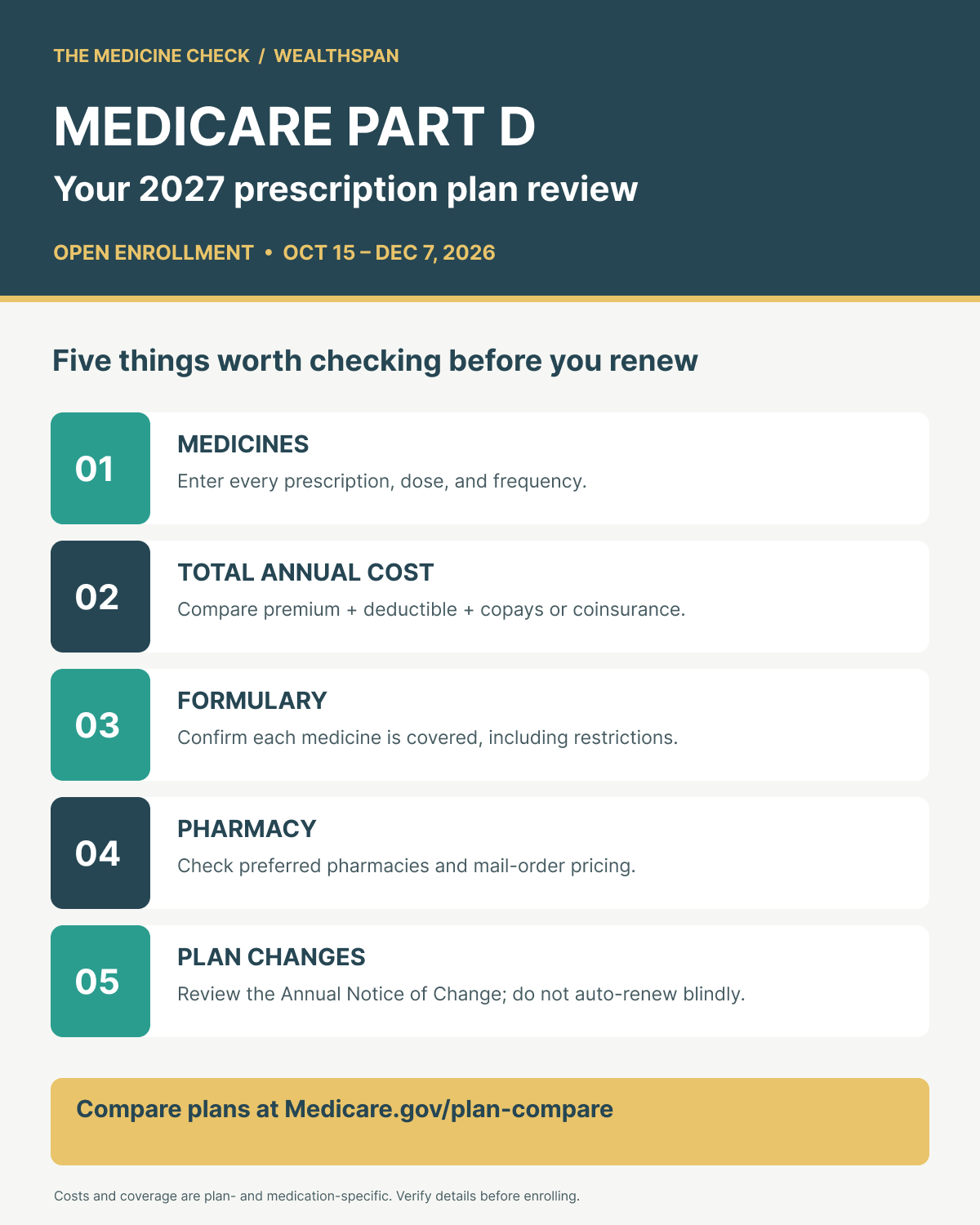
Medicare open enrollment runs from October 15 through December 7, and changes take effect January 1. A useful review does not need to become a sprawling financial project. I would make it a short, repeatable check.
- Start with the Annual Notice of Change. Your plan sends this notice each fall. Review premium, deductible, formulary, drug-tier, pharmacy-network, and utilization-management changes before assuming the coverage is unchanged.
- Update the medication list. Include the exact drug name, dose, quantity, and refill frequency. A plan comparison built from an incomplete list can produce a precise-looking answer to the wrong question.
- Compare annual cost, not premium alone. Medicare Plan Finder can use your prescriptions and pharmacies to estimate plan costs. Compare the expected premium plus drug spending, then look at whether those costs are concentrated early in the year.
- Check the friction around each medication. A lower estimate may come with prior authorization, step therapy, quantity limits, a narrower pharmacy network, or a drug that is not covered. Cost and access belong in the same review.
- Get independent help when the choice is unclear. Medicare can help at 1-800-MEDICARE, and State Health Insurance Assistance Programs provide free local counseling. A pharmacist can help confirm the medication list and identify prescription questions to bring to the prescriber, without choosing an insurance plan for you.
Do not let one drug premium decide the rest of Medicare
The average drug premium inside Medicare Advantage may look lower than the premium for a stand-alone Part D plan, partly because Medicare Advantage plans can use rebate dollars to reduce the drug premium. That comparison is real, but it is incomplete.
Moving between traditional Medicare and Medicare Advantage can change provider networks, prior-authorization rules, medical cost sharing, supplemental benefits, and out-of-pocket exposure. Returning to traditional Medicare may also raise a separate Medigap question because federal guaranteed-issue protections are limited outside certain enrollment periods and circumstances, although state rules vary. I would not let a lower Part D premium make that broader decision by itself.
First compare drug plans within the coverage structure you intend to keep. If you are considering a change to the structure itself, compare medical and prescription coverage together and get help with the Medigap implications before enrolling.
When the bill is still too high
Plan comparison cannot solve every affordability problem. Medicare’s Extra Help program can reduce Part D premiums, deductibles, and cost sharing for people who qualify, and Medicare Savings Programs may help with other Medicare costs. Eligibility rules can change, and people whose income or resources have fallen can apply even if they did not qualify before.
The Medicare Prescription Payment Plan can spread eligible out-of-pocket prescription costs across the calendar year; however, it changes timing, not the total price. That distinction is important for cash flow. A lower monthly spike can make the budget easier to manage, but it is not a discount.
The Wealthspan takeaway
A Medicare drug-plan review is not glamorous, and no average premium can tell you which plan fits your medications. The work is still worth doing because avoidable recurring costs reduce future flexibility, while an uncovered or heavily restricted medication can interrupt care.
Your prescriptions may stay the same while the plan around them changes. Put the review on the calendar, use the medication list you actually take, compare the annual total, and keep the rest of your Medicare coverage in view. You are not trying to find a perfect plan. You are trying to make a deliberate choice before automatic renewal makes one for you.
Keep Building Your Wealthspan
- Start with the Wealthspan Wheel. See how cash flow, savings, protection, healthcare planning, and long-term goals work together to support financial resilience.
- Estimate a major retirement expense with the Retirement Healthcare Cost Calculator. Get a clearer view of what future healthcare could mean for your retirement plan.
- Check your progress with the Retirement Readiness Calculator. See whether your current savings path may support the retirement you are working toward.
- Take a deeper look with the Wealthspan Checkup. Review the financial building blocks that can strengthen flexibility, independence, and confidence over time.
- Become a member for access to member-specific resources.
Sources
- KFF. Medicare Part D Premiums and Cost Sharing in 2027. Published October 30, 2026. https://www.kff.org/medicare/medicare-part-d-premiums-and-cost-sharing-in-2027/
- Centers for Medicare & Medicaid Services. Medicare Advantage and Medicare Prescription Drug Programs Expected to Remain Stable in 2027. Published September 28, 2026. https://www.cms.gov/newsroom/press-releases/medicare-advantage-medicare-prescription-drug-programs-expected-remain-stable-2027
- Centers for Medicare & Medicaid Services. Announcement of Calendar Year 2027 Medicare Advantage Capitation Rates and Part C and Part D Payment Policies. Published April 6, 2026. https://www.cms.gov/files/document/2027-announcement.pdf
- Medicare.gov. Plan Annual Notice of Change. Accessed November 1, 2026. https://www.medicare.gov/basics/forms-publications-mailings/mailings/costs-and-coverage/upcoming-plan-changes
- Medicare.gov. Find a Medicare Plan. Accessed November 1, 2026. https://www.medicare.gov/plan-compare/
- Medicare.gov. Help With Drug Costs. Accessed November 1, 2026. https://www.medicare.gov/basics/costs/help/drug-costs
- Medicare.gov. Open Enrollment. Accessed November 1, 2026. https://www.medicare.gov/health-drug-plans/open-enrollment
- Medicare.gov. How Much Does Medicare Drug Coverage Cost? Accessed November 1, 2026. https://www.medicare.gov/health-drug-plans/part-d/basics/costs
- Medicare.gov. What Is the Medicare Prescription Payment Plan? Accessed November 1, 2026. https://www.medicare.gov/prescription-payment-plan
Educational information only. This article does not recommend a particular Medicare, Part D, Medicare Advantage, Medigap, prescription, tax, or financial decision. Plan availability, costs, coverage, and assistance eligibility vary by person and location. Confirm details with Medicare, the plan, or a free SHIP counselor before enrolling.