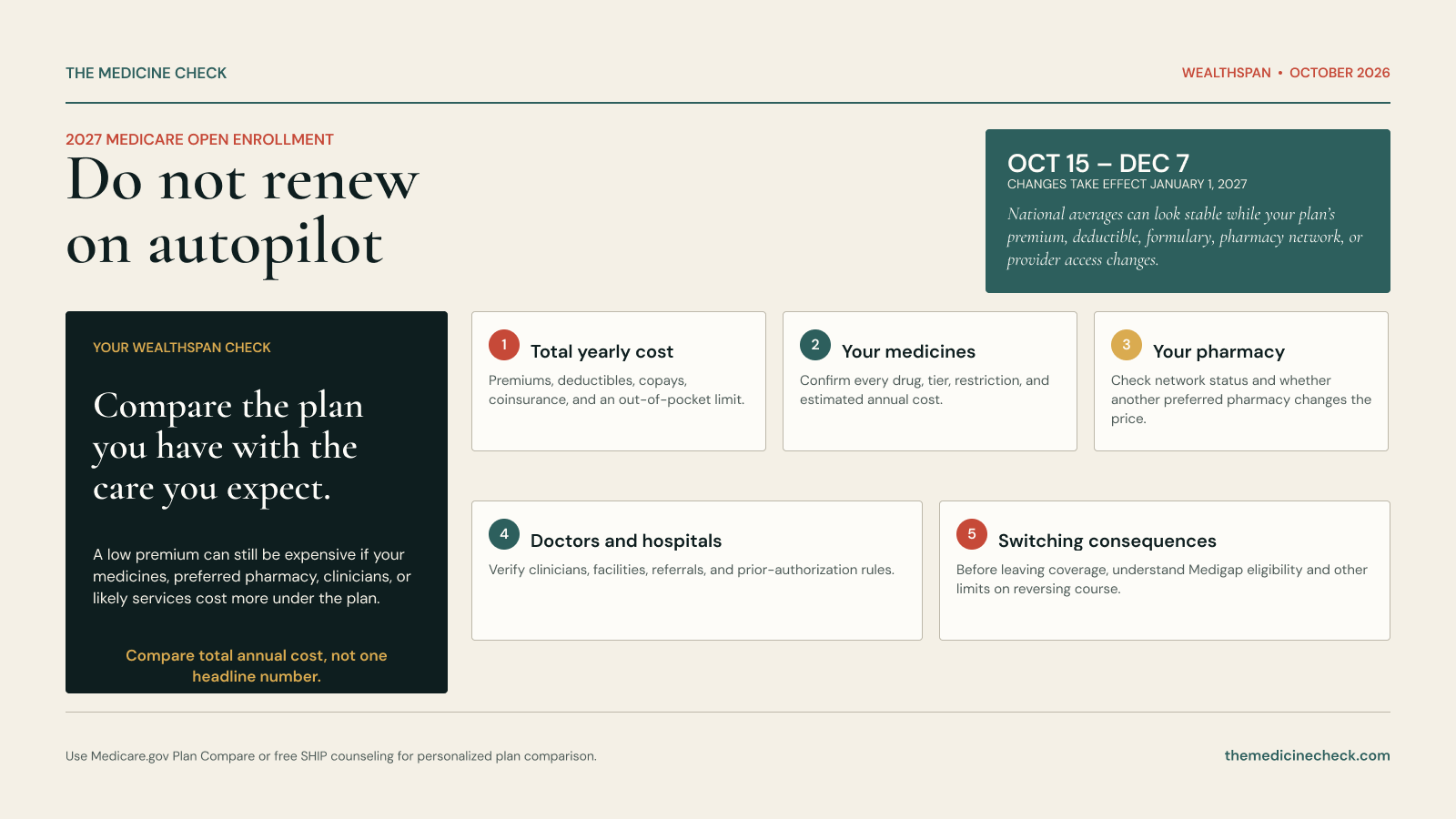
The envelope arrives in the fall, joins a small pile of mail, and seems to ask for a simple decision: keep what you have or spend an evening comparing Medicare plans. If your current coverage worked reasonably well this year, renewal can feel like the sensible default. I understand the appeal. You already made this decision once, the plan names can blur together, and a lower monthly premium is easy to mistake for a lower-cost year.
For 2027, the national picture looks fairly stable. The Centers for Medicare & Medicaid Services projects that the weighted average Medicare Advantage premium will fall from $14.37 in 2026 to $12.00 in 2027, while the average total monthly premium for a stand-alone Part D drug plan will edge up from $35.09 to $36. Those numbers are useful context; however, they cannot tell you whether your medicines remain covered on favorable terms, your pharmacy is still preferred, your clinicians stay in network, or your likely annual cost rises by much more than the premium suggests.
That is why I see Medicare open enrollment as a Wealthspan decision. The work is not simply to find the cheapest plan on the screen. It is to preserve access to the care you use, reduce avoidable financial surprises, and keep room in your retirement budget for the people, places, and activities that make those years worth planning for.
A Stable Average Can Hide a Personal Change
Open enrollment runs from October 15 through December 7, and changes generally begin January 1. CMS reports that more than 99 percent of Medicare beneficiaries will have access to at least one Medicare Advantage plan in 2027, and 97 percent will have access to ten or more. Choice is abundant on paper, but more choice does not automatically produce a better decision, especially when every plan combines premiums, deductibles, cost sharing, formularies, pharmacy arrangements, provider networks, and extra benefits in a different way.
The stand-alone Part D market also gives us a reason to look past the average. KFF’s analysis of CMS plan files found that the average beneficiary will have nine stand-alone drug plans available in 2027, down from eleven in 2026, marking a fourth consecutive year of fewer options. KFF also found that many enrollees will see modest premium changes while some could pay considerably more if they remain in their current plan. A national average can be accurate and still be unhelpful for your particular medication list.
Two 2027 Part D numbers to know
A Part D deductible cannot exceed $700 in 2027. The annual out-of-pocket threshold for covered Part D drugs is $2,400. That threshold applies to covered prescription drugs under Part D; it is not a cap on every medical expense you may have during the year.
The Annual Notice of Change is the first place to look. It explains how your plan’s costs and coverage will change in January. Read it with your own care in mind, because a benefit you never use can look generous while a formulary or network change that affects you directly may sit several pages deeper.
The Five-Part Review I Would Use
1. Compare total yearly cost, not one monthly premium
Start with the premium, but do not stop there. Add the deductible, the copays or coinsurance you are likely to face, and any costs attached to the clinicians, medicines, and services you expect to use. Medicare’s Plan Compare tool can estimate monthly and annual drug costs when you enter your prescriptions and pharmacies; those estimates are more decision-useful than a premium viewed by itself.
A plan with a zero-dollar premium can still be the more expensive choice if your medicines sit on unfavorable tiers, your usual pharmacy is not preferred, or your expected services carry higher cost sharing. The reverse can also be true: paying a somewhat higher premium may buy lower, more predictable costs for the care you actually use. Compare scenarios, not slogans.
2. Rebuild your medication list from the bottle labels
Use the exact drug name, dose, formulation, and how often you take it. Include medicines you take only as needed, and remove those you no longer use. Then check whether each drug is on the plan’s formulary, which tier it occupies, whether prior authorization or step therapy applies, and whether the plan places quantity limits on it.
This is where a small administrative change can become a large household expense. The same medication can have different coverage terms across plans, and a class-level substitute may not be clinically appropriate for you. If a plan appears to require a medication change, treat that as a reason to speak with your prescriber or pharmacist, not as an instruction to alter treatment on your own.
3. Check the pharmacy, not only the drug
Part D plans can charge different amounts at preferred and standard in-network pharmacies. Medicare notes that you may pay less at a preferred in-network pharmacy, while using an out-of-network pharmacy can leave you paying the full cost in many situations. Compare the pharmacies you would realistically use, including mail order only if it fits how you manage refills and temperature-sensitive or time-sensitive medicines.
Convenience belongs in the calculation. If a lower price requires repeated long drives, complicated transfers, or a refill process that makes adherence harder, the nominal savings may not support your health or independence. Wealthspan includes the time, energy, and reliability required to make a plan work.
4. Confirm your doctors, hospitals, and expected care
For Medicare Advantage, verify the network status of the primary care clinician, specialists, hospital system, rehabilitation facility, and other services you rely on. Do not assume that a clinician who accepted the plan this year will remain in network next year. Check the plan’s directory, then confirm with the clinician’s office when the relationship is important to you.
Also think one year ahead. Are you expecting a procedure, more physical therapy, new imaging, frequent specialist visits, travel, or time in another state? A plan that fits a low-use year may fit poorly when your care pattern changes. No one can predict every need, but your known appointments and active conditions deserve more weight than an extra benefit you may never use.
5. Understand what may be difficult to reverse
Switching between Original Medicare and Medicare Advantage can affect more than next year’s premium. In many states and situations, moving from Medicare Advantage back to Original Medicare does not guarantee that you can buy the Medigap policy you want without medical underwriting after your protected enrollment rights have ended. Rules and protections vary, and special rights can apply.
Before changing your coverage route, ask specifically about Medigap eligibility, underwriting, timing, and the costs you could face without supplemental coverage. This is one of the moments when free, individualized counseling is worth the call, because a reversible-looking click can have longer consequences.
Prepare Before You Open Plan Compare
A short preparation pass makes the comparison less confusing. Put the following information in one place before you begin:
- Your current plan’s Annual Notice of Change and Evidence of Coverage.
- A current list of every prescription, including dose, formulation, and refill frequency.
- The pharmacies you would actually use, plus whether mail order is practical for you.
- Your preferred clinicians, hospitals, therapy providers, and durable medical equipment suppliers.
- Expected care for 2027, including procedures, travel, rehabilitation, and frequent specialist visits.
- The total amount you paid this year, separated into premiums, prescriptions, visits, procedures, and other out-of-pocket costs.
Then compare your current plan with at least two realistic alternatives using the same information. Look at the annual estimate, the months when costs are concentrated, and the conditions attached to coverage. If the result surprises you, save or print the comparison so you can verify it with the plan or a counselor.
When the Choice Is Still Unclear
Medicare.gov and 1-800-MEDICARE can answer coverage questions, and every state has a State Health Insurance Assistance Program, or SHIP, that provides free, unbiased Medicare counseling. A qualified financial adviser can help you place health care costs inside the larger retirement plan, but plan selection often turns on details that deserve Medicare-specific expertise.
Be precise about how a helper is paid and which plans the person can discuss. Insurance agents can be useful, but they may represent selected insurers rather than the full market. Ask for the assumptions behind any recommendation, verify the prescription and provider details yourself, and keep a record of what you were told.
An older KFF survey found that 69 percent of Medicare beneficiaries did not compare their coverage options during the 2022 open-enrollment period. That figure does not tell us how people will behave in 2026, but it captures a familiar human tendency: once a complicated choice has been made, we prefer to treat it as settled. Medicare plans are annual contracts. Your health, prescriptions, household budget, and tolerance for administrative friction are changing too.
A Good Plan Supports the Life You Are Trying to Protect
The most reasonable Medicare choice is not necessarily the plan with the lowest premium, the most extra benefits, or the best national headline. It is the plan that offers a credible fit between your expected care, your clinicians, your medicines, your travel, your budget, and the risks you are willing to carry.
Give the Annual Notice of Change a careful read, rebuild your medication list, and compare total annual cost before December 7. If a change could affect Medigap access or a clinician relationship you value, get individualized help before you act. A thoughtful review cannot eliminate uncertainty, but it can reduce the chance that an automatic renewal makes an important decision for you.
Keep Building Your Wealthspan
- Start with the Wealthspan Wheel. See how cash flow, savings, protection, healthcare planning, and long-term goals work together to support financial resilience.
- Estimate a major retirement expense with the Retirement Healthcare Cost Calculator. Get a clearer view of what future healthcare could mean for your retirement plan.
- Check your progress with the Retirement Readiness Calculator. See whether your current savings path may support the retirement you are working toward.
- Take a deeper look with the Wealthspan Checkup. Review the financial building blocks that can strengthen flexibility, independence, and confidence over time.
- Become a member for access to member-specific resources.
Sources
All sources below were reviewed as full public webpages or public documents. No journal article in this package is abstract-only. Accessed October 18, 2026.
This article offers general education, not individualized Medicare, insurance, medical, legal, tax, or investment advice. Plan availability, benefits, formularies, networks, costs, Medigap rights, and underwriting rules vary by location and circumstance. Readers should verify current details with Medicare, the plan, their clinicians, and a qualified counselor before changing coverage.
- Centers for Medicare & Medicaid Services. Medicare Advantage and Medicare Prescription Drug Programs Expected to Remain Stable in 2027. September 28, 2026. View source
- Centers for Medicare & Medicaid Services. 2027 Medicare Advantage and Part D Star Ratings. October 8, 2026. View source
- Medicare.gov. Medicare Open Enrollment. View source
- Medicare.gov. Part D costs. View source
- Medicare.gov. Plan Compare for 2027. View source
- Medicare.gov. Upcoming plan changes and the Annual Notice of Change. View source
- Medicare.gov. Pharmacies and Part D coverage. View source
- Medicare.gov. Your Yearly Medicare Review. View source
- KFF. Many Medicare Part D Stand-Alone Drug Plan Enrollees Will See Modest Premium Increases for 2027, But Others Could Pay Much More If They Don’t Switch Plans. October 2, 2026. View source
- KFF. Medicare Open Enrollment and Coverage Options: Key Questions and Answers. October 9, 2026. View source
- KFF. Nearly 7 in 10 Medicare Beneficiaries Did Not Compare Coverage Options During Open Enrollment. September 26, 2024. View source