The Annual Notice of Change lands on the counter, and the first number most of us look for is the premium. If it barely moved, or even fell, it is tempting to put the packet aside and let the current plan renew. I understand the appeal. Medicare is complicated, the comparisons take time, and a familiar insurance card can feel like one less decision to make.
A stable premium, however, does not tell you whether your specialist remains in network, whether a prescription moved to a more expensive tier, whether your pharmacy is still preferred, or how much you could spend in a year when your health changes. Medicare Open Enrollment runs from October 15 through December 7, 2026, for coverage that begins January 1, 2027. I would use that window as a Wealthspan checkup: a structured review of how your coverage protects cash flow, care access, independence, and future choice.
A national average is not a personal cost estimate
The national outlook sounds reassuring. The Centers for Medicare & Medicaid Services projects that the weighted average Medicare Advantage monthly premium will decline from $14.37 in 2026 to $12 in 2027, while the average stand-alone Part D premium will rise modestly from $35.09 to $36. CMS also expects more than 99% of Medicare beneficiaries to have access to at least one Medicare Advantage plan.
Those figures describe projected averages across millions of people and many plans. They do not price your prescriptions, confirm your physicians, or show what happens if you need an outpatient procedure, repeated physical therapy, expensive imaging, or a hospital stay. A plan with a low premium can still create a large bill through deductibles, copays, coinsurance, out-of-network care, and drug costs; a plan with a higher premium may buy broader access or more predictable spending.
Choice itself can add friction. KFF reports that the average Medicare beneficiary can choose among 35 Medicare Advantage plans for 2027, including 28 plans that include drug coverage, and among eight to 12 stand-alone Part D plans, depending on location. Yet 65% of beneficiaries did not compare Medicare options during the 2024 Open Enrollment period. Inertia is understandable, but it is not a coverage strategy.
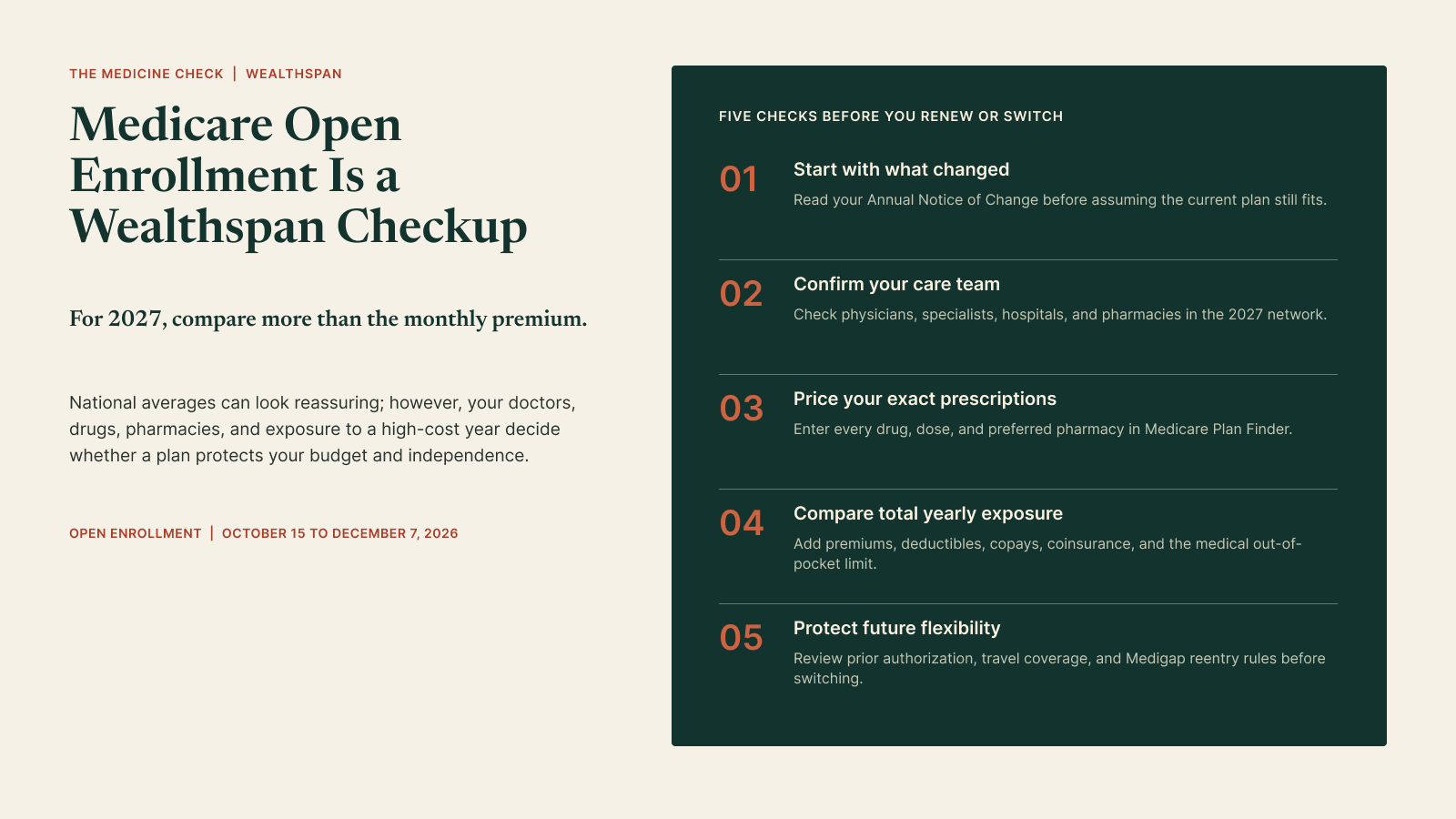
Five checks before you renew or switch
Check 1 Start with what changed
Read the Annual Notice of Change from your current plan before opening a comparison tool. Mark every change to the premium, medical deductible, drug deductible, copays, coinsurance, maximum medical out-of-pocket limit, drug list, network, and extra benefits. The most consequential change may not be the number printed at the top of the first page.
Separate benefits you rely on from benefits that merely sound useful. Dental allowances, fitness programs, transportation, and over-the-counter credits can have value, but they should not distract you from access to the clinicians, hospitals, medicines, and services that protect your function and independence.
Check 2 Confirm your care team and places of care
Make a short list of the physicians, specialists, hospitals, rehabilitation facilities, and pharmacies you would be reluctant to lose. Check each one against the 2027 plan network, and confirm important relationships directly with the provider and the plan because online directories can lag behind contracting changes.
Think beyond routine appointments. Where would you receive urgent care while traveling? Does a second home place you outside the service area for part of the year? Which hospital would you use for a planned procedure? Medicare Advantage plans can organize care efficiently and may offer useful extras; however, network design and prior authorization can limit where and how care is received. Original Medicare generally offers broader nationwide clinician access, but it does not include an annual out-of-pocket cap for Part A and Part B services by itself.
Check 3 Price your exact prescriptions
Enter every medication, dose, quantity, and preferred pharmacy into Medicare Plan Finder. Drug coverage is not interchangeable across plans: formularies, tiers, prior authorization, step therapy, quantity limits, and preferred-pharmacy contracts can change the amount you pay and the work required to fill a prescription.
For 2027, the standard Part D deductible cannot exceed $700, and annual out-of-pocket spending on covered Part D drugs is capped at $2,400. The cap is meaningful protection, but it does not include premiums, and it does not guarantee that every medicine is covered on favorable terms. Medicare's Prescription Payment Plan may spread eligible drug costs across the year; it changes timing, not the total amount owed.
Check 4 Compare total yearly exposure, not only the monthly premium
I would compare each option in three layers. First, list fixed costs: monthly premiums for medical coverage, Part D, and any Medigap policy. Second, estimate a normal year using the care and prescriptions you reasonably expect. Third, test a high-use year by looking at deductibles, specialist and hospital cost sharing, drug costs, and the plan's medical out-of-pocket limit.
Keep medical and drug exposure separate because they follow different rules. A Medicare Advantage plan's medical out-of-pocket maximum does not include every expense, such as premiums or Part D drug costs. Original Medicare paired with Medigap and Part D has a different cost pattern: usually more fixed premium, less dependence on a local medical network, and cost sharing shaped by the selected supplement. There is no universally cheapest structure because health needs, geography, prescriptions, and tolerance for uncertainty differ.
Check 5 Protect future flexibility before you switch
A coverage change can affect options beyond 2027. Federal law provides a one-time six-month Medigap Open Enrollment period that begins when you are 65 or older and enrolled in Part B. Outside that window, and outside specific guaranteed-issue protections, an insurer may use medical underwriting, charge more, or decline an application; state protections vary.
If you are considering leaving Medicare Advantage for Original Medicare and expect to use Medigap, investigate your ability to obtain the supplement before you disenroll. Also review prior authorization rules, referral requirements, travel coverage, and the administrative help available in your household. A plan is not financially resilient if its rules make necessary care difficult to use.
A practical comparison you can finish
You do not need to analyze every plan in the county. Begin with your current Annual Notice of Change, a complete medication list, and the names of your essential providers and pharmacies. Log in to Medicare Plan Finder so your saved prescriptions can populate the comparison, then narrow the field to two or three options that cover the care you use.
- Compare access. Confirm physicians, hospitals, pharmacies, travel needs, referrals, and prior authorization rules.
- Compare a normal year. Add premiums and the cost sharing you expect from routine visits, services, and prescriptions.
- Compare a difficult year. Review the medical out-of-pocket limit, the separate Part D exposure, and which expenses do not count toward either limit.
- Confirm before enrolling. Call the plan and important providers, save notes or screenshots, and check any Medigap eligibility before changing coverage.
For impartial help, contact your State Health Insurance Assistance Program. SHIP counselors offer free Medicare guidance and are not connected to an insurance company or health plan. Medicare.gov and 1-800-MEDICARE can also clarify official plan information.
Use open enrollment to preserve choice
Medicare coverage is more than an annual insurance purchase. It determines how readily you can reach care, how predictable your spending may be, and how much flexibility remains when your health or household changes. The premium deserves attention, but it should sit beside the physicians you trust, the medicines you take, the risks you can absorb, and the options you want to preserve.
My practical takeaway is simple: do not renew from the premium alone. Give yourself one focused comparison before December 7, and judge each plan by the total job it needs to do for your health and your Wealthspan.
Keep Building Your Wealthspan
- Start with the Wealthspan Wheel. See how cash flow, savings, protection, healthcare planning, and long-term goals work together to support financial resilience.
- Estimate a major retirement expense with the Retirement Healthcare Cost Calculator. Get a clearer view of what future healthcare could mean for your retirement plan.
- Check your progress with the Retirement Readiness Calculator. See whether your current savings path may support the retirement you are working toward.
- Take a deeper look with the Wealthspan Checkup. Review the financial building blocks that can strengthen flexibility, independence, and confidence over time.
- Become a member for access to member-specific resources.
Sources
1. Centers for Medicare & Medicaid Services, Medicare Advantage and Medicare Prescription Drug Programs Expected to Remain Stable in 2027, September 28, 2026. Accessed October 11, 2026.
2. KFF, Medicare Open Enrollment and Coverage Options: Key Questions and Answers, October 9, 2026. Accessed October 11, 2026.
3. Medicare.gov, Medicare Plan Finder for 2027. Accessed October 11, 2026.
4. Medicare.gov, Medicare & You 2027. Accessed October 11, 2026.
5. Medicare.gov, Costs for Medicare Drug Coverage. Accessed October 11, 2026.
6. Medicare.gov, Pharmacies in Medicare Drug Plans. Accessed October 11, 2026.
7. Medicare.gov, Get Ready to Buy a Medigap Policy. Accessed October 11, 2026.
8. Medicare.gov, Switching Medigap Policies. Accessed October 11, 2026.
9. Medicare.gov, Buying a Medigap Policy and Free SHIP Help. Accessed October 11, 2026.
10. Fidelity, When Is Open Enrollment?. Accessed October 11, 2026.
Educational information only. This article does not provide individualized insurance, medical, tax, or financial advice. Coverage, costs, provider participation, drug coverage, and Medigap rights vary. Confirm details with Medicare.gov, the plan, your providers, or a free SHIP counselor before changing coverage.