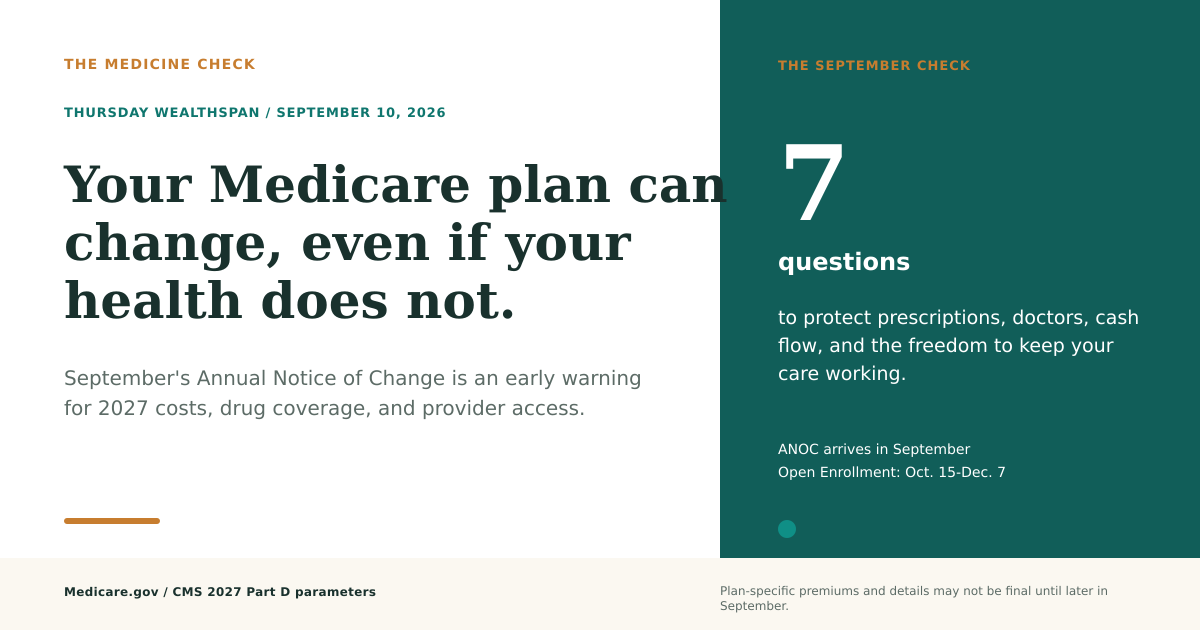
A Medicare plan is not a lifetime contract with fixed terms. Premiums can rise, deductibles and copayments can move, a medication can land on a different formulary tier, a preferred pharmacy can change, and a familiar clinician or hospital may no longer participate in the same network. None of that requires your health to change first.
That is why the Plan Annual Notice of Change, usually shortened to ANOC, deserves more attention than its bureaucratic name suggests. Medicare.gov says people enrolled in a Medicare plan receive this notice in September. It explains changes in coverage, costs, and other plan terms that take effect in January. If the document never arrives, Medicare advises contacting the plan.
For a Wealthspan plan, the ANOC is an early-warning system. It gives households time to see whether next year's coverage still fits the care they use and the money they can comfortably spend, then compare options during Medicare Open Enrollment from October 15 through December 7. The decision is not simply which plan has the lowest advertised premium. It is which arrangement is most likely to keep needed care accessible without making retirement cash flow unnecessarily fragile.
What Is Already Known for 2027, and What Is Not
CMS has finalized two Part D numbers that make a fresh review especially worthwhile. Under the defined standard benefit for people who do not receive the low-income subsidy, the deductible rises from $615 in 2026 to $700 in 2027, while the annual out-of-pocket threshold for covered Part D drugs rises from $2,100 to $2,400. A particular plan may use a lower deductible or a different cost-sharing design, so these figures are program parameters, not a forecast of any one person's bill.
CMS also set the 2027 national base beneficiary premium at $41.33. That figure is an input to a statutory formula, not the premium a reader should plug into a budget. The agency is explicit that plan-specific premiums vary, and its July announcement said the final average premiums and plan landscape would come later in September.
The larger planning context is harder to dismiss. Fidelity's 2026 Retiree Health Care Cost Estimate puts average lifetime healthcare and medical expenses at $185,500 for a 65-year-old retiring this year, up 7.5% from the 2025 estimate. The model assumes Original Medicare Parts A and B plus Part D and includes premiums, cost sharing, prescription costs, and certain services excluded by Original Medicare. It does not include over-the-counter medicines, most dental care, or long-term care. It is a benchmark, not a personal invoice, but it shows why small annual coverage decisions accumulate inside a retirement plan.
Seven Questions to Ask Before You Renew on Autopilot
- What will the plan cost in a year I actually use it? Compare more than the monthly premium. Note the medical and drug deductibles, copayments, coinsurance, any separate Part D premium, and the plan's medical out-of-pocket maximum. A low premium can still produce high total costs when a person needs specialists, therapy, imaging, or frequent prescriptions.
- Are all of my prescriptions still covered on workable terms? Check every current drug against the 2027 formulary, including its tier, copayment or coinsurance, prior-authorization rules, step-therapy requirements, and quantity limits. Review the exact drug and formulation. A class-level assumption can miss a meaningful plan restriction.
- Does my pharmacy still give me the plan's best price? A pharmacy can remain in network without being preferred. Compare the pharmacies and mail-order options you would realistically use, then look at the estimated annual drug cost rather than a single copayment.
- Can I still use the clinicians and facilities that matter? Do not rely only on an old directory or the fact that a clinician accepted the plan this year. Verify primary care, specialists, hospitals, rehabilitation facilities, laboratories, and other recurring providers with both the plan and the provider when practical.
- Have the rules for getting care become harder? Look for changes in referrals, prior authorization, service limits, and out-of-network coverage. These details affect more than convenience. Delays and unexpected denials can disrupt continuity for chronic conditions or recovery after an illness or injury.
- Does the plan support the services that preserve independence? Think ahead to physical or occupational therapy, durable medical equipment, home health, mental healthcare, transportation, and the dental, vision, or hearing benefits you value. An extra benefit has little value if its allowance is small, its network is impractical, or the service you need is excluded.
- What is the household's downside if health needs rise? Estimate a routine year and a difficult year. Ask which account would cover higher premiums, drug spending, or the medical out-of-pocket maximum, and whether the budget still leaves room for housing, food, caregiving, and other essentials. People with limited income or resources should also check eligibility for Part D Extra Help or a Medicare Savings Program rather than assuming assistance is unavailable.
Why This Is a Wealthspan Decision
Health insurance is often evaluated as a shopping exercise, but the deeper question is whether the plan preserves options. A network that includes the right rehabilitation team can influence where someone recovers after a fall. Affordable prescriptions can support adherence. Workable access to specialists can reduce the friction of managing several chronic conditions. These are financial details with consequences for function, time, and independence.
There is also a household dimension. A spouse, adult child, or friend may eventually help manage appointments, claims, and medications, especially after an acute illness or when cognition changes. Keeping the ANOC, a current medication list, provider names, and the reason for the final plan choice in one place reduces the burden on whoever may need to step in.
The reasonable standard is not to find a perfect plan. No plan removes every cost or access tradeoff. It is to notice material changes before they become January surprises, compare the options on the facts that matter most, and keep enough financial slack that care remains usable when health becomes more complicated.
A Manageable Review Process
Start with the ANOC and mark every change that affects a premium, deductible, copayment, drug, pharmacy, provider, authorization rule, or benefit you use. Next, make a one-page list of current prescriptions and recurring clinicians. Use Medicare Plan Compare when 2027 offerings are available, and save the estimated annual costs for the strongest alternatives. Finally, verify uncertain network or formulary details directly before enrolling.
People who want individualized, non-sales help can contact their State Health Insurance Assistance Program. SHIP services are federally funded, objective, and free to consumers. Counselors can help with open-enrollment choices, cost-assistance programs, supplemental coverage, and the way Medicare interacts with other insurance.
Do not stop or substitute a medication because a formulary changes, and do not assume a benefit is covered based on marketing language. A clinician or pharmacist can help identify medically appropriate alternatives, while Medicare, the plan, or a SHIP counselor can clarify coverage and appeal options.
A Small Task That Protects Future Flexibility
Reading an insurance notice will never feel like the most inspiring part of aging well, yet it is exactly the kind of modest annual task that can preserve future choice. The goal is not to predict every diagnosis or eliminate every expense. It is to keep the care you rely on connected to a plan and a budget that can continue to support it.
This September, treat the ANOC as a prompt to look forward rather than a letter to file away. Your health may be unchanged today. Your coverage and costs may not be.
Keep Building Your Wealthspan
Start with the Wealthspan Wheel to see how cash flow, savings, protection, healthcare planning, and long-term goals work together to support financial resilience.
Use the Retirement Healthcare Cost Calculator to get a clearer view of what future healthcare could mean for your retirement plan.
Check your progress with the Retirement Readiness Calculator and see whether your current savings path may support the retirement you are working toward.
Take the Wealthspan Checkup to review the financial building blocks that can strengthen flexibility, independence, and confidence over time.
Become a member for access to member resources.
Sources
Full webpage reviewed. Medicare.gov: Plan Annual Notice of Change. Accessed September 6, 2026.
Full document reviewed for the cited 2027 Part D parameters. Centers for Medicare & Medicaid Services. Announcement of Calendar Year 2027 Medicare Advantage Capitation Rates and Part C and Part D Payment Policies. April 6, 2026.
Centers for Medicare & Medicaid Services. Medicare Part D 2027 National Average Monthly Bid Amount Information. July 28, 2026.
Current official guidance. Medicare.gov: Understanding Health Plan Costs, Compare Original Medicare and Medicare Advantage, and Find a Medicare Plan. Accessed September 6, 2026.
Fidelity Investments. Fidelity Investments Shares 25th Annual Retiree Health Care Cost Estimate. July 21, 2026.
State Health Insurance Assistance Programs National Technical Assistance Center: About SHIPs. Accessed September 6, 2026.
Educational information only. This article provides general Medicare, financial, and benefits education, not individualized medical, insurance, investment, legal, or tax advice. Plan terms, costs, formularies, networks, eligibility, and household circumstances vary. Verify current plan documents and consult Medicare, the plan, a SHIP counselor, and qualified professionals when needed.