A July 2026 Global Burden of Disease (GBD) analysis found that people are living longer, but spending more years in poor health. The practical takeaway is not panic; it is to measure and protect function earlier.
A Longer Life Is Not The Same As A Healthier Life
For years, longevity conversations have often treated longer life as the main prize. A new analysis in The Lancet Public Health is a useful correction: living longer matters, but the real healthspan question is whether those added years are lived with enough function, cognition, mobility, and independence to feel like a success.
The study, published online in July 2026 and based on Global Burden of Disease 2023 estimates, examined the morbidity gap across 204 countries and territories from 1990 through 2023. The morbidity gap is the difference between total life expectancy and healthy life expectancy. In plainer language, it is the average number of years people live with illness, disability, or reduced health.
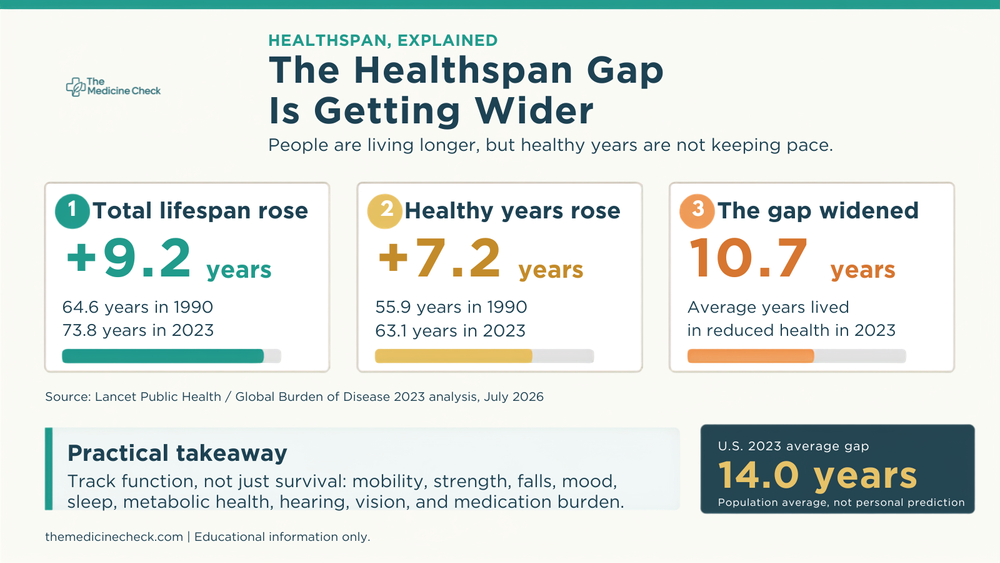
The headline finding is uncomfortable. Global life expectancy rose from 64.6 years in 1990 to 73.8 years in 2023. Healthy life expectancy also improved, from 55.9 to 63.1 years. But healthy years did not keep pace with total years. The average global morbidity gap widened from 8.8 years to 10.7 years.
Why This Matters For Healthspan
This is exactly the distinction Healthspan is meant to make. Lifespan asks how long we live. Healthspan asks how long we can preserve the abilities that make life workable: walking, seeing, hearing, thinking clearly, sleeping, recovering from illness, managing blood pressure and glucose, staying socially connected, and doing the daily tasks that protect independence.
The United States stood out in the analysis with an estimated 14.0-year morbidity gap in 2023, the largest national gap reported. That does not mean any individual American should expect exactly 14 unhealthy years. Population averages blend many different lives together. But it does suggest that the U.S. is especially good at extending survival while still leaving many people with long stretches of chronic disease, pain, disability, or functional limitation.
That should change how we think about prevention. The goal is not simply to avoid death this year. It is to delay disability, preserve strength, prevent avoidable complications, and keep health problems from stacking up in ways that narrow daily life.
What Drove The Gap
The analysis points to a practical pattern. More than half of all years lived in poor health worldwide came from a relatively concentrated group of mostly nonfatal chronic conditions. Musculoskeletal disorders, especially low back pain, were a major contributor. Mental health conditions such as depression and anxiety mattered. Sense-organ problems, including hearing and vision loss, contributed. Falls and other injuries also played a meaningful role.
The leading risk factors differed by region, but several are familiar healthspan targets: high fasting plasma glucose, high body mass index, tobacco use, and other preventable or manageable risks. These are not glamorous longevity targets. They are the everyday drivers of whether later life is active or restricted.
That is the quiet lesson of the paper. Healthspan is often lost through ordinary problems that become cumulative: blood sugar that stays high for years, blood pressure that quietly injures the brain and kidneys, untreated hearing loss that shrinks social connection, preventable falls, persistent pain, depression, poor sleep, and loss of muscle.
What The Evidence Can And Cannot Prove
This study is strong for describing population trends. It draws from the Global Burden of Disease framework, which integrates large-scale estimates across diseases, injuries, risk factors, countries, age groups, and time. That makes it useful for seeing the big picture.
But it is not a randomized trial. It does not prove that any single personal habit will close the healthspan gap. Healthy life expectancy is also an estimate, not a direct measurement of every person’s lived function. Different countries have different data quality, health systems, demographics, and reporting patterns. Those details matter.
The right takeaway is therefore measured: the healthspan gap appears real and widening at the population level, and many of the contributors are conditions clinicians, patients, families, and communities can detect earlier, manage better, or sometimes prevent.
The Practical Shift: Track Function, Not Just Diagnoses
Many people already know their cholesterol or blood pressure numbers. Fewer routinely track the markers that determine whether aging is going well in daily life. Can you rise from a chair without using your hands? Has your walking speed changed? Are you falling or nearly falling? Are sleep, mood, vision, hearing, or memory beginning to limit life? Is glucose control drifting? Are medications causing dizziness, confusion, constipation, or fatigue?
Those questions belong beside the usual lab work. They are not soft measures. They are the visible edge of healthspan.
This is also why annual review habits matter. A yearly check-in gives people a chance to notice small losses before they become large ones: strength before frailty, balance before falls, hearing before isolation, glucose before complications, medication burden before avoidable side effects.
A Reasonable Healthspan Check This Year
For a general adult audience, the evidence supports a practical checklist rather than a promise. Review cardiometabolic risks such as blood pressure, lipids, glucose, weight trend, tobacco exposure, and sleep. Ask about mobility: walking, balance, pain, falls, and strength. Include brain and mood: memory concerns, depression, anxiety, social connection, and hearing or vision changes. Review medications with a clinician or pharmacist, especially drugs that can worsen dizziness, confusion, constipation, or sedation. Make prevention concrete with vaccines, cancer screening when appropriate, dental care, and fall-risk reduction.
None of this is flashy. That is the point. The healthspan gap is not closed by chasing every new longevity claim. It is narrowed by protecting the systems that keep a person functional.
Takeaway
The new GBD analysis is a reminder that modern medicine can add years without automatically adding healthy years. For readers, the useful response is not fear. It is to make healthspan measurable.
If your annual checkup only asks whether you are alive and whether your labs are barely acceptable, it is missing the larger question. Are you preserving the abilities that let you live independently, move confidently, think clearly, recover well, and keep participating in the life you want? That is the healthspan question worth asking.
Keep Building Your Healthspan
- Track your yearly progress with the Annual Wealthspan + Healthspan Checkup Tracker.
- If medications are part of the story, review your list with the Anticholinergic Burden Calculator.
- Sources Hay SI, Nam P, Saqib H, et al. Global, regional, and national trends in the morbidity gap and contributing diseases, injuries, and risk factors, 1990-2023: a systematic analysis for the Global Burden of Disease Study 2023. The Lancet Public Health. 2026;11(8):e487-e505. doi:10.1016/S2468-2667(26)00098-8. https://www.thelancet.com/journals/lanpub/article/PIIS2468-2667(26)00098-8/fulltext
- Institute for Health Metrics and Evaluation / News-Medical summary of the July 2026 Lancet Public Health analysis. https://www.news-medical.net/news/20260721/Global-study-reveals-widening-gap-between-lifespan-and-healthspan.aspx
- Global Burden of Disease 2023 overview, The Lancet/IHME. https://www.thelancet.com/global-burden-of-disease
- World Health Organization. Healthy ageing and functional ability framework. https://www.who.int/news-room/questions-and-answers/item/healthy-ageing-and-functional-ability