Your retirement plan probably has a date in it. Perhaps you expect to stop working at 65, 67, or 70. That date affects nearly every other calculation: how long you will contribute to retirement accounts, when employer health coverage ends, how soon you may claim Social Security, and how many years your savings must support.
It is also one of the least controllable parts of the plan.
New research on artificial intelligence and employment shows why this assumption deserves another look. The findings do not support a sweeping claim that AI is forcing older Americans into retirement. They do show that the labor market can shift quickly, and that different datasets can capture different forms of risk.
For Wealthspan, the useful question is not whether AI will take your job. It is simpler: Could your plan still work if your paycheck ended two years earlier than expected?
What the new AI research actually found
Two recent U.S. analyses reach different conclusions about experienced workers.
A Stanford Digital Economy Lab working paper, revised on August 12, 2026, analyzed a balanced panel of employers using ADP payroll data. The sample included roughly 3.5 million to 5 million workers per month from January 2021 through June 2026. The researchers found no evidence of widespread, economy-wide job displacement associated with generative AI. The clearest employment gap appeared among workers ages 22 to 25 in highly AI-exposed occupations. Workers age 50 and older did not show a comparable gap between more- and less-exposed occupations.
The authors are careful about what that means. Their results are descriptive, not proof that AI caused the employment patterns. The ADP sample overrepresents larger firms, manufacturing, wholesale, and occupations with higher AI exposure. The paper also notes trends that began before ChatGPT and differences between the ADP sample and national benchmarks.
A June 2026 brief from the Center for Retirement Research at Boston College used Current Population Survey data and an occupational AI-exposure index. Among workers age 55 and older, greater AI exposure was associated with a relative increase in exits from work after ChatGPT's launch, especially transitions to unemployment. The study did not find a corresponding significant increase in self-reported retirement or departure from the labor force.
That distinction matters. An older worker becoming unemployed is not the same as choosing to retire. The analysis also cannot fully separate AI from other changes affecting highly exposed occupations. Even after the increase, workers in many AI-exposed, less physically demanding jobs still had lower exit rates than workers in less-exposed occupations.
These studies are not as contradictory as their headlines may sound. One tracks employment levels in a large panel of employers; the other tracks one-year job exits among individual older workers. They use different age groups, exposure measures, outcomes, and time periods. Together, they suggest an unsettled labor market, not a settled prediction.
Earlier retirement is already a common planning risk
AI is only one possible reason a career may end early.
The Federal Reserve's 2026 report on household economic well-being found that health problems, caregiving, or lack of available work contributed to the timing of retirement for 46% of retirees surveyed. Health problems were a factor for 28%, caregiving for 17%, and just over 1 in 10 said they were forced to retire or retired because work was unavailable. Respondents could select more than one reason.
The 2026 Retirement Confidence Survey from EBRI and Greenwald Research found a similar gap between expectation and experience. Workers reported a median expected retirement age of 65, while retirees reported a median actual retirement age of 62. Nearly half of retirees said they retired earlier than planned.
These are survey findings, not a forecast for any one household. Still, they reveal a recurring weakness in retirement planning: people often model investment returns and inflation while treating the length of their career as fixed.
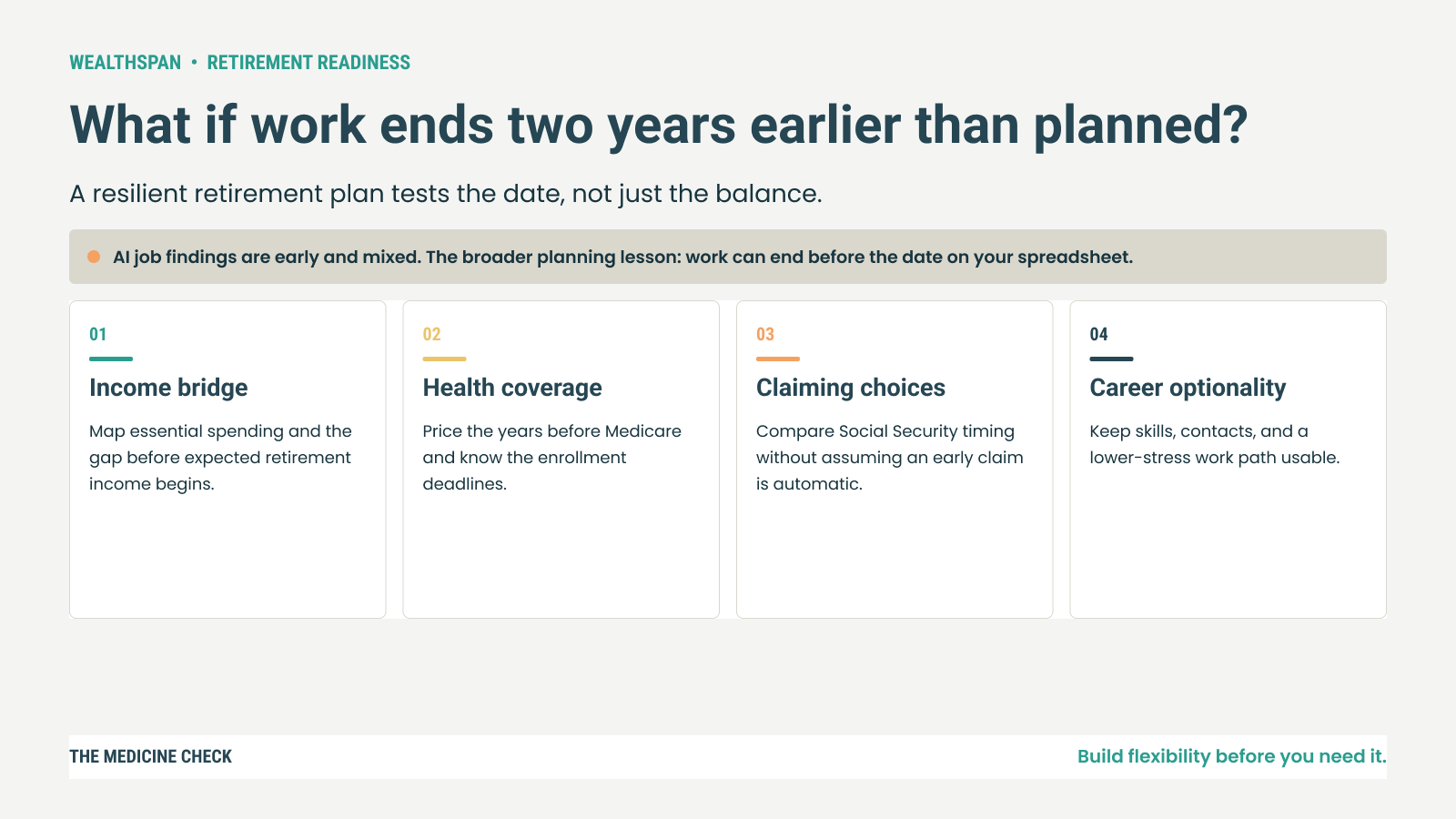
A four-part earlier-exit stress test
This is not a formula for deciding when to retire. It is a way to find where an earlier loss of employment would create the most pressure.
1. Map the income bridge
Run the plan again with earned income ending two years earlier. Keep the exercise simple enough to understand.
Start with essential expenses: housing, food, utilities, insurance, transportation, debt payments, and routine health costs. Then identify which expected income sources would actually be available during the gap. Do not automatically count severance, unemployment benefits, consulting income, or a quick return to work unless the plan also tests what happens without them.
Next, separate spending that could be delayed from spending that cannot. The purpose is not to slash every enjoyable expense. It is to see how much flexibility exists before a surprise becomes a crisis.
2. Price health coverage before Medicare
For someone who loses employer coverage before age 65, the health-insurance bridge may be as important as the income bridge.
Possible sources of coverage include a spouse's employment plan, COBRA continuation coverage, or an individual Marketplace plan. The Department of Labor notes that COBRA can generally continue employer coverage for up to 18 months after job loss, but the former employee may have to pay the full group premium plus a 2% administrative fee. Special-enrollment deadlines can also be short.
The practical check is to estimate premiums, deductibles, and out-of-pocket exposure for the gap years. A placeholder of "use COBRA" is not a budget.
3. Separate stopping work from claiming Social Security
The day a paycheck ends does not have to be the day Social Security begins.
Social Security says benefits can begin as early as age 62, but claiming before full retirement age permanently reduces the monthly amount. For people born in 1960 or later, claiming at 62 can reduce the retirement benefit by as much as 30% compared with claiming at full retirement age. Stopping work can also affect the earnings record used to calculate benefits, especially when a person has fewer than 35 years of earnings or could otherwise replace a lower-earning year.
An earlier-exit stress test should therefore compare more than one claiming date. That comparison is educational, not a universal argument for claiming early or delaying. Health, household income, survivor needs, taxes, and available savings all affect the decision.
4. Treat career optionality as an asset
Retirement readiness is partly financial, but it also depends on the ability to keep earning when plans change.
Career optionality can include staying current with tools used in your field, documenting transferable skills, maintaining professional relationships, and knowing what a lower-stress or part-time version of work might look like. For workers encountering AI, the useful question is not whether every task can be automated. It is which tasks the technology may replace, which it may improve, and where experience and judgment still add value.
This is not a promise that retraining will prevent job loss. Employers, local labor demand, health, caregiving duties, and age discrimination also shape opportunity. The goal is to avoid making one employer and one job description the only bridge to the planned retirement date.
Turn the stress test into a trigger plan
A stress test is more useful when it names the first actions to take.
Keep a short list of the documents and contacts you would need after an unexpected work exit: the retirement plan's Summary Plan Description, the latest benefit statement, health-plan information, accrued leave and severance policies, and contact details for the benefits administrator. The Department of Labor specifically recommends obtaining the retirement plan description and individual benefit statement after job loss.
Then decide what event would trigger a full review. It might be a layoff announcement, a major change in job duties, new caregiving responsibilities, worsening health, or a reduction in hours. The trigger should start a fresh look at cash flow, health coverage, Social Security timing, and the retirement date itself.
Practical takeaway
The newest AI studies do not tell older workers to expect forced retirement. One finds no comparable employment gap for experienced workers; another finds that older workers in highly exposed occupations have become relatively more likely to exit employment, particularly into unemployment. Both say the evidence is early.
That uncertainty is exactly why a retirement date should be tested rather than trusted. A plan that still functions after an earlier work exit preserves more choice: more time to compare health coverage, more room to consider Social Security carefully, and less pressure to turn a career disruption into an immediate retirement decision.
Evidence verdict
Early and mixed for AI-related employment effects; strong as a planning case for flexibility. The two AI analyses use different populations, outcomes, exposure measures, and time periods, and neither proves that AI caused workers to leave employment. The Federal Reserve and EBRI surveys more clearly show that unplanned early retirement is common, but they do not predict what will happen to an individual household.
Keep building your Wealthspan
Start with the Wealthspan Wheel to see how cash flow, savings, protection, health-care planning, and long-term goals work together to support financial resilience.
Use the Retirement Healthcare Cost Calculator to get a clearer view of what future health care could mean for your retirement plan.
Check your progress with the Retirement Readiness Calculator and see whether your current savings path may support the retirement you are working toward.
Take the Wealthspan Checkup to review the financial building blocks that can strengthen flexibility, independence, and confidence over time.
Sources
Full working paper reviewed. Brynjolfsson E, Chandar B, Chen R. Canaries in the Coal Mine? Six Facts about the Recent Employment Effects of Artificial Intelligence. Stanford Digital Economy Lab. Revised August 12, 2026.
Sanzenbacher GT. Are the Careers of Older Workers Being Cut Short by AI? Center for Retirement Research at Boston College. June 30, 2026.
Official and survey evidence. Federal Reserve Board. Economic Well-Being of U.S. Households in 2025. May 2026.
Employee Benefit Research Institute and Greenwald Research. 2026 Retirement Confidence Survey. Fielded January 2-28, 2026.
Current benefit guidance. U.S. Department of Labor: Protecting Retirement and Health Benefits after Job Loss; Social Security Administration: Your Retirement Age and When You Stop Working; and Social Security Administration: At what age should I start receiving retirement benefits? Accessed August 23, 2026.
Educational information only. This article does not provide individualized financial, investment, tax, legal, insurance, Social Security, employment, or retirement-planning advice. Benefit rules, coverage options, costs, and household circumstances vary.