You open your Medicare plan notice, find the new monthly premium, and think you have the answer. Is it lower? Is it higher? Can you keep the same plan and move on?
I understand the instinct, because the premium is the cleanest number on the page; however, it is often a poor summary of what your coverage will actually cost, what care you will be able to use, and how much financial flexibility you will keep in 2027.
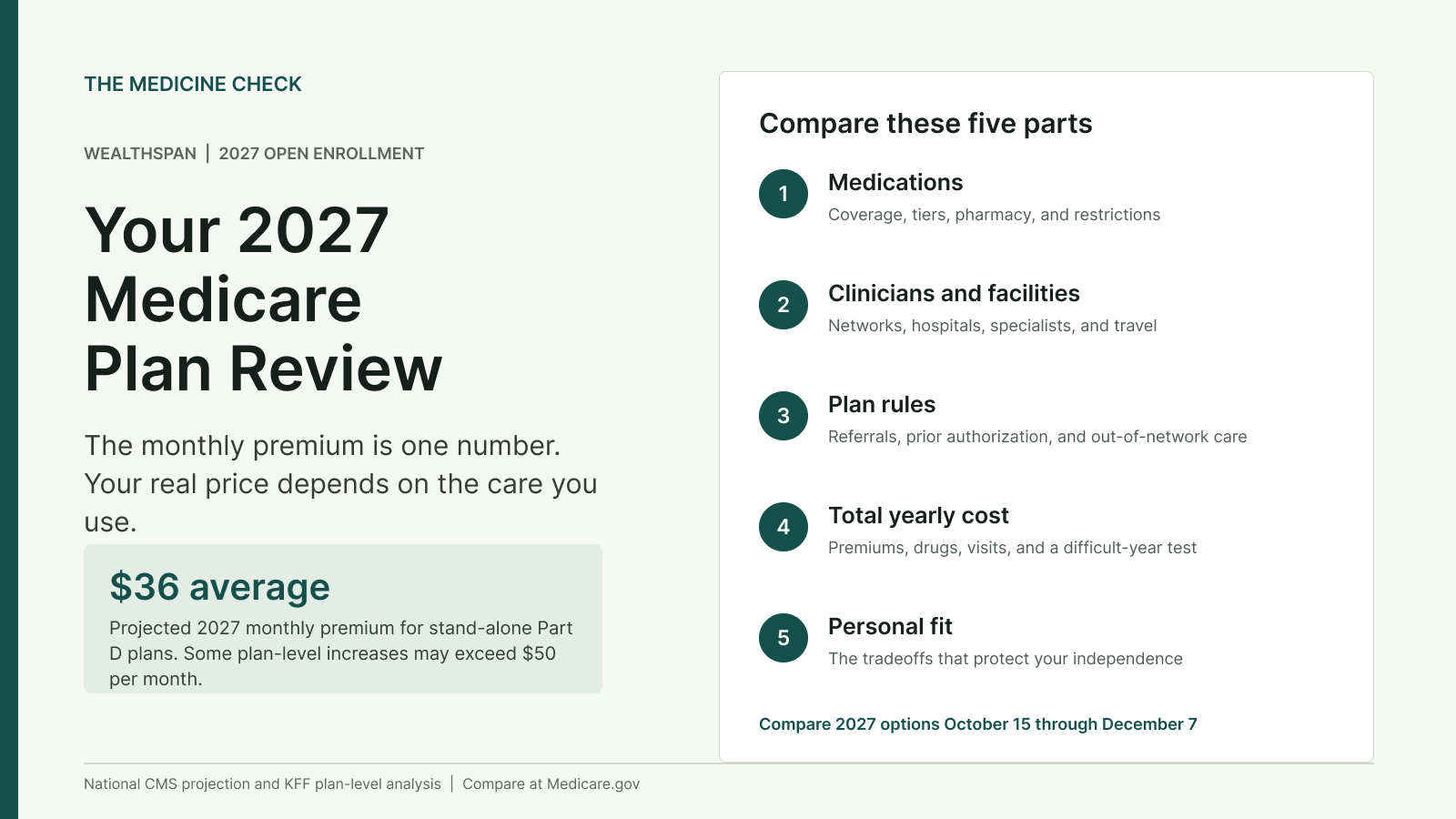
The Centers for Medicare & Medicaid Services released the finalized 2027 Medicare Advantage and Part D plan landscape on September 28. Nationally, the numbers look fairly calm: CMS projects the average monthly premium across Medicare Advantage plans to fall from $14.37 in 2026 to $12 in 2027, while the average premium for a stand-alone Part D prescription drug plan is projected to rise by less than $1, from $35.09 to $36.
Those averages are real. They are also not your price.
A stable average can hide an expensive change
KFF examined the same CMS plan files and found a much more uneven picture for stand-alone drug plans. The average beneficiary will have nine stand-alone Part D plans available in 2027, down from 11 in 2026, and some people who keep their current plan could see premium increases of $50 or more per month. KFF also found that no $0-premium stand-alone Part D plans will be available to beneficiaries who do not receive the low-income subsidy in 2027; about 4 million people without that subsidy paid no premium in 2026.
Medicare Advantage choices remain numerous, although the average beneficiary will have 28 Medicare Advantage plans with prescription coverage available in 2027, down from 32 in 2026. More choices do not automatically produce a better decision. Which hospitals are in network? Which specialists can you see? What requires prior authorization? What will you pay when you need an MRI, outpatient procedure, hospital stay, rehabilitation, or a costly prescription?
This is where a national average stops helping. Your county, plan, medications, pharmacies, clinicians, and expected care create your personal cost structure; two people with the same premium can finish the year with very different bills and very different access to care.
Start with the notice your plan sent you
If you are already in a Medicare Advantage or Part D plan, your first document is the Annual Notice of Change, often shortened to ANOC. Medicare says plans send it each fall, and it explains the coverage, cost, and other changes that take effect in January.
Do not read only the premium line. Look for changes to the deductible, copayments, coinsurance, out-of-pocket limit, drug formulary, drug tiers, preferred pharmacies, provider network, referral rules, and prior authorization requirements. A benefit may still appear in the brochure while becoming harder or more expensive to use.
Your own health has changed too. Did you start a medication this year? Add a specialist? Change pharmacies? Receive a new diagnosis? Begin planning a procedure? A plan that fit your life last January may not fit it next January, even if the plan itself barely changed.
Compare the five parts of the real price
I would review a Medicare plan in this order, because it keeps the most personal and consequential details ahead of the marketing.
1. Your medications
Enter every current prescription into Medicare's Plan Compare tool, including the exact name, dose, frequency, and preferred pharmacy. Then check whether each medication is covered, which tier it occupies, what you would pay at your pharmacy, whether mail order changes the cost, and whether the plan uses prior authorization, step therapy, or quantity limits.
A cheap premium can be overwhelmed by one poorly covered medication. A higher-premium plan can sometimes cost less over the full year if its formulary and cost sharing fit your prescriptions; however, this is not a universal rule, and the comparison must use your actual list.
2. Your clinicians and facilities
For Medicare Advantage, verify that your primary care clinician, specialists, preferred hospital, rehabilitation providers, and other important facilities participate in the 2027 network. Use the plan directory, then confirm directly with the clinician or facility when continuity is important, because directories can be incomplete or change.
For Original Medicare, confirm that the clinicians you want accept Medicare, and understand how a separate Part D plan and any Medigap coverage fit together. Switching from Medicare Advantage to Original Medicare can also raise a separate Medigap question; in many situations, federal law does not guarantee that you can buy any Medigap policy you want outside protected enrollment periods, and state rules vary. Verify that part before changing the foundation of your coverage.
3. The rules between you and care
Premiums and copays are visible. Administrative friction is harder to price, but it can shape whether care arrives when you need it.
Check referral requirements, prior authorization, out-of-network rules, travel coverage, and the process for obtaining expensive drugs or services. If you split time between states, see specialists outside your county, or expect a procedure in 2027, these details may carry more weight than a dental allowance or another extra benefit you may never use.
4. Your total likely yearly cost
Add the pieces you can reasonably estimate: 12 months of plan premiums, prescription costs, regular visit copays, expected tests or procedures, and a reasonable allowance for unpredictable use. For Medicare Advantage, include the medical out-of-pocket limit, while remembering that premiums and some services may sit outside that figure. For Original Medicare, examine Part B cost sharing, the cost and coverage of any Medigap policy, and the separate Part D plan.
You are not trying to predict every claim. You are testing whether the plan works in an ordinary year and whether your savings and cash flow could absorb a difficult one.
5. The fit with what you value
Do you value a broader choice of clinicians, more predictable costs, lower monthly premiums, travel flexibility, simpler administration, or specific extra benefits? Which tradeoffs can you accept? Which ones would threaten continuity, independence, or your ability to follow through on care?
Wealthspan is the capacity to age with options. A Medicare plan supports Wealthspan when it protects access to the care you are likely to use without making the rest of your retirement plan brittle.
Use the 2027 headlines carefully
CMS estimates that about eight in 10 Medicare Advantage beneficiaries will be able to remain in their current plan with the same or a lower premium in 2027. It also projects that the average stand-alone Part D premium will rise by less than $1. Those are useful market-level signals; however, they do not establish that keeping your current plan is the least expensive or most usable choice.
KFF's plan-level findings explain why. Some premiums are falling, some are rising modestly, some are rising sharply, and the number of choices is changing. Formularies, tiers, cost sharing, networks, and utilization rules can move independently of the premium. The headline describes the market. Your comparison describes your life.
Fidelity estimates that a 65-year-old retiring in 2026 may spend about $185,000 on healthcare and medical expenses over retirement, based on its assumptions and excluding long-term care. That figure is not a personal forecast, but it reinforces the reason to treat annual coverage review as retirement planning rather than paperwork. A plan decision repeated year after year can affect cash flow, access, and the room you retain for housing, family, travel, caregiving, and everything else you hope retirement will hold.
Give yourself a clean review process
Medicare open enrollment runs from October 15 through December 7, 2026, and changes take effect January 1, 2027. Medicare's Plan Compare tool is available now for 2027 coverage. If the comparison feels overwhelming, State Health Insurance Assistance Programs provide free, personalized counseling and are not connected to an insurance company or health plan. Medicare also offers help through 1-800-MEDICARE.
Before you finish, save or print the comparison, note the date, and keep the plan documents that support your choice. If you are considering a major switch, confirm the consequences for prescription coverage, provider access, Medigap eligibility, employer or retiree coverage, and any other insurance that coordinates with Medicare.
This is general educational information, not individualized insurance, financial, legal, or medical advice. Plan availability and rules vary by location and circumstance.
Practical Takeaway
The premium deserves a line in your comparison, but it does not deserve the whole page. Start with your medications, your clinicians, the rules between you and care, the likely yearly cost, and the tradeoffs you can live with. Then choose.
You are not buying a headline. You are choosing the coverage structure that will sit between your health, your retirement income, and your independence for the next year.
Keep Building Your Wealthspan
- Start with the Wealthspan Wheel. See how cash flow, savings, protection, healthcare planning, and long-term goals work together to support financial resilience.
- Estimate a major retirement expense with the Retirement Healthcare Cost Calculator. Get a clearer view of what future healthcare could mean for your retirement plan.
- Check your progress with the Retirement Readiness Calculator. See whether your current savings path may support the retirement you are working toward.
- Take a deeper look with the Wealthspan Checkup. Review the financial building blocks that can strengthen flexibility, independence, and confidence over time.
- Become a member for access to member-specific resources.
Sources
• Full source reviewed: Centers for Medicare & Medicaid Services. “Medicare Advantage and Medicare Prescription Drug Programs Expected to Remain Stable in 2027.” September 28, 2026. https://www.cms.gov/newsroom/press-releases/medicare-advantage-medicare-prescription-drug-programs-expected-remain-stable-2027
• Full source reviewed: KFF. “Many Medicare Part D Stand-Alone Drug Plan Enrollees Will See Modest Premium Increases for 2027, But Others Could Pay Much More If They Don't Switch Plans.” October 2, 2026. https://www.kff.org/medicare/many-medicare-part-d-stand-alone-drug-plan-enrollees-will-see-modest-premium-increases-for-2027-but-others-could-pay-much-more-if-they-dont-switch-plans/
• Full source reviewed: KFF. “The Average Medicare Beneficiary Has 28 Medicare Advantage Prescription Drug Plan Options for 2027.” October 1, 2026. https://www.kff.org/medicare/the-average-medicare-beneficiary-has-28-medicare-advantage-prescription-drug-plan-options-for-2027/
• Full source reviewed: Medicare.gov. “Plan Annual Notice of Change.” https://www.medicare.gov/basics/forms-publications-mailings/mailings/costs-and-coverage/upcoming-plan-changes
• Full source reviewed: Medicare.gov. “Open Enrollment.” https://www.medicare.gov/health-drug-plans/open-enrollment
• Full source reviewed: Medicare.gov. “Find the Plan That Works for You.” 2027 Plan Compare. https://www.medicare.gov/plan-compare/?lang=en&year=2027
• Full source reviewed: Medicare.gov. “Your Coverage Options.” https://www.medicare.gov/basics/get-started-with-medicare/get-more-coverage/your-coverage-options
• Full source reviewed: Fidelity Investments. “4 Retirement Health Care Decisions to Get Right.” July 27, 2026. https://www.fidelity.com/learning-center/personal-finance/health-insurance-before-and-after-retirement